Huggins Lucas G, Stevenson Mark, Baydoun Zahida, Mab Ron, Khouri Yulia, Schunack Bettina, Traub Rebecca J
Faculty of Veterinary and Agricultural Sciences, University of Melbourne, Parkville, Victoria, 3050, Australia.
Animal Mama Veterinary Hospital, Phnom Penh, 12312, Cambodia.
Curr Res Parasitol Vector Borne Dis. 2022 Jun 28;2:100095. doi: 10.1016/j.crpvbd.2022.100095. eCollection 2022.
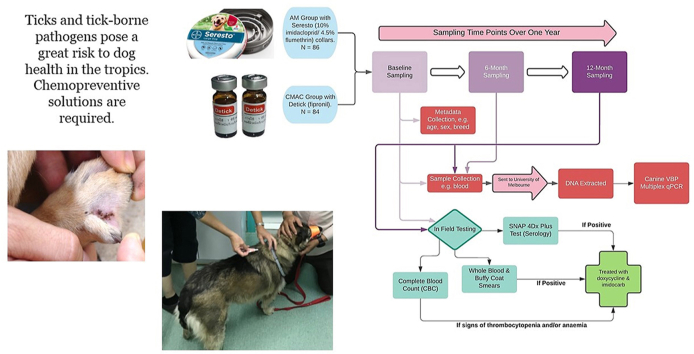
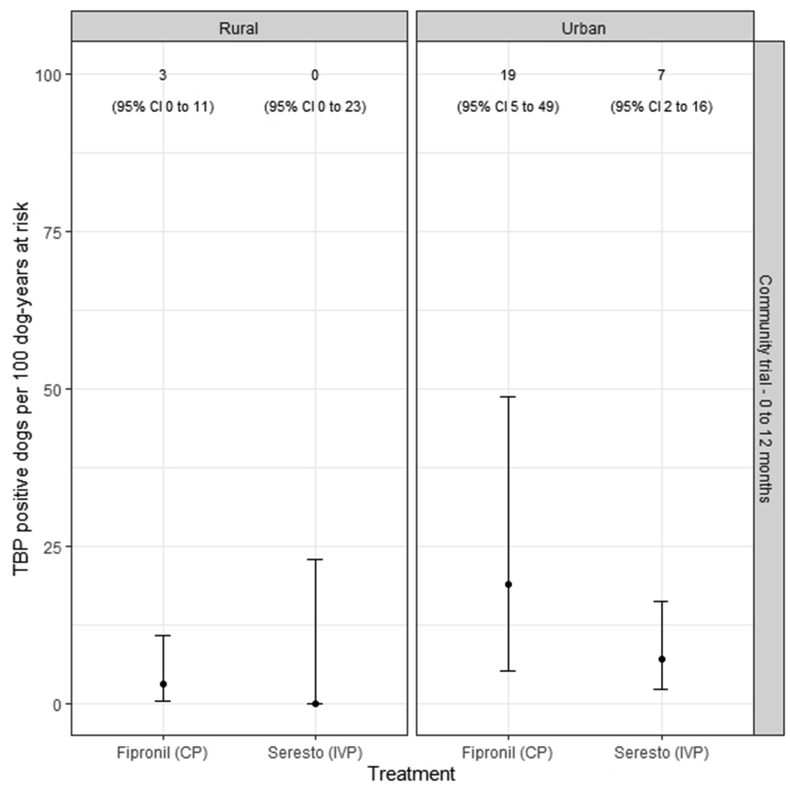
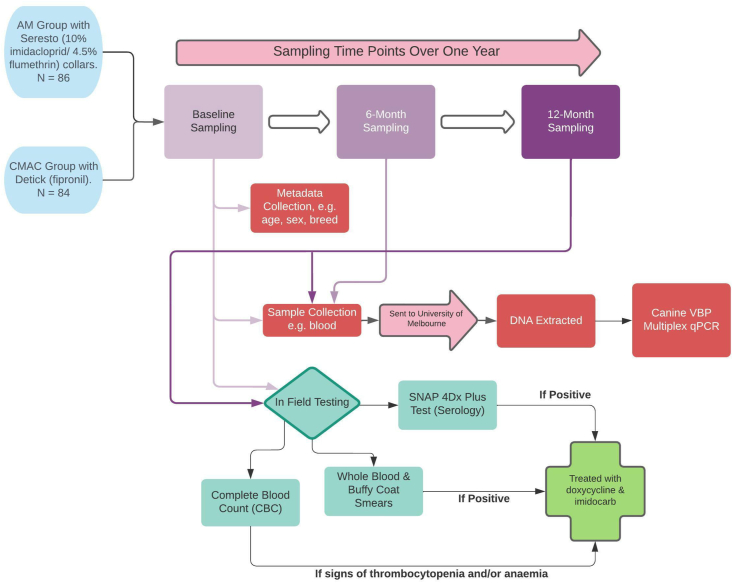
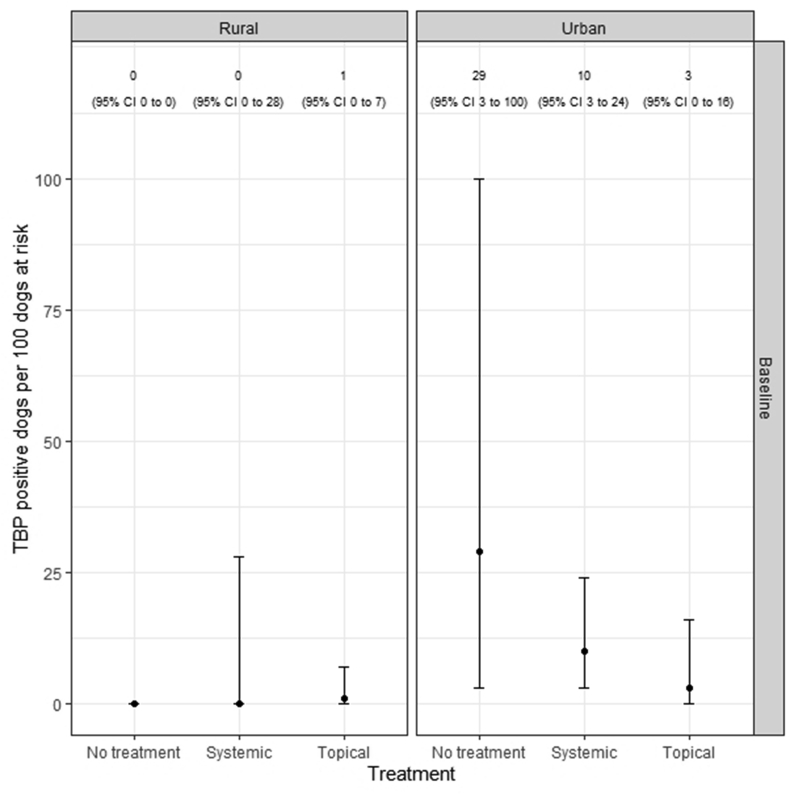
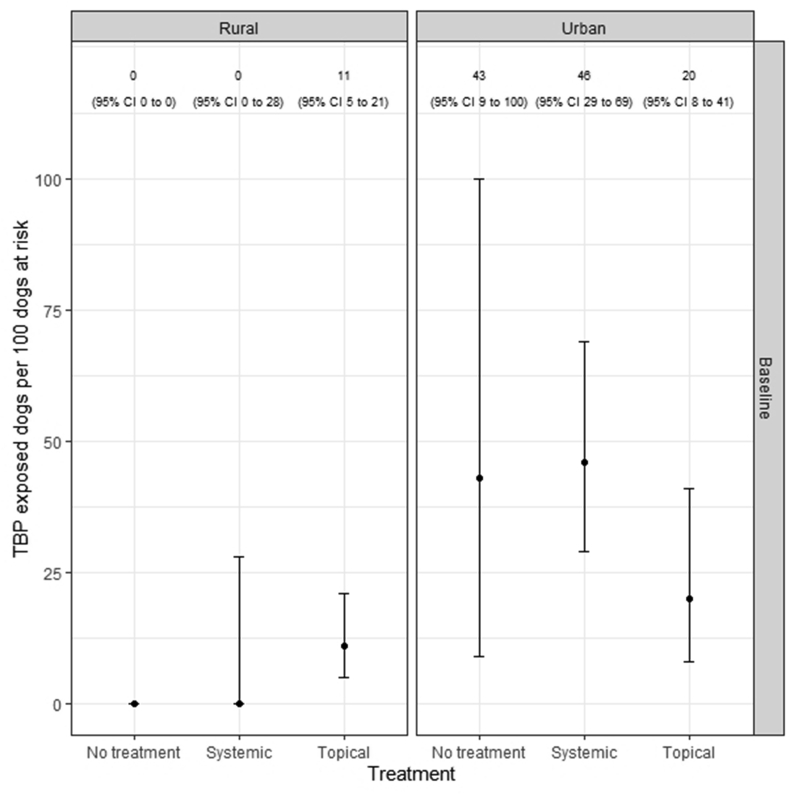
The tropical brown dog tick, , commonly infests canines in the tropics and is an important vector for disease-causing and sometimes lethal pathogens including spp., , and . In tropical climates ticks and their pathogens exert an extremely high infection pressure on unprotected dogs. To protect canines in such regions, effective acaricidal products possessing a speed of kill that blocks pathogen transmission is paramount. We conducted a 12-month community trial to compare the chemoprophylactic efficacy of two topical commercial acaricidal formulations: an imidacloprid 10% and flumethrin 4.5%, 8-month acting collar (Seresto®) against a monthly spot-on containing 12% w/v fipronil (Detick, Thailand). In a separate analysis, we used baseline data collected at the start of the trial to quantify tick-borne pathogen (TBP) infection status in dogs with a prior history of being administered a systemically-acting (isoxazoline) a topically-acting ectoparasiticide. We found that both topical products in the community trial demonstrated high efficacy at protecting dogs from ticks and TBP, with Seresto® demonstrating a moderate increase in protection at 3 (95% confidence interval (CI): 1-5) TBP-positive dogs per 100 dog-years at risk compared to 11 (95% CI: 4-26) TBP-positive dogs per 100 dog-years at risk for those on fipronil. Additionally, at baseline dogs treated with commercial systemic isoxazoline acaricides prior to the trial's commencement were 2.7 (95% CI: 0.5-15.0) times more likely to be TBP-positive compared to dogs that had been topically treated, highlighting such isoxazoline products as being less efficacious than topical products at preventing canine TBP acquisition in a tropical setting.
热带棕狗蜱(Rhipicephalus sanguineus sensu lato)通常侵扰热带地区的犬类,是包括立克次氏体属(Rickettsia spp.)、巴贝斯虫属(Babesia spp.)、泰勒虫属(Theileria spp.)和无形体属(Anaplasma spp.)等致病且有时致命病原体的重要传播媒介。在热带气候中,蜱及其病原体对未受保护的犬类施加极高的感染压力。为保护此类地区的犬类,拥有能阻断病原体传播的快速杀灭速度的有效杀螨产品至关重要。我们进行了一项为期12个月的社区试验,以比较两种局部用商业杀螨制剂的化学预防效果:一种是含10%吡虫啉和4.5%氟氯氰菊酯、作用期为8个月的项圈(Seresto®),与一种每月使用一次、含12% w/v氟虫腈的滴剂(Detick,泰国)。在另一项分析中,我们使用试验开始时收集的基线数据,对既往有全身作用(异恶唑啉)或局部作用杀外寄生虫剂用药史的犬类蜱传病原体(TBP)感染状况进行量化。我们发现,社区试验中的两种局部用产品在保护犬类免受蜱和TBP侵害方面均显示出高效,与使用氟虫腈的犬类每100犬年有11只(95%置信区间(CI):4 - 26)TBP阳性犬相比,Seresto®在每100犬年有3只(95% CI:1 - 5)TBP阳性犬的风险下显示出适度的保护增加。此外,在基线时,试验开始前用商业全身异恶唑啉杀螨剂治疗的犬类TBP阳性的可能性是局部治疗犬类的2.7倍(95% CI:0.5 - 15.0),这突出表明在热带环境中,此类异恶唑啉产品在预防犬类TBP感染方面不如局部用产品有效。