Rentería Elisenda, Zueras Pilar
Centre d'Estudis Demogràfics, Carrer de Ca n'Altayó, Edifici E2, Universitat Autònoma de Barcelona, 08193, Bellaterra, Barcelona, Spain.
Institute for Social and Economic Research, University of Essex, Wivenhoe Park, Colchester, CO4 3SQ, UK.
SSM Popul Health. 2022 Jul 2;19:101152. doi: 10.1016/j.ssmph.2022.101152. eCollection 2022 Sep.
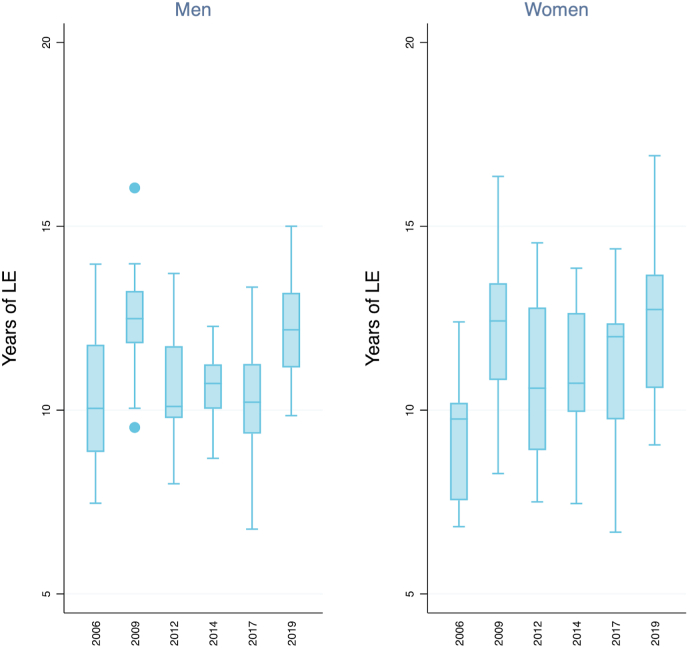
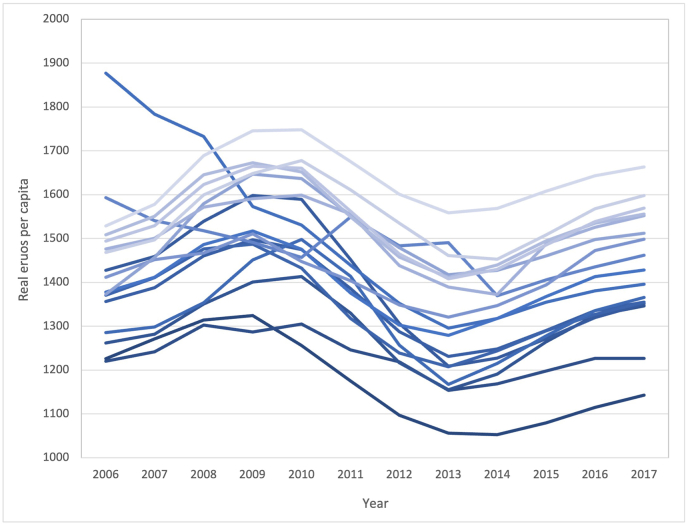
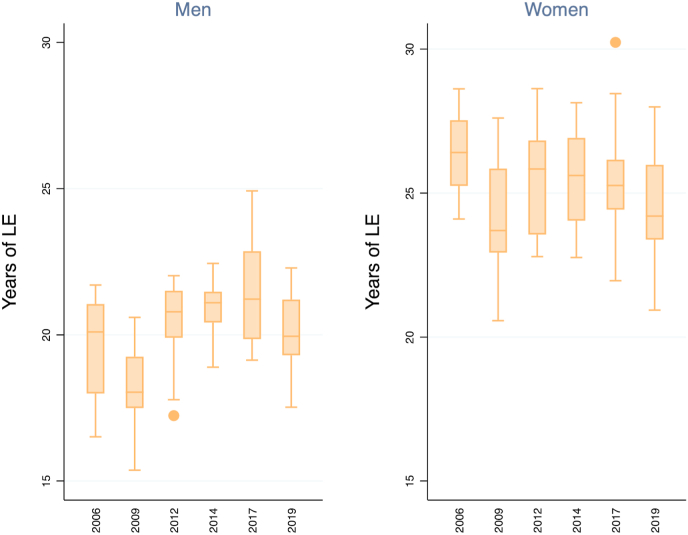
Life expectancy has long been associated with macro-level factors, including health expenditures, but little research has focused on the relationship with morbidity measures. This paper examines the relationship between the expected years lived free of and with chronic conditions (YLFCC and YLCC) at age 50 and macroeconomic and social factors including, for the first time, several indicators of public health expenditure. We calculate YLFCC and YLCC for Spanish regions using the Sullivan method over a long period of time (2006-2019). Spain is a good case study due to two reasons. First, its national health system is decentralized among regional administrations since 2002. Second, the financial crisis of 2008 led to public health cuts in 2010-2014 that each region handled differently. We use fixed-effects models to assess the relationship between changes in macro-level regional indicators (socioeconomic factors, healthcare resources, health behavior and public health expenditures) with YLFCC and YLCC across regions and over time. Results show that socioeconomic levels, public health expenditure, healthcare resources and health behaviors are associated with years lived free of and with chronic conditions when analyzing them independently. However, in the global model including all these dimensions only public health expenditure is associated with both YLFCC and YLCC for men and women, showing that a higher level of expenditures is correlated with more YLFCC and less YLCC. Therefore, regional authorities need to pay special attention to the level of investments on health services, as they are clearly associated with a better quality of living of the middle age and older population.
长期以来,预期寿命一直与宏观层面的因素相关,包括卫生支出,但很少有研究关注其与发病率指标之间的关系。本文研究了50岁时无慢性病和患有慢性病的预期寿命年数(YLFCC和YLCC)与宏观经济和社会因素之间的关系,其中首次纳入了若干公共卫生支出指标。我们运用沙利文方法计算了西班牙各地区在一段较长时期(2006 - 2019年)内的YLFCC和YLCC。西班牙是一个很好的案例研究对象,原因有二。其一,自2002年起,其国家卫生系统在各地区行政机构间实行分权管理。其二,2008年的金融危机导致2010 - 2014年公共卫生支出削减,而每个地区的应对方式各不相同。我们使用固定效应模型来评估宏观层面地区指标(社会经济因素、医疗资源、健康行为和公共卫生支出)的变化与各地区不同时间的YLFCC和YLCC之间的关系。结果表明,在单独分析时,社会经济水平、公共卫生支出、医疗资源和健康行为与无慢性病和患有慢性病的预期寿命年数相关。然而,在包含所有这些维度的全局模型中,只有公共卫生支出与男性和女性的YLFCC和YLCC均相关,这表明较高的支出水平与更多的YLFCC和更少的YLCC相关。因此,地区当局需要特别关注卫生服务的投资水平,因为它们显然与中老年人群更好的生活质量相关。