Jiang Maocheng, Lv Ziyao, Huang Yinghao, Cheng Zhiqiang, Meng Zitong, Yang Tianyu, Yan Qi, Lin Miao, Zhan Kang, Zhao Guoqi
College of Animal Science and Technology, Institute of Animal Culture Collection and Application, Yangzhou University, Yangzhou, China.
Chia Tai Tianqing Pharmaceutical Group Co., Ltd., Nanjing, China.
Front Vet Sci. 2022 Jul 4;9:915726. doi: 10.3389/fvets.2022.915726. eCollection 2022.
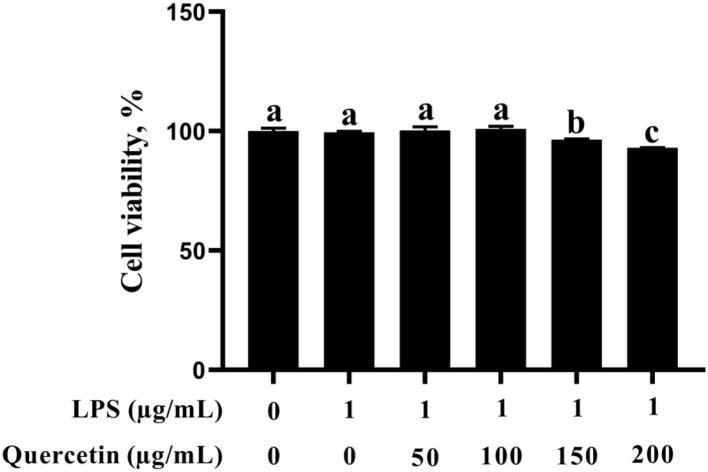
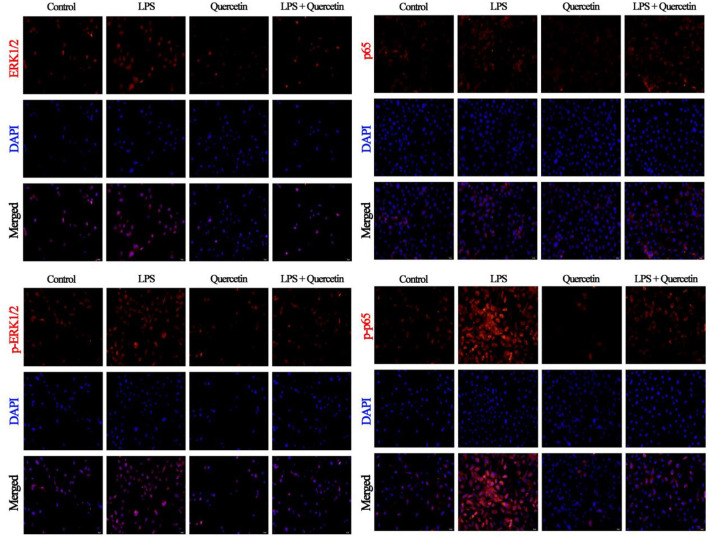
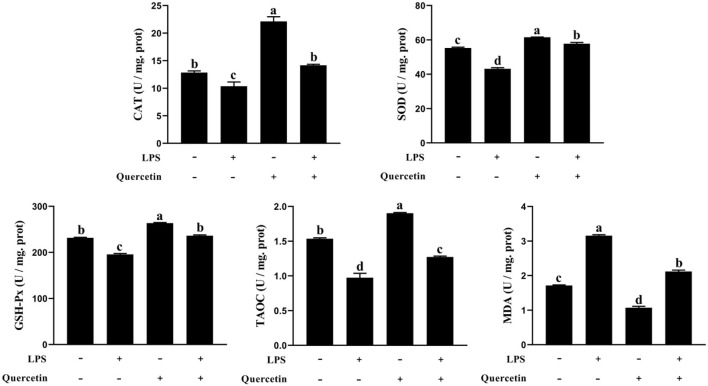
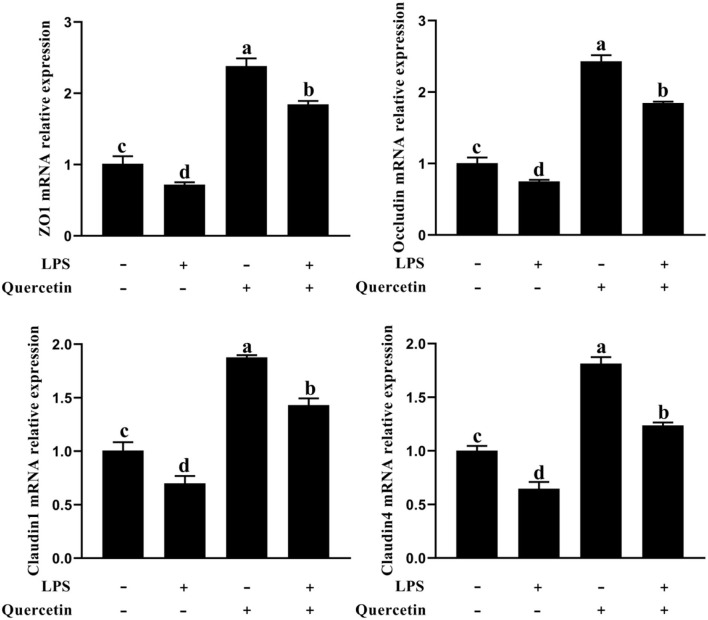
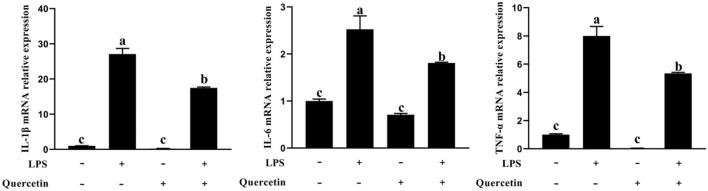
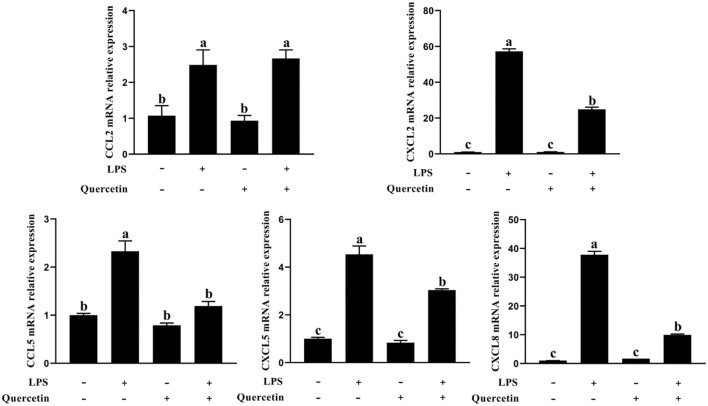
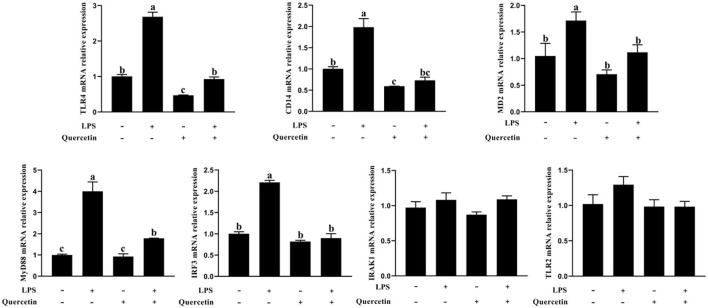
Bovine mastitis is one of the most common clinical diseases in dairy cows, causing huge economic losses to the dairy industry. Quercetin is an important flavonoid existing in many food resources, which has attracted widespread attention as a potential anti-inflammatory and antioxidant. However, the molecular mechanism of quercetin on inflammatory responses and oxidative stress in bovine mammary epithelial cells (BMECs) induced by lipopolysaccharide (LPS) remains unknown. The objective of this study was to investigate the effects of quercetin on inflammation responses, oxidative stress, and barrier function of BMEC induced by LPS. Our results showed that BMEC viability was not affected by treatment with 50 and 100 μg/ml of quercetin and 1 μg/ml of LPS compared with control group. The results of oxidative stress indicators and related genes of barrier function indicated that 100 μg/ml of quercetin effectively protected the BMECs from damage of oxidative and barrier induced by 1 μg/ml of LPS. Moreover, the messenger RNA (mRNA) expressions of pro-inflammatory cytokines TNF-α, IL-1β, IL-6, and chemokines CXCL2, CXCL5, CCL5, and CXCL8 were markedly decreased in the LPS-treated bovine retinal endothelial cells (BRECs) with 100 μg/ml of quercetin relatively to LPS alone. More importantly, the mRNA expressions of toll-like receptor 4 (TLR4), CD14, myeloid differential protein-2 (MD2), and myeloid differentiation primary response protein (MyD88) genes involved in TLR4 signal pathway were significantly attenuated by the addition of quercetin in LPS-treated BMEC, suggesting that quercetin can inhibit the TLR4 signal pathway. In addition, immunocytofluorescence showed that quercetin significantly inhibited the nuclear translocation of NF-κB p65 in BMEC induced by LPS. Therefore, the protective effects of quercetin on inflammatory responses in LPS-induced BMEC may be due to its ability to suppress the TLR4-mediated NF-κB signaling pathway. These findings suggest that quercetin can be used as an anti-inflammatory reagent to treat mastitis induced by exogenous or endogenous LPS release.
奶牛乳腺炎是奶牛最常见的临床疾病之一,给乳制品行业造成巨大经济损失。槲皮素是一种存在于多种食物资源中的重要类黄酮,作为一种潜在的抗炎和抗氧化剂受到广泛关注。然而,槲皮素对脂多糖(LPS)诱导的牛乳腺上皮细胞(BMECs)炎症反应和氧化应激的分子机制尚不清楚。本研究的目的是探讨槲皮素对LPS诱导的BMEC炎症反应、氧化应激和屏障功能的影响。我们的结果表明,与对照组相比,50和100μg/ml的槲皮素以及1μg/ml的LPS处理对BMEC活力没有影响。氧化应激指标和屏障功能相关基因的结果表明,100μg/ml的槲皮素有效地保护BMECs免受1μg/ml LPS诱导的氧化和屏障损伤。此外,在LPS处理的牛视网膜内皮细胞(BRECs)中,相对于单独使用LPS,100μg/ml的槲皮素使促炎细胞因子TNF-α、IL-1β、IL-6以及趋化因子CXCL2、CXCL5、CCL5和CXCL-8的信使核糖核酸(mRNA)表达显著降低。更重要的是,在LPS处理的BMEC中添加槲皮素可显著减弱参与Toll样受体4(TLR4)信号通路的TLR4、CD14、髓样分化蛋白-2(MD2)和髓样分化初级反应蛋白(MyD88)基因的mRNA表达,表明槲皮素可抑制TLR4信号通路。此外,免疫细胞荧光显示槲皮素显著抑制LPS诱导的BMEC中NF-κB p65的核转位。因此,槲皮素对LPS诱导的BMEC炎症反应的保护作用可能归因于其抑制TLR4介导的NF-κB信号通路的能力。这些发现表明,槲皮素可作为一种抗炎试剂用于治疗由外源性或内源性LPS释放引起的乳腺炎。