Ramírez-Guerrero Sofía, Guardo-Maya Santiago, Medina-Rincón Germán J, Orrego-González Eduardo E, Cabezas-Pérez Ricardo, González-Reyes Rodrigo E
Grupo de Investigación en Neurociencias (NeURos), Centro de Neurociencias Neurovitae-UR, Instituto de Medicina Traslacional (IMT), Escuela de Medicina y Ciencias de la Salud, Universidad del Rosario, Bogotá, Colombia.
Grupo de Investigación en Ciencias Biomédicas GRINCIBIO, Facultad de Medicina, Universidad Antonio Nariño, Bogotá, Colombia.
Front Mol Neurosci. 2022 Jul 5;15:937789. doi: 10.3389/fnmol.2022.937789. eCollection 2022.
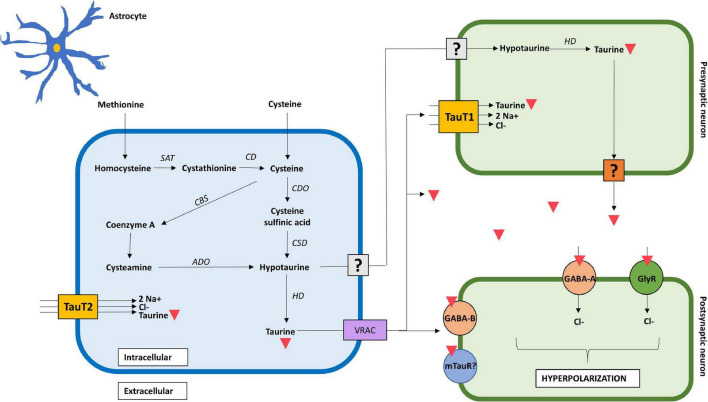
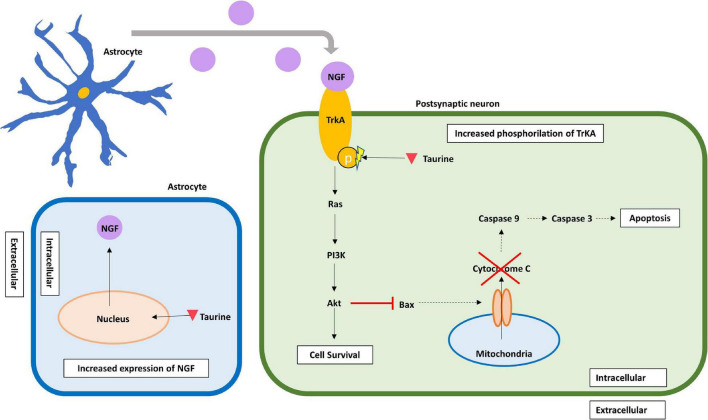
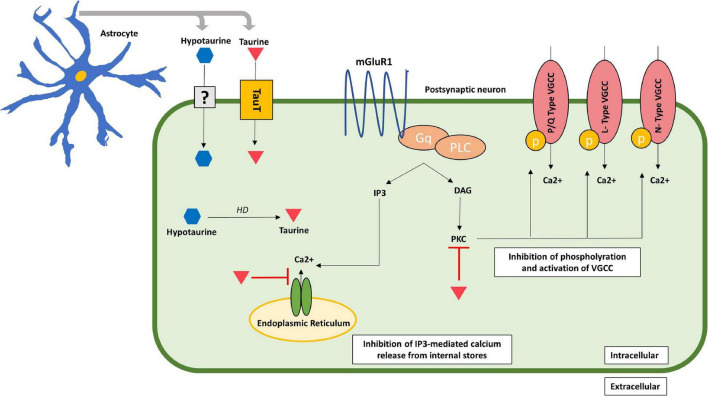
Taurine is considered the most abundant free amino acid in the brain. Even though there are endogenous mechanisms for taurine production in neural cells, an exogenous supply of taurine is required to meet physiological needs. Taurine is required for optimal postnatal brain development; however, its brain concentration decreases with age. Synthesis of taurine in the central nervous system (CNS) occurs predominantly in astrocytes. A metabolic coupling between astrocytes and neurons has been reported, in which astrocytes provide neurons with hypotaurine as a substrate for taurine production. Taurine has antioxidative, osmoregulatory, and anti-inflammatory functions, among other cytoprotective properties. Astrocytes release taurine as a gliotransmitter, promoting both extracellular and intracellular effects in neurons. The extracellular effects include binding to neuronal GABA and glycine receptors, with subsequent cellular hyperpolarization, and attenuation of -methyl-D-aspartic acid (NMDA)-mediated glutamate excitotoxicity. Taurine intracellular effects are directed toward calcium homeostatic pathway, reducing calcium overload and thus preventing excitotoxicity, mitochondrial stress, and apoptosis. However, several physiological aspects of taurine remain unclear, such as the existence or not of a specific taurine receptor. Therefore, further research is needed not only in astrocytes and neurons, but also in other glial cells in order to fully comprehend taurine metabolism and function in the brain. Nonetheless, astrocyte's role in taurine-induced neuroprotective functions should be considered as a promising therapeutic target of several neuroinflammatory, neurodegenerative and psychiatric diseases in the near future. This review provides an overview of the significant relationship between taurine and astrocytes, as well as its homeostatic and neuroprotective role in the nervous system.
牛磺酸被认为是大脑中含量最丰富的游离氨基酸。尽管神经细胞内存在牛磺酸生成的内源性机制,但仍需要外源性补充牛磺酸以满足生理需求。牛磺酸是出生后脑发育达到最佳状态所必需的;然而,其在大脑中的浓度会随着年龄增长而降低。中枢神经系统(CNS)中牛磺酸的合成主要发生在星形胶质细胞中。据报道,星形胶质细胞和神经元之间存在代谢耦合,其中星形胶质细胞为神经元提供次牛磺酸作为牛磺酸生成的底物。牛磺酸具有抗氧化、渗透调节和抗炎功能以及其他细胞保护特性。星形胶质细胞释放牛磺酸作为神经胶质递质,促进神经元的细胞外和细胞内效应。细胞外效应包括与神经元γ-氨基丁酸(GABA)和甘氨酸受体结合,随后细胞超极化,并减弱N-甲基-D-天冬氨酸(NMDA)介导的谷氨酸兴奋性毒性。牛磺酸的细胞内效应针对钙稳态途径,减少钙超载,从而防止兴奋性毒性、线粒体应激和细胞凋亡。然而,牛磺酸的几个生理方面仍不清楚,例如是否存在特定的牛磺酸受体。因此,不仅需要对星形胶质细胞和神经元进行进一步研究,还需要对其他神经胶质细胞进行研究,以便全面理解牛磺酸在大脑中的代谢和功能。尽管如此,星形胶质细胞在牛磺酸诱导的神经保护功能中的作用在不久的将来应被视为几种神经炎症性、神经退行性和精神疾病有前景的治疗靶点。本综述概述了牛磺酸与星形胶质细胞之间的重要关系,以及其在神经系统中的稳态和神经保护作用。