Misal Santosh A, Zhao Bingqing, Reilly James P
Department of Chemistry, Indiana University 800 East Kirkwood Avenue Bloomington IN 47405 USA
RSC Chem Biol. 2022 May 16;3(7):886-894. doi: 10.1039/d2cb00101b. eCollection 2022 Jul 6.
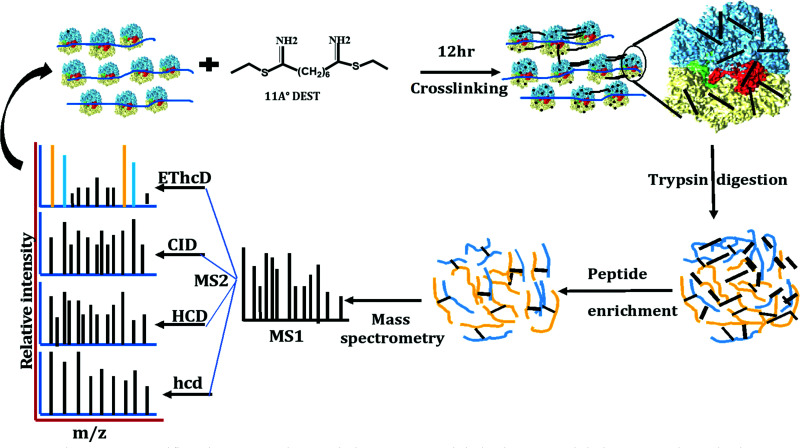
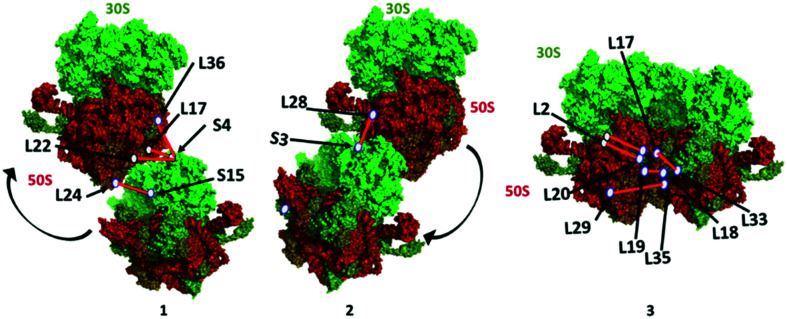
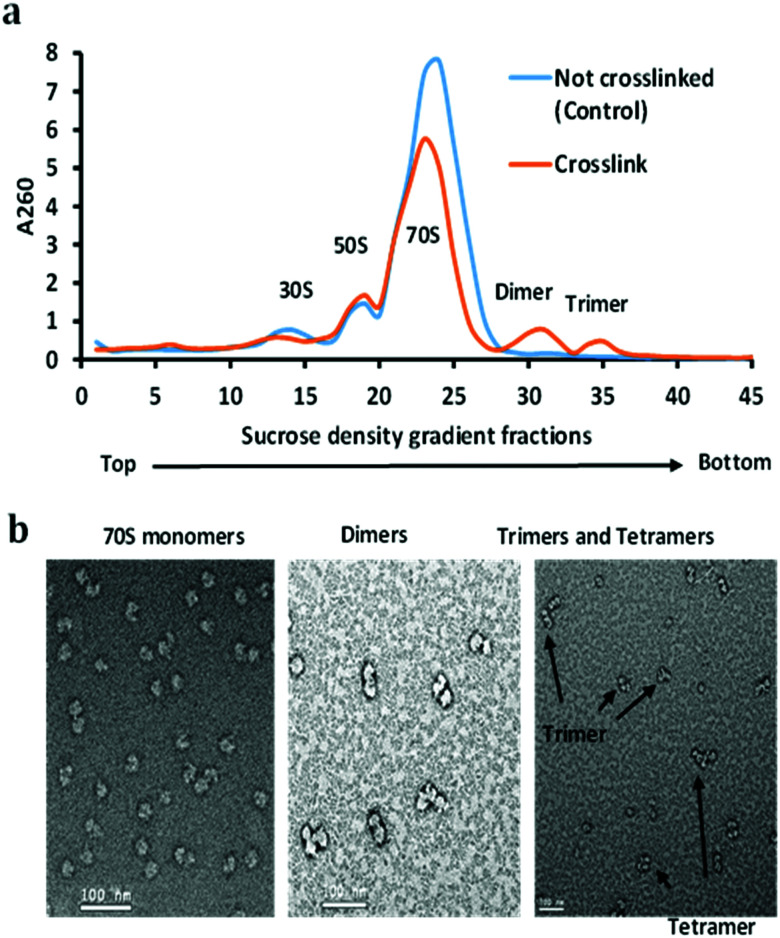
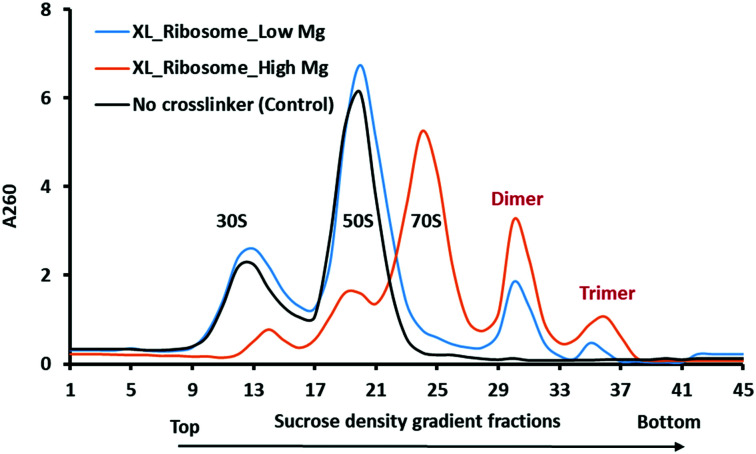
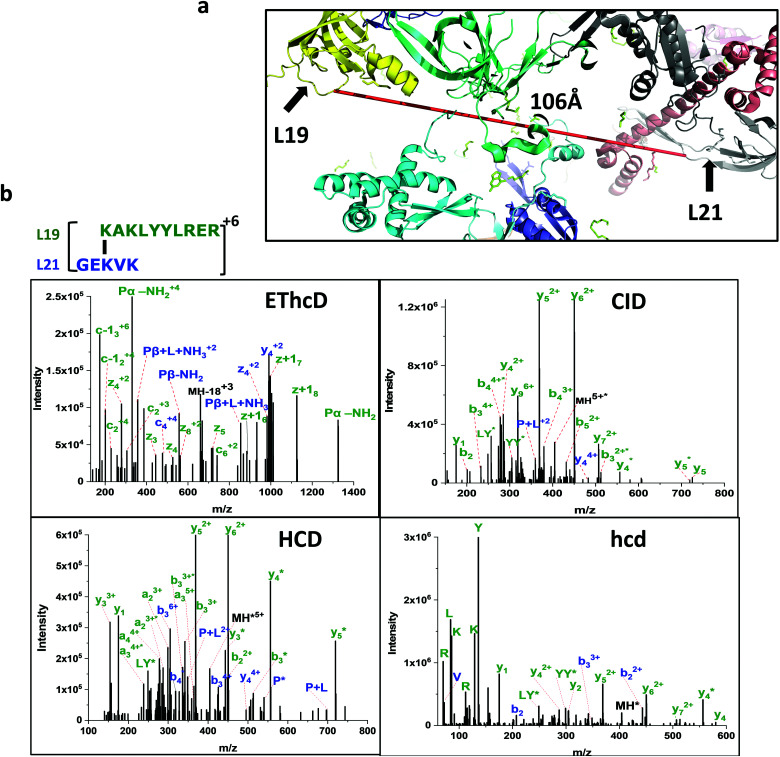
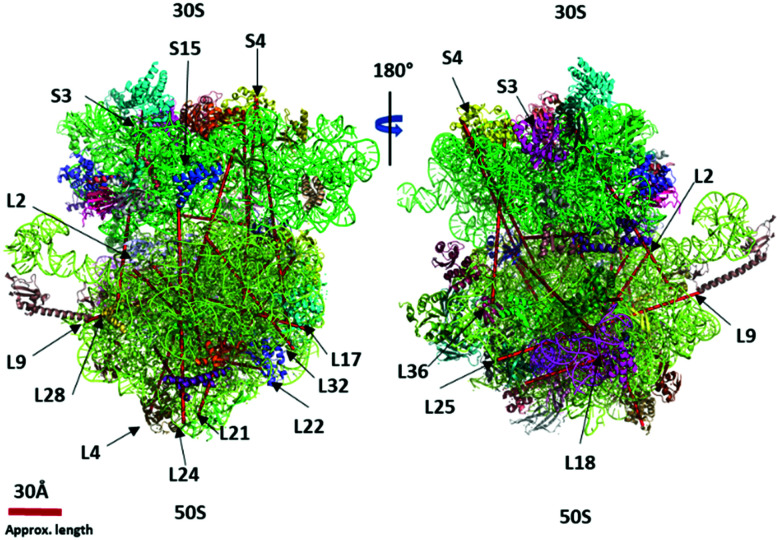
Crosslinking mass spectrometry (XL-MS) of bacterial ribosomes revealed the dynamic intra- and intermolecular interactions within the ribosome structure. It has been also extended to capture the interactions of ribosome binding proteins during translation. Generally, XL-MS often identified the crosslinks within a cross-linkable distance (<40 Å) using amine-reactive crosslinkers. The crosslinks larger than cross-linkable distance (>40 Å) are always difficult to interpret and remain unnoticed. Here, we focused on stationary phase bacterial ribosome crosslinking that yields ultra-long crosslinks in an cell lysate. We explain these ultra-long crosslinks with the combination of sucrose density gradient centrifugation, chemical crosslinking, high-resolution mass spectrometry, and electron microscopy analysis. Multiple ultra-long crosslinks were observed in ribosomes for example ribosomal protein L19 (K63, K94) crosslinks with L21 (K71, K81) at two locations that are about 100 Å apart. Structural mapping of such ultra-long crosslinks in 70S ribosomes suggested that these crosslinks are not potentially formed within one 70S particle and could be a result of dimer and trimer formation as evidenced by negative staining electron microscopy. Ribosome dimerization captured by chemical crosslinking reaction could be an indication of ribosome-ribosome interactions in the stationary phase.
细菌核糖体的交联质谱分析(XL-MS)揭示了核糖体结构内的动态分子内和分子间相互作用。它还被扩展用于捕捉翻译过程中核糖体结合蛋白的相互作用。一般来说,XL-MS通常使用胺反应性交联剂来鉴定可交联距离(<40 Å)内的交联。大于可交联距离(>40 Å)的交联总是难以解释且未被注意到。在这里,我们专注于在细胞裂解物中产生超长交联的固定相细菌核糖体交联。我们通过蔗糖密度梯度离心、化学交联、高分辨率质谱和电子显微镜分析相结合的方法来解释这些超长交联。例如,在核糖体中观察到多个超长交联,如核糖体蛋白L19(K63、K94)在两个相距约100 Å的位置与L21(K71、K81)交联。70S核糖体中此类超长交联的结构图谱表明,这些交联不太可能在一个70S颗粒内形成,可能是二聚体和三聚体形成的结果,负染色电子显微镜证明了这一点。化学交联反应捕获的核糖体二聚化可能表明固定相中核糖体与核糖体之间的相互作用。