Bill & Melinda Gates Institute for Population and Reproductive Health, Johns Hopkins Bloomberg School of Public Health, Baltimore, Maryland (Dr Malik and Mss Graham, O'Donnell, and Reid); and Jhpiego, Nairobi, Kenya (Messrs Nyachae and Sama).
J Public Health Manag Pract. 2022;28(5):550-558. doi: 10.1097/PHH.0000000000001515.
Many donor-driven public health programs are now seeking evidence for sustainability prior to investment, creating the need for tools to better appraise these capabilities. Assessing the sustainability of programs and interventions at the local level remains a community-wide challenge.
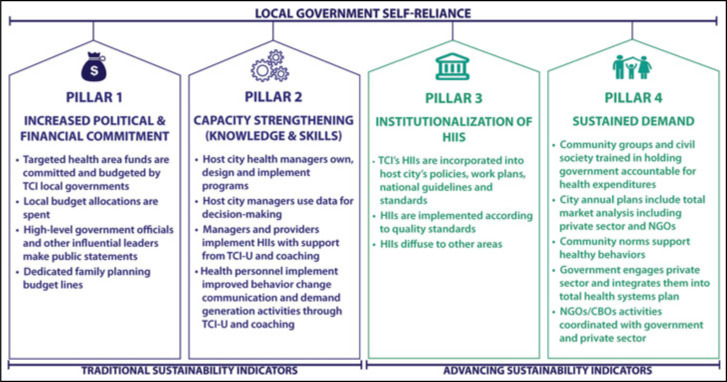
This article presents a new self-assessment tool, the Reflection and Action to Improve Self-reliance and Effectiveness (RAISE) Tool ("the Tool"), modeled after The Challenge Initiative's (TCI) Sustainability Pillars. It describes the evolution of the Tool, explores its structure and applications, demonstrates its data analysis capabilities, and illustrates how it can be used for continuous program self-assessment by local governments, which TCI considers an indicator of program sustainability at the local level.
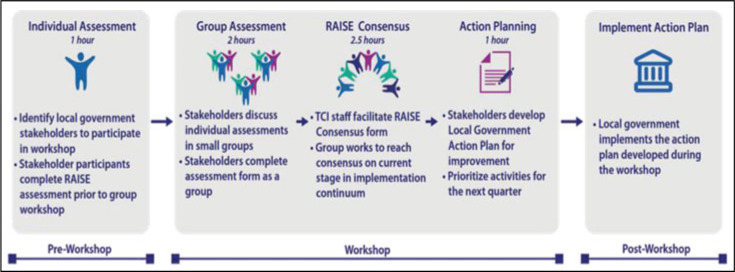
Developed in 2019, the Tool has been adapted, adopted, and implemented by 92 local governments across 11 countries. The Challenge Initiative works with these local governments over a minimum of 3 years, providing management and technical coaching on high-impact interventions. Using the Tool, local governments self-assess and evaluate the quality and effectiveness of their activity implementation and identify gaps for improvement. The Tool helps both local governments and TCI track their readiness toward becoming self-reliant and taking ownership of their family planning programs.
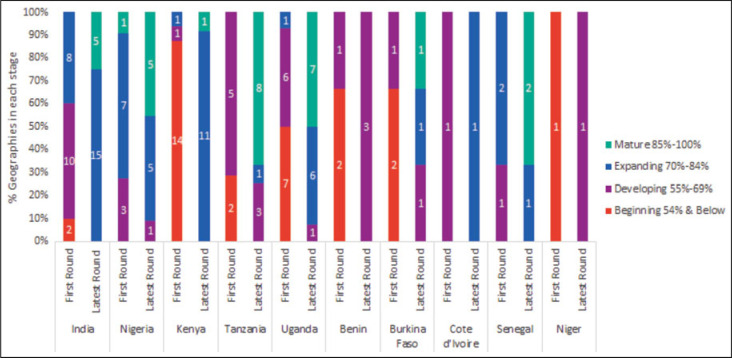
As of June 30, 2021, 39 of the 92 local governments reached the final stage of maturity, self-reliance.
Experts have stated that it can take 15 years for a sustainability assessment tool such as RAISE to be adopted into government policies. After 2 years of using the Tool on a quarterly basis, on average 87.3% of eligible local governments completed the self-assessments, made course corrections, and have taken steps toward program independence. The 39 local governments that successfully progressed to self-reliance continue to use the Tool without TCI's coaching support and have expressed interest in adapting the Tool for other health interventions.
许多以捐赠者为驱动的公共卫生项目在投资前都在寻求可持续性的证据,这就需要有工具来更好地评估这些能力。在地方一级评估方案和干预措施的可持续性仍然是一个全社区的挑战。
本文介绍了一种新的自我评估工具,即反思和行动以提高自力更生和有效性(RAISE)工具(“工具”),该工具是仿照挑战倡议(TCI)的可持续性支柱设计的。它描述了工具的演变,探讨了其结构和应用,展示了其数据分析能力,并说明了如何将其用于地方政府的持续方案自我评估,TCI 将其视为地方一级方案可持续性的一个指标。
该工具于 2019 年开发,已被 11 个国家的 92 个地方政府改编、采用和实施。挑战倡议与这些地方政府合作至少 3 年,对高影响力的干预措施提供管理和技术指导。地方政府使用该工具进行自我评估,评估其活动实施的质量和效果,并确定改进的差距。该工具有助于地方政府和 TCI 跟踪其实现自力更生和对计划生育方案拥有自主权的准备情况。
截至 2021 年 6 月 30 日,92 个地方政府中有 39 个达到了成熟度的最后阶段,即自力更生。
专家表示,像 RAISE 这样的可持续性评估工具可能需要 15 年的时间才能被政府政策采用。在每季度使用该工具两年后,平均有 87.3%的符合条件的地方政府完成了自我评估,进行了课程调整,并朝着方案独立迈出了一步。39 个成功实现自力更生的地方政府继续使用该工具,而无需 TCI 的指导支持,并表示有兴趣将该工具用于其他卫生干预措施。