Department of Restorative, Preventive and Pediatric Dentistry, University of Bern, Freiburgstrasse 7, 3012, Bern, Switzerland.
Department of Surgery, Microsurgery and Medicine Sciences, School of Dentistry, University of Sassari, Viale San Pietro 3/c, 07100, Sassari, Italy.
BMC Pediatr. 2022 Jul 23;22(1):443. doi: 10.1186/s12887-022-03470-4.
The study was aimed to describe caries prevalence and severity and health inequalities among Italian preschool children with European and non-European background and to explore the potential presence of a social gradient.
The ICDAS (International Caries Detection and Assessment System) was recorded at school on 6,825 children (52.8% females). Caries frequency and severity was expressed as a proportion, recording the most severe ICDAS score observed. Socioeconomic status (SES) was estimated by mean a standardized self-submitted questionnaire filled-in by parents. The Slope Index of Inequality (SII) based on regression of the mid-point value of caries experiences score for each SES group was calculated and a social gradient was generated, children were stratified into four social gradient levels based on the number of worst options. Multivariate regression models (Zero-Inflated Negative Binomial logistic and logistic regression) were used to elucidate the associations between all explanatory variables and caries prevalence.
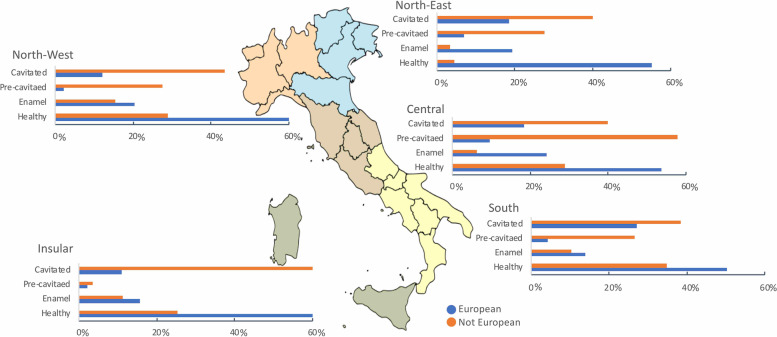
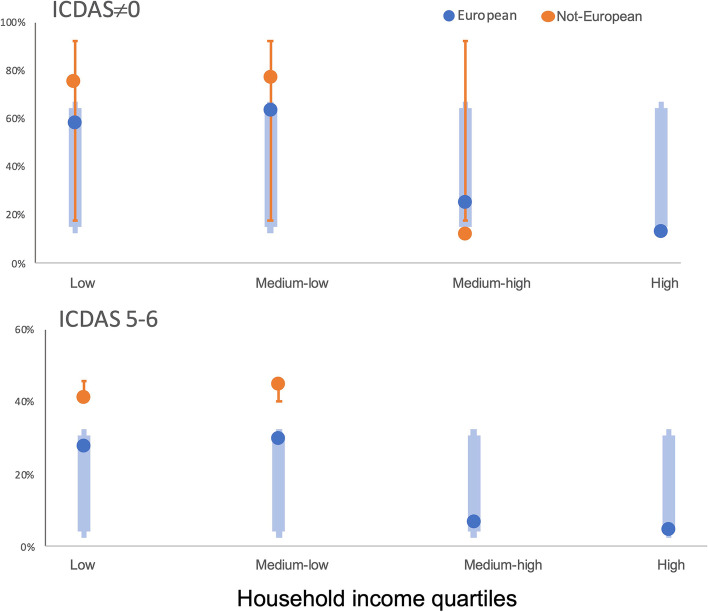
Overall, 54.4% (95%CI 46.7-58.3%) of the children were caries-free; caries prevalence was statistically significant higher in children with non-European background compared to European children (72.6% vs 41.6% p < 0.01) and to the area of living (p = 0.03). A statistically significant trend was observed for ICDAS 5/6 score and the worst social/behavioral level (Z = 5.24, p < 0.01). Children in the highest household income group had lower levels of caries. In multivariate analysis, Immigrant status, the highest parents' occupational and educational level, only one kid in the family, living in the North-Western Italian area and a high household income, were statistically significant associated (p = 0.01) to caries prevalence. The social gradient was statistically significant associated (p < 0.01) to the different caries levels and experience in children with European background.
Data show how caries in preschool children is an unsolved public health problem especially in those with a non-European background.
本研究旨在描述具有欧洲和非欧洲背景的意大利学龄前儿童的龋齿患病率和严重程度以及健康不平等现象,并探讨潜在的社会梯度的存在。
在学校,使用 ICDAS(国际龋齿检测和评估系统)对 6825 名儿童(52.8%为女性)进行记录。龋齿频率和严重程度用比例表示,记录观察到的最严重 ICDAS 评分。社会经济地位(SES)通过父母填写的标准化自我报告问卷来估计。根据每个 SES 组龋齿经验评分中点值的回归计算不平等斜率指数(SII),并生成社会梯度,根据最差选项的数量将儿童分为四个社会梯度水平。使用零膨胀负二项逻辑回归和逻辑回归多变量回归模型来阐明所有解释变量与龋齿患病率之间的关联。
总体而言,54.4%(95%CI 46.7-58.3%)的儿童无龋齿;与欧洲儿童相比,非欧洲背景的儿童的龋齿患病率显著更高(72.6%比 41.6%,p<0.01),与居住地区也存在差异(p=0.03)。ICDAS 5/6 评分和最差社会/行为水平之间观察到显著的趋势(Z=5.24,p<0.01)。家庭收入最高的儿童龋齿水平较低。多变量分析表明,移民身份、父母最高职业和教育水平、家庭中只有一个孩子、居住在意大利西北部地区和高家庭收入与龋齿患病率具有统计学显著关联(p=0.01)。社会梯度与具有欧洲背景的儿童不同的龋齿水平和经历具有统计学显著关联(p<0.01)。
数据表明,学龄前儿童的龋齿是一个未解决的公共卫生问题,尤其是在那些具有非欧洲背景的儿童中。