Departement of Laboratory Medicine, Seoul St. Mary's Hospital, College of Medicine, The Catholic University of Korea, Seoul, South Korea.
Research and Development Institute for In Vitro Diagnostic Medical Devices of Catholic University of Korea, College of Medicine, The Catholic University of Korea, Seoul, South Korea.
J Clin Lab Anal. 2022 Sep;36(9):e24618. doi: 10.1002/jcla.24618. Epub 2022 Jul 23.
Analytical evaluation of newly developed presepsin by a Sysmex HISCL-5000 (Sysmex, Japan) automated immune analyzer was performed.
For evaluation, sepsis patient samples were collected before treatment in an emergency department. Precision, linearity, limit of blank/limit of detection, method comparisons, and reference intervals were evaluated. Method comparisons were performed using a PATHFAST immune analyzer (LSI Medience Corporation, Japan).
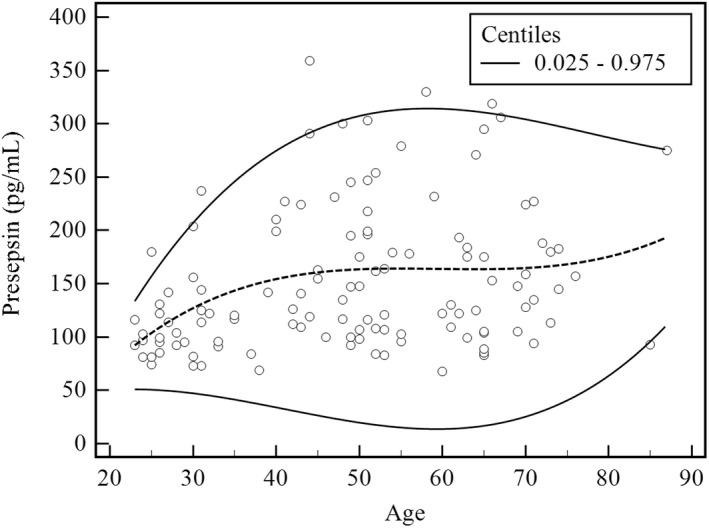
Precision using a 20x2x2 protocol for low (306 pg/mL) and high (1031 pg/mL) levels resulted in within-laboratory standard deviation (95% confidence interval [CI]) and coefficient of variation (CV) %, which were as follows: 15.3 (13.1-18.7), 5.5% and 47.7, (40.5-58.1), 6.4%, respectively. Linearity using patient samples and calibrators were measured from 201 to 16,177 and 188 to 30,000 pg/mL, respectively. The regression equation was y = -23.2 + 1.008x (SE = 162.4) for low levels and y = 779.9 + 1.006x (SE = 668) for high levels. Method comparison by Passing-Bablock analysis was as follows: y = -209.77 + 1.047x (S = 335.3). The correlation coefficient (95% CI) was 0.869 (0.772-0.927) with statistical significance (p < 0.001). Reference intervals from 120 normal healthy subjects showed that 300 pg/mL was the cut off. Presepsin tended to show a higher value at higher ages and in males. Presepsin showed correlation with some parameters, and the correlation coefficient (p value) were as follows: hematocrit, 0.198 (0.03); eGFR (CKD-EPI), -0.240 (0.0129); MDRD-eGFR, -0.194 (0.048), respectively.
Presepsin measurement by HISCL-5000 showed reliable performance. Further clinical studies are required for the diagnosis and prognosis of sepsis.
使用希森美康 HISCL-5000(日本希森美康)自动化免疫分析仪对新开发的降钙素原进行分析评估。
在急诊科治疗前采集脓毒症患者样本进行评估。评估内容包括精密度、线性、空白限/检测限、方法比较和参考区间。使用 PATHFAST 免疫分析仪(LSI Medience Corporation,日本)进行方法比较。
使用低值(306pg/mL)和高值(1031pg/mL)的 20x2x2 方案进行精密度测试,实验室内部标准差(95%置信区间 [CI])和变异系数(CV)%分别为:15.3(13.1-18.7)、5.5%和 47.7(40.5-58.1)、6.4%。使用患者样本和校准品测量线性度,范围分别为 201 至 16177pg/mL 和 188 至 30000pg/mL。低值的回归方程为 y=-23.2+1.008x(SE=162.4),高值的回归方程为 y=779.9+1.006x(SE=668)。Passing-Bablock 分析的方法比较结果为 y=-209.77+1.047x(S=335.3)。相关系数(95%CI)为 0.869(0.772-0.927),具有统计学意义(p<0.001)。120 名健康受试者的参考区间显示 300pg/mL 为截断值。降钙素原在年龄较高和男性中呈现出较高的值。降钙素原与一些参数呈相关性,相关系数(p 值)分别为:红细胞压积,0.198(0.03);eGFR(CKD-EPI),-0.240(0.0129);MDRD-eGFR,-0.194(0.048)。
HISCL-5000 检测降钙素原的性能可靠。需要进一步的临床研究来确定降钙素原在脓毒症诊断和预后中的作用。