Department of Thoracic and Cardiovascular Surgery, Seoul St. Mary's Hospital, College of Medicine, The Catholic University of Korea, Seoul, Korea.
Department of Laboratory Medicine, Seoul St. Mary's Hospital, College of Medicine, The Catholic University of Korea, Seoul, Korea.
PLoS One. 2021 Mar 5;16(3):e0247669. doi: 10.1371/journal.pone.0247669. eCollection 2021.
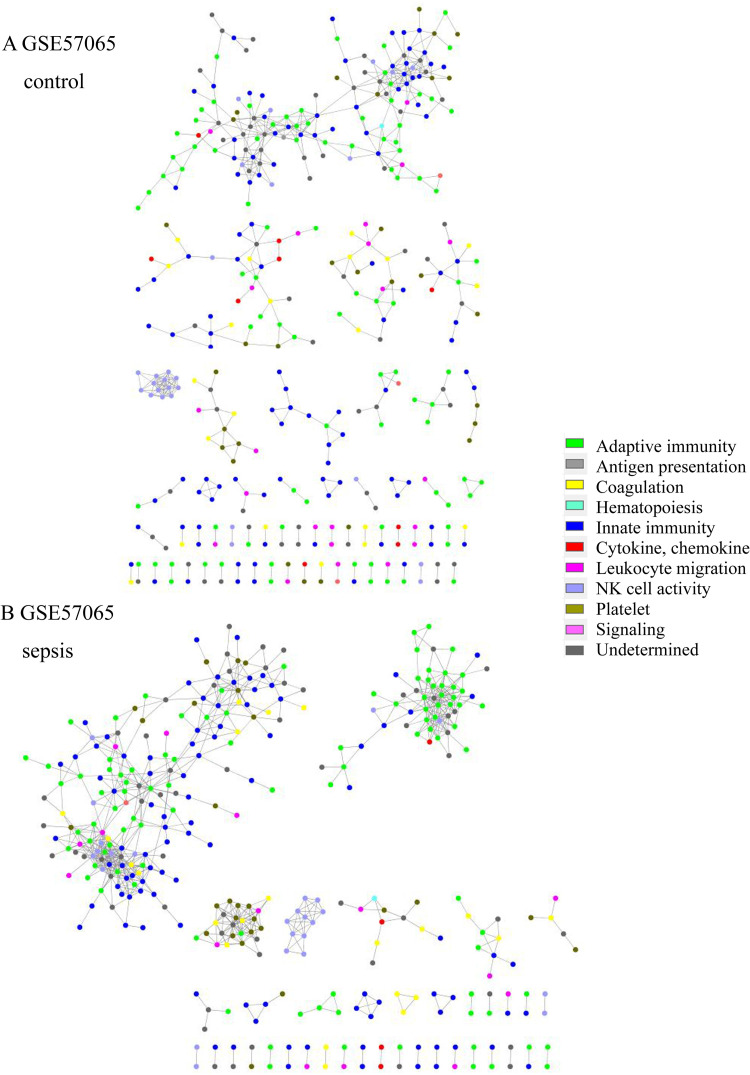
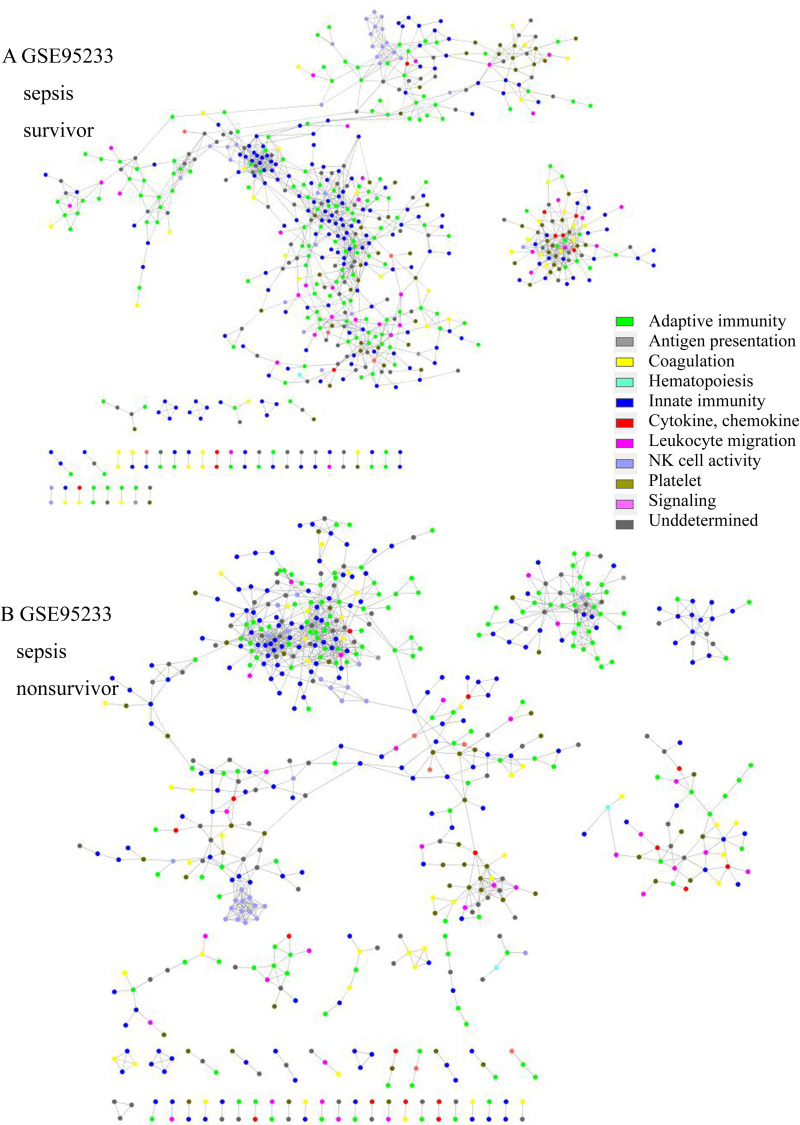
To study the dysregulated host immune response to infection in sepsis, gene expression profiles from the Gene Expression Omnibus (GEO) datasets GSE54514, GSE57065, GSE64456, GSE95233, GSE66099 and GSE72829 were selected. From the Kyoto Encyclopedia of Genes and Genomes (KEGG) immune system pathways, 998 unique genes were selected, and genes were classified as follows based on gene annotation from KEGG, Gene Ontology, and Reactome: adaptive immunity, antigen presentation, cytokines and chemokines, complement, hematopoiesis, innate immunity, leukocyte migration, NK cell activity, platelet activity, and signaling. After correlation matrix formation, correlation coefficient of 0.8 was selected for network generation and network analysis. Total transcriptome was analyzed for differentially expressed genes (DEG), followed by gene set enrichment analysis. The network topological structure revealed that adaptive immunity tended to form a prominent and isolated cluster in sepsis. Common genes within the cluster from the 6 datasets included CD247, CD8A, ITK, LAT, and LCK. The clustering coefficient and modularity parameters were increased in 5/6 and 4/6 datasets in the sepsis group that seemed to be associated with functional aspect of the network. GSE95233 revealed that the nonsurvivor group showed a prominent and isolated adaptive immunity cluster, whereas the survivor group had isolated complement-coagulation and platelet-related clusters. T cell receptor signaling (TCR) pathway and antigen processing and presentation pathway were down-regulated in 5/6 and 4/6 datasets, respectively. Complement and coagulation, Fc gamma, epsilon related signaling pathways were up-regulated in 5/6 datasets. Altogether, network and gene set enrichment analysis showed that adaptive-immunity-related genes along with TCR pathway were down-regulated and isolated from immune the network that seemed to be associated with unfavorable prognosis. Prominence of platelet and complement-coagulation-related genes in the immune network was associated with survival in sepsis. Complement-coagulation pathway was up-regulated in the sepsis group that was associated with favorable prognosis. Network and gene set enrichment analysis supported elucidation of sepsis pathogenesis.
为了研究脓毒症中宿主对感染的失调免疫反应,我们从基因表达综合数据库(GEO)数据集 GSE54514、GSE57065、GSE64456、GSE95233、GSE66099 和 GSE72829 中选择了基因表达谱。从京都基因与基因组百科全书(KEGG)的免疫系统途径中,我们选择了 998 个独特的基因,并根据 KEGG、基因本体论和反应网络数据库的基因注释对基因进行分类:适应性免疫、抗原呈递、细胞因子和趋化因子、补体、造血、固有免疫、白细胞迁移、NK 细胞活性、血小板活性和信号转导。在形成相关矩阵后,我们选择相关系数为 0.8 来生成和分析网络。对全转录组进行差异表达基因(DEG)分析,然后进行基因集富集分析。网络拓扑结构显示,适应性免疫在脓毒症中倾向于形成一个突出和孤立的簇。来自 6 个数据集的聚类中的常见基因包括 CD247、CD8A、ITK、LAT 和 LCK。在脓毒症组的 5/6 和 4/6 数据集的聚类系数和模块参数增加,这似乎与网络的功能方面有关。GSE95233 表明,非幸存者组显示出一个突出和孤立的适应性免疫簇,而幸存者组则显示出孤立的补体-凝血和血小板相关簇。T 细胞受体信号(TCR)途径和抗原加工和呈递途径在 5/6 和 4/6 数据集分别下调。补体和凝血、Fc 伽马、epsilon 相关信号通路在 5/6 数据集上调。总的来说,网络和基因集富集分析表明,适应性免疫相关基因和 TCR 途径下调并从免疫网络中孤立出来,这似乎与不良预后有关。血小板和补体-凝血相关基因在免疫网络中的突出地位与脓毒症的存活有关。补体-凝血途径在脓毒症组中上调,这与良好的预后有关。网络和基因集富集分析支持脓毒症发病机制的阐明。