Laveriano-Santos Emily P, Arancibia-Riveros Camila, Tresserra-Rimbau Anna, Castro-Barquero Sara, Ruiz-León Ana María, Estruch Ramón, Casas Rosa, Bodega Patricia, de Miguel Mercedes, de Cos-Gandoy Amaya, Martínez-Gómez Jesús, Rodríguez Carla, Santos-Beneit Gloria, Fernández-Alvira Juan M, Fernández-Jiménez Rodrigo, Lamuela-Raventós Rosa M
Department of Nutrition, Food Science and Gastronomy, School of Pharmacy and Food Sciences, XIA, Institute of Nutrition and Food Safety (INSA-UB), University of Barcelona, Barcelona, Spain.
Consorcio CIBER, M.P. Fisiopatología de la Obesidad y Nutrición (CIBERObn), Instituto de Salud Carlos III (ISCIII), Madrid, Spain.
Front Nutr. 2022 Jul 6;9:931171. doi: 10.3389/fnut.2022.931171. eCollection 2022.
Cocoa-based products are a good source of flavonoids, which may have beneficial effects on metabolic health.
The aim of this study is to assess the relationship between flavonoids from cocoa-based products and adiposity parameters in adolescents.
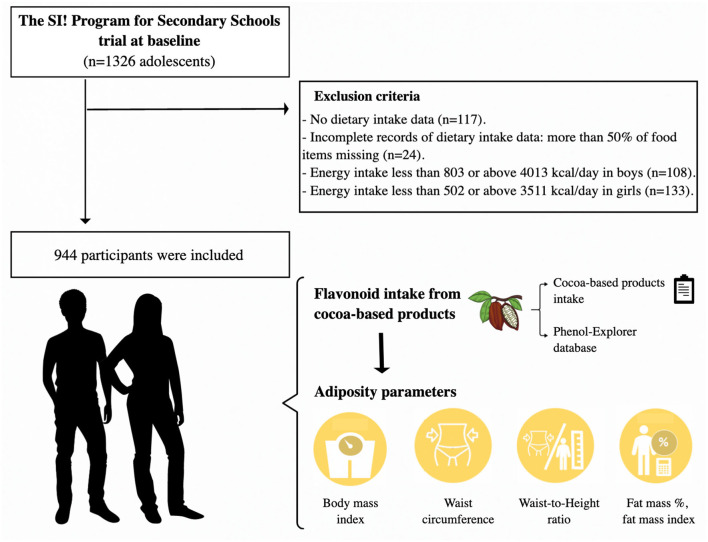
A cross-sectional study was conducted involving 944 adolescents aged 11-14 years enrolled in the SI! Program for Secondary Schools trial in Spain with available baseline data from food frequency questionnaires and anthropometric measurements [weight, height, waist circumference (WC), and fat mass percentage (% FM) by bioimpedance analysis]. Fat mass index (FMI) and waist-to-height ratio (WHtR) were obtained by dividing fat mass by height and WC by height, respectively. Body mass index (BMI), WC, and FMI for age and gender z-score were calculated. Overweight/obesity was defined as BMI ≥ 85th percentile and excess adiposity as %FM or FMI ≥ 75th percentile. WC ≥ 90th percentile and WHtR with a 0.5 threshold were considered as criteria of abdominal obesity. Multilevel mixed-effect regressions were used to evaluate the association between flavonoids from cocoa-based products and adiposity parameters. Municipalities and schools were considered random effects.
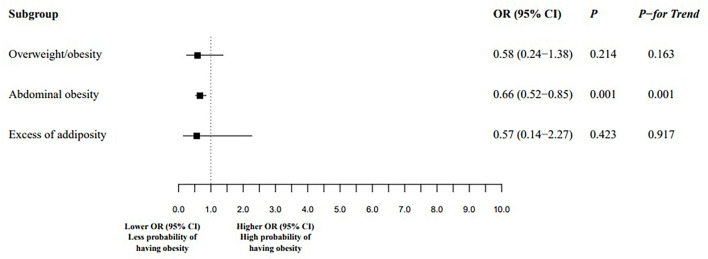
Participants with a higher flavonoid intake from cocoa-based products had lower WC z-score [B = -0.04, 95% CI (-0.07; -0.01), = 0.045] and WHtR [B = -0.01, 95% CI (-0.02; -0.01), < 0.001]. They also had lower probability of having abdominal obesity [OR 0.66, 95% CI (0.52; 0.85), = 0.001]. Inverse associations were observed between flavonoids from cocoa powder and BMI z-score [B = -0.08, 95% CI (-0.12; -0.05), < 0.001], WC z-score [B = -0.06, 95% CI (-0.11; -0.02), = 0.003], WHtR [B = -0.01, 95% CI (-0.01; -0.00), < 0.001], %FM [B = -1.11, 95% CI (-1.48; -0.75), < 0.001], and FMI z-score [B = -0.18, 95% CI (-0.20; -0.17), < 0.001]. Regarding dark chocolate, an inverse association only with WC z-score [B = -0.06, 95% CI (-0.08; -0.05), < 0.001] was found. However, no association was observed between flavonoids from milk chocolate intake and anthropometric parameters.
A higher intake of flavonoids from cocoa-based products was associated with lower adiposity parameters and a lower probability of presenting abdominal obesity.
可可制品是黄酮类化合物的良好来源,黄酮类化合物可能对代谢健康有有益影响。
本研究旨在评估可可制品中的黄酮类化合物与青少年肥胖参数之间的关系。
进行了一项横断面研究,纳入了944名11至14岁的青少年,他们参与了西班牙中学SI!项目试验,有来自食物频率问卷和人体测量数据(通过生物电阻抗分析测量体重、身高、腰围(WC)和脂肪质量百分比(%FM))的可用基线数据。脂肪质量指数(FMI)和腰高比(WHtR)分别通过脂肪质量除以身高和WC除以身高获得。计算年龄和性别z评分的体重指数(BMI)、WC和FMI。超重/肥胖定义为BMI≥第85百分位数,肥胖定义为%FM或FMI≥第75百分位数。WC≥第90百分位数且WHtR阈值为0.5被视为腹部肥胖标准。采用多水平混合效应回归评估可可制品中的黄酮类化合物与肥胖参数之间的关联。将市和学校视为随机效应。
从可可制品中摄入黄酮类化合物较多的参与者WC z评分较低[B = -0.04,95%CI(-0.07;-0.01),P = 0.045]和WHtR较低[B = -0.01,95%CI(-0.02;-0.01),P < 0.001]。他们患腹部肥胖的概率也较低[OR 0.66,95%CI(0.52;0.85),P = 0.001]。观察到可可粉中的黄酮类化合物与BMI z评分[B = -(此处原文有误,应为0.08),95%CI(-0.12;-0.05),P < 0.001]、WC z评分[B = -0.06,95%CI(-0.11;-0.02),P = 0.003]、WHtR[B = -0.01,95%CI(-0.01;-0.00),P < 0.001]、%FM[B = -1.11,95%CI(-1.48;-0.75),P < 0.001]和FMI z评分[B = -0.18,95%CI(-0.20;-0.17),P < 0.001]之间呈负相关。关于黑巧克力,仅发现与WC z评分呈负相关[B = -0.06,95%CI(-0.08;-0.05),P < 0.001]。然而,未观察到牛奶巧克力摄入的黄酮类化合物与人体测量参数之间的关联。
从可可制品中较高的黄酮类化合物摄入量与较低的肥胖参数以及较低的腹部肥胖发生率相关。