Li Cuiru, Zhou Kang, Xiao Nenqun, Peng Maijiao, Tan Zhoujin
College of Chinese Medicine, Hunan University of Chinese Medicine, Changsha, China.
College of Pharmacy, Hunan University of Chinese Medicine, Changsha, China.
Front Nutr. 2022 Jul 8;9:952647. doi: 10.3389/fnut.2022.952647. eCollection 2022.
Qiweibaizhu powder (QWBZP) has been shown to be effective in treating antibiotic-associated diarrhea (AAD). Previous research has reported that plant polysaccharides can promote the growth of beneficial intestinal bacteria and inhibit the multiplication of pathogenic bacteria, thus effectively treating diarrhea. Here, we investigated the effect of QWBZP crude polysaccharide on the diversity of intestinal mucosal bacteria and their community structure composition in mice with AAD, and the aim of this study was to provide the scientific basis for the efficacy of QWBZP crude polysaccharide on diarrhea.
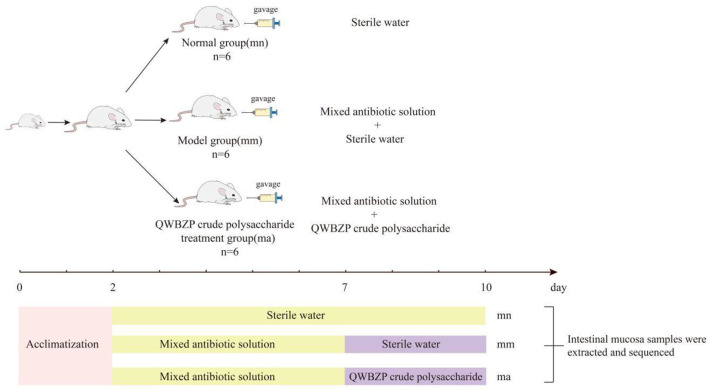
Eighteen Kunming (KM) mice were randomly divided into the normal (mn) group, the model (mm) group, and the QWBZP crude polysaccharide treatment (ma) group, with six mice in each group. An AAD model was constructed using a mixed antibiotic solution and treated with gavage crude polysaccharide solution of QWBZP. The intestinal mucosa was extracted from the jejunum to the ileum of mice, and the metagenome was extracted and then analyzed using MiSeq sequencing to characterize the intestinal mucosal bacteria in mice.
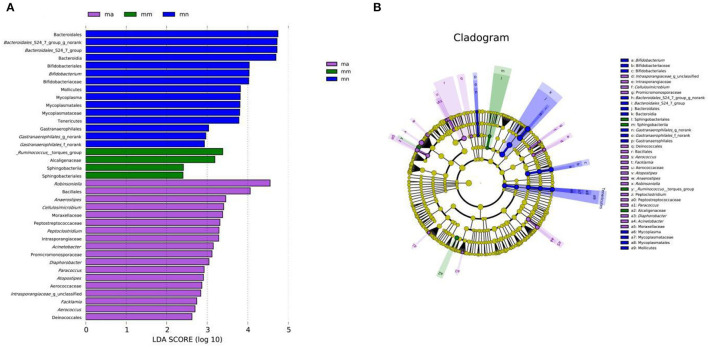
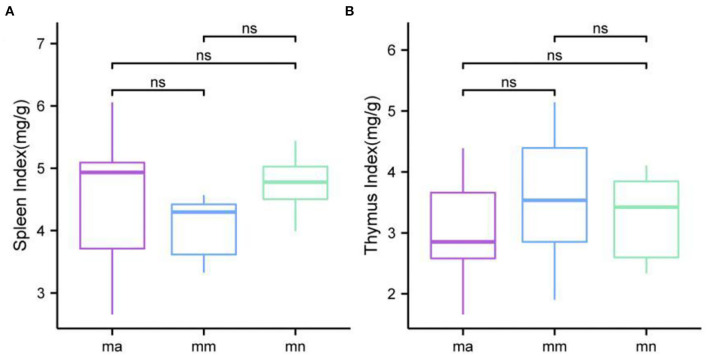
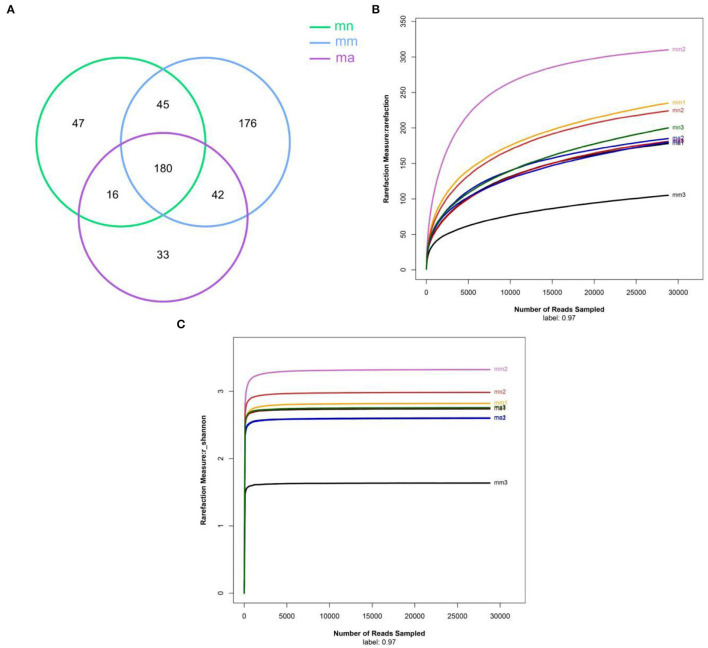
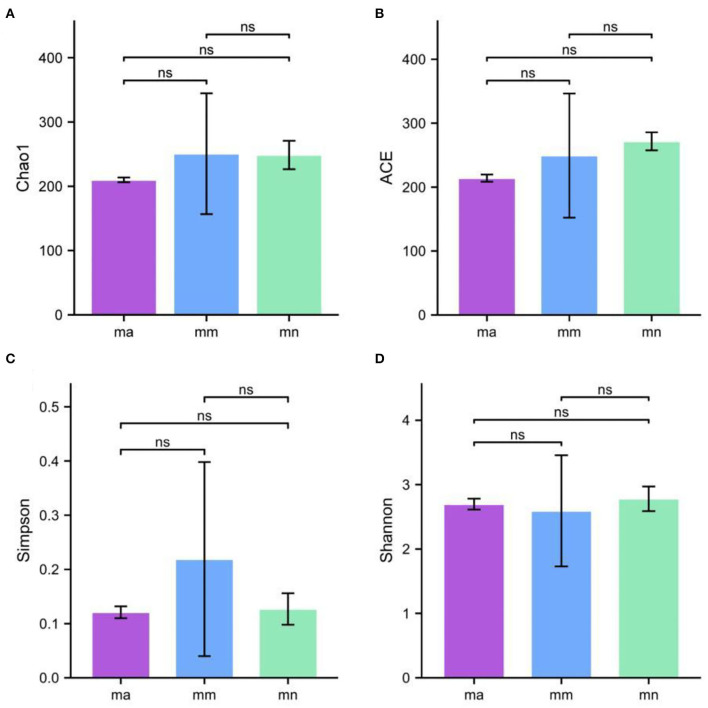
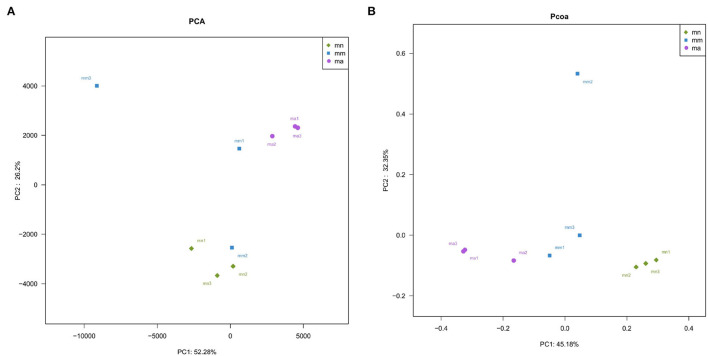
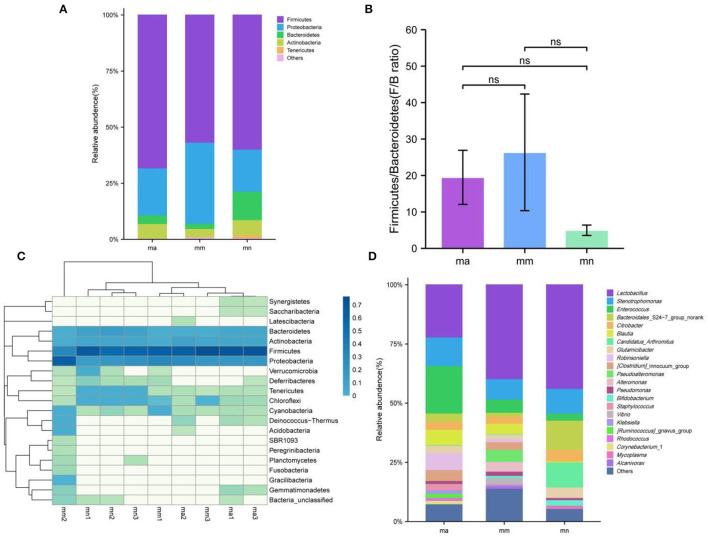
The spleen and thymus indices of each group of mice had no significant differences. The Chao1 and ACE indices of the mn and mm groups were similar, the Simpson index was the largest and the Shannon index was the smallest in the mm group, and there was no significant difference in the diversity indices of all three groups. In the PCA and PCoA, the mn and ma group samples were both relatively concentrated with a high similarity of community structure. In contrast, the samples in the mm group were more scattered and farther away from the samples in the mn and ma groups, i.e., the community structure similarity within and between the groups was low. Compared with the mm group, the relative abundance of Proteobacteria, , and the Firmicutes/Bacteroidetes (F/B) ratio in the ma group was decreased, while that of continued to increase. In the LEfSe analysis, there were significant differences in the characteristic bacteria in the mn, mm, and ma groups.
The single crude polysaccharide component is not very effective in treating AAD, so the clinical efficacy of the QWBZP crude polysaccharide is subject to further investigation.
已证明七味白术散(QWBZP)在治疗抗生素相关性腹泻(AAD)方面有效。先前的研究报道植物多糖可促进肠道有益菌的生长并抑制病原菌的繁殖,从而有效治疗腹泻。在此,我们研究了QWBZP粗多糖对AAD小鼠肠道黏膜细菌多样性及其群落结构组成的影响,本研究的目的是为QWBZP粗多糖治疗腹泻的疗效提供科学依据。
18只昆明(KM)小鼠随机分为正常(mn)组、模型(mm)组和QWBZP粗多糖治疗(ma)组,每组6只。使用混合抗生素溶液构建AAD模型,并用QWBZP粗多糖溶液灌胃治疗。从小鼠空肠至回肠提取肠道黏膜,提取宏基因组,然后使用MiSeq测序进行分析,以表征小鼠肠道黏膜细菌。
各组小鼠的脾脏和胸腺指数无显著差异。mn组和mm组的Chao1和ACE指数相似,mm组的辛普森指数最大,香农指数最小,三组的多样性指数无显著差异。在主成分分析(PCA)和主坐标分析(PCoA)中,mn组和ma组的样本均相对集中,群落结构相似度高。相比之下,mm组的样本更分散,且与mn组和ma组的样本距离更远,即组内和组间的群落结构相似度较低。与mm组相比,ma组中变形菌门的相对丰度以及厚壁菌门/拟杆菌门(F/B)比值降低,而另一种菌门的相对丰度持续增加。在线性判别分析效应大小(LEfSe)分析中,mn组、mm组和ma组的特征菌存在显著差异。
单一的粗多糖成分在治疗AAD方面效果不太显著,因此QWBZP粗多糖的临床疗效有待进一步研究。