Murakami Kei, Hirata Daizen, Haraguchi Kengo, Arai Noriko, Inoue Koji, Miyazaki Yuka, Funase Kimihiro, Nakashige Tadao, Teramoto Akira, Iwatate Mineo, Hattori Santa, Fujita Mikio, Sano Wataru, Sano Yasushi
Gastrointestinal Center and Institute of Minimally-invasive Endoscopic Care Sano Hospital Hyogo Japan.
Department of Gastroenterology and Hepatology Kindai University Osaka Japan.
DEN Open. 2022 Mar 6;2(1):e101. doi: 10.1002/deo2.101. eCollection 2022 Apr.
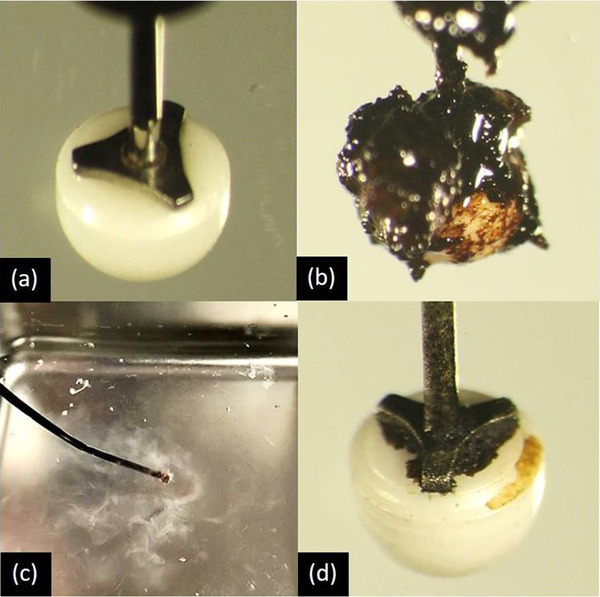
Since carbonized clots and tissue (debris) tend to adhere firmly to the tip of the endoscopic submucosal dissection (ESD) knife as the procedure proceeds, manual removing the firm debris is often challenging and time-consuming. Recently, effective ultrasonic cleaning for other medical devices has been reported. The aim of the present study was to clarify whether ultrasonic cleaning is effective in removing the debris on the insulation-tipped diathermic (IT) knife-2.
This study was an ex-vivo experimental randomized study. A total of 40 IT knife-2 knives with debris on their tip surfaces were prepared and randomly assigned to two groups (Group A and Group B). The knives in Group A were cleaned using the conventional scrubbing method for 30 s (conventional cleaning method), while those in Group B were cleaned using a combined method of scrubbing for 20 s and ultrasonic cleaning for 10 s (combined ultrasonic cleaning method). The tip electrode of the knife after cleaning was photographed under a microscope (40x). The 40 images of the knives were evaluated by independent three endoscopists and two clinical engineers using the five-step evaluation criteria ranging from cleaning score 1 (dirty) to 5 (clean).
The mean cleaning score of 3.78 (range: 2.33-4.67) in Group B was significantly higher than that of 1.68 (range: 1.00-2.83) in Group A.
The combined ultrasonic cleaning method could remove debris adhering to the IT knife-2 more effectively than the conventional cleaning method. Ultrasonic cleaning may be applied for real-world ESD.
随着内镜黏膜下剥离术(ESD)的进行,碳化血栓和组织(碎片)往往会牢固地附着在内镜黏膜下剥离刀的尖端,手动清除这些牢固的碎片通常具有挑战性且耗时。最近,有报道称超声清洗对其他医疗设备有效。本研究的目的是阐明超声清洗是否能有效去除绝缘尖端透热(IT)刀-2上的碎片。
本研究是一项体外实验性随机研究。共准备了40把尖端表面有碎片的IT刀-2,并随机分为两组(A组和B组)。A组的刀采用传统刷洗方法清洗30秒(传统清洗方法),而B组的刀采用刷洗20秒和超声清洗10秒的联合方法清洗(联合超声清洗方法)。清洗后的刀的尖端电极在显微镜(40倍)下拍照。40张刀的图像由3名独立的内镜医师和2名临床工程师使用从清洗评分1(脏)到5(干净)的五步评估标准进行评估。
B组的平均清洗评分为3.78(范围:2.33 - 4.67),显著高于A组的1.68(范围:1.00 - 2.83)。
联合超声清洗方法比传统清洗方法能更有效地去除附着在IT刀-2上的碎片。超声清洗可应用于实际的ESD操作。