Celebi Sozener Zeynep, Özbey Yücel Ümüs, Altiner Seda, Ozdel Oztürk Betül, Cerci Pamir, Türk Murat, Gorgülü Akin Begüm, Akdis Mübeccel, Yilmaz Insu, Ozdemir Cevdet, Mungan Dilsad, Akdis Cezmi A
Clinic of Immunology and Allergic Diseases, Ankara City Hospital, Ankara, Turkey.
Department of Nutrition and Diet, Ankara University, Ankara, Turkey.
Front Allergy. 2022 Jul 8;3:887672. doi: 10.3389/falgy.2022.887672. eCollection 2022.
In the last decades, we have seen a rapid increase in the prevalence of allergic diseases such as asthma, allergic rhinitis, atopic dermatitis, and food allergies. The environmental changes caused by industrialization, urbanization and modernization, including dramatic increases in air pollutants such as particulate matter (PM), diesel exhaust, nitrogen dioxide (NO2), ozone (O3), alarming effects of global warming, change and loss of biodiversity, affect both human health and the entire ecosystem.
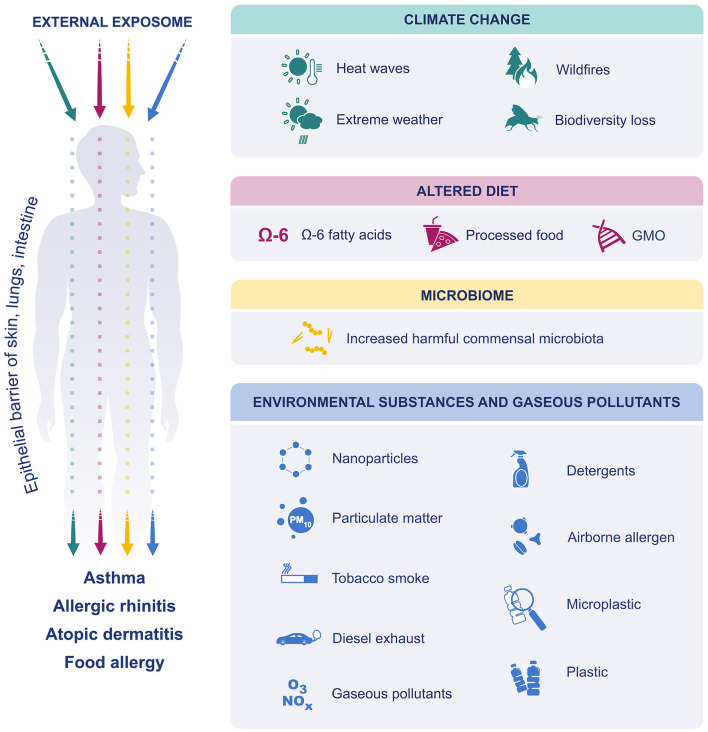
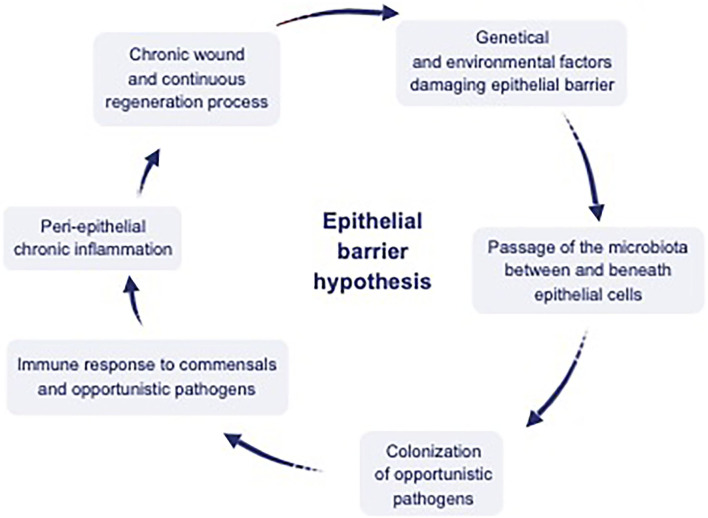
In this review, we aimed to discuss the effects of the external exposome on epithelial barriers and its relationship with the development of allergic diseases by considering the changes in all stakeholders of the outer exposome together, in the light of the recently proposed epithelial barrier hypothesis.
To reach current, prominent, and comprehensive studies on the subject, PubMed databases were searched. We included the more resounding articles with reliable and strong results.
Exposure to altered environmental factors such as increased pollution, microplastics, nanoparticles, tobacco smoke, food emulsifiers, detergents, and household cleaners, and climate change, loss and change in microbial biodiversity, modifications in the consumption of dietary fatty acids, the use of emulsifiers, preservatives and the decrease in the antioxidant content of the widely consumed western diet may disrupt the epithelial barriers of the skin, respiratory and gastrointestinal tracts, making us more vulnerable to exogeneous allergens and microbes. Epithelial cell activation, microbial dysbiosis and bacterial translocation disrupt the immune balance and a chronic Th2 inflammation ensues.
Dramatic increases in air pollution, worrisome effects of global warming, dysbiosis, changing dietary habits and the complex interactions of all these factors affect the epithelial barriers and local and systemic inflammation. We want to draw attention to the emerging health effects of environmental changes and to motivate the public to influence government policies for the well-being of humans and the nature of the earth and the well-being of future generations.
在过去几十年中,我们看到哮喘、过敏性鼻炎、特应性皮炎和食物过敏等过敏性疾病的患病率迅速上升。工业化、城市化和现代化所带来的环境变化,包括颗粒物(PM)、柴油尾气、二氧化氮(NO2)、臭氧(O3)等空气污染物的急剧增加、全球变暖的惊人影响、生物多样性的变化和丧失,影响着人类健康和整个生态系统。
在本综述中,我们旨在根据最近提出的上皮屏障假说,综合考虑外部暴露组所有相关因素的变化,探讨外部暴露组对上皮屏障的影响及其与过敏性疾病发展的关系。
为获取关于该主题的最新、突出且全面的研究,我们检索了PubMed数据库。我们纳入了结果可靠且有力的更具影响力的文章。
暴露于污染增加、微塑料、纳米颗粒、烟草烟雾、食品乳化剂、洗涤剂和家用清洁剂等环境因素变化,以及气候变化、微生物生物多样性丧失和变化、膳食脂肪酸消费的改变、乳化剂和防腐剂的使用,以及广泛消费的西方饮食中抗氧化剂含量的降低,可能会破坏皮肤、呼吸道和胃肠道的上皮屏障,使我们更容易受到外源性过敏原和微生物的侵害。上皮细胞活化、微生物群落失调和细菌易位会破坏免疫平衡,继而引发慢性Th2炎症。
空气污染的急剧增加、全球变暖的令人担忧的影响、微生物群落失调、饮食习惯的改变以及所有这些因素的复杂相互作用,都会影响上皮屏障以及局部和全身炎症。我们希望引起人们对环境变化所产生的新出现的健康影响的关注,并激励公众影响政府政策,以促进人类福祉、地球自然以及子孙后代的福祉。