Bigoni Claudia, Zandvliet Sarah B, Beanato Elena, Crema Andrea, Coscia Martina, Espinosa Arnau, Henneken Tina, Hervé Julie, Oflar Meltem, Evangelista Giorgia G, Morishita Takuya, Wessel Maximilian J, Bonvin Christoph, Turlan Jean-Luc, Birbaumer Niels, Hummel Friedhelm C
Defitech Chair of Clinical Neuroengineering, Center for Neuroprosthetics (CNP) and Brain Mind Institute (BMI), École Polytechnique Fédérale de Lausanne (EPFL), Geneva, Switzerland.
Defitech Chair of Clinical Neuroengineering, Center for Neuroprosthetics (CNP) and Brain Mind Institute (BMI), École Polytechnique Fédérale de Lausanne (EPFL), Clinique Romande de Réadaptation, Sion, Switzerland.
Front Neurol. 2022 Jul 7;13:919511. doi: 10.3389/fneur.2022.919511. eCollection 2022.
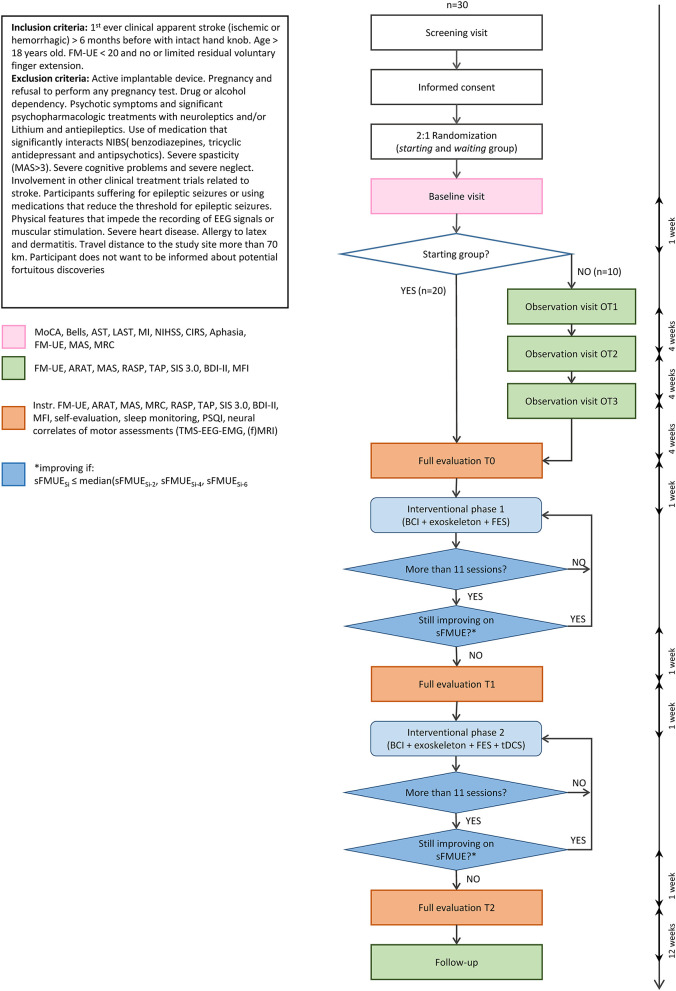
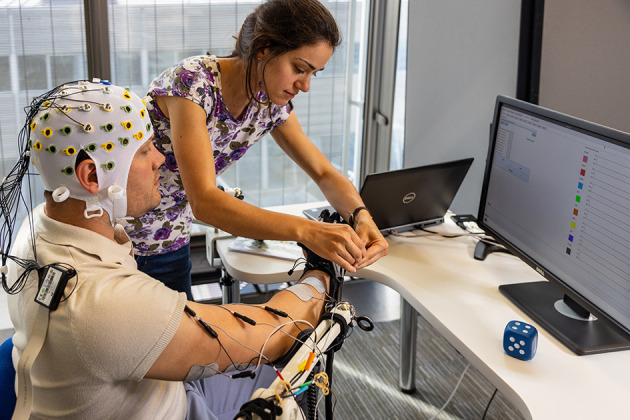
Effective, patient-tailored rehabilitation to restore upper-limb motor function in severely impaired stroke patients is still missing. If suitably combined and administered in a personalized fashion, neurotechnologies offer a large potential to assist rehabilitative therapies to enhance individual treatment effects. AVANCER (clinicaltrials.gov NCT04448483) is a two-center proof-of-concept trial with an individual based cumulative longitudinal intervention design aiming at reducing upper-limb motor impairment in severely affected stroke patients with the help of multiple neurotechnologies. AVANCER will determine feasibility, safety, and effectivity of this innovative intervention. Thirty chronic stroke patients with a Fugl-Meyer assessment of the upper limb (FM-UE) <20 will be recruited at two centers. All patients will undergo the cumulative personalized intervention within two phases: the first uses an EEG-based brain-computer interface to trigger a variety of patient-tailored movements supported by multi-channel functional electrical stimulation in combination with a hand exoskeleton. This phase will be continued until patients do not improve anymore according to a quantitative threshold based on the FM-UE. The second interventional phase will add non-invasive brain stimulation by means of anodal transcranial direct current stimulation to the motor cortex to the initial approach. Each phase will last for a minimum of 11 sessions. Clinical and multimodal assessments are longitudinally acquired, before the first interventional phase, at the switch to the second interventional phase and at the end of the second interventional phase. The primary outcome measure is the 66-point FM-UE, a significant improvement of at least four points is hypothesized and considered clinically relevant. Several clinical and system neuroscience secondary outcome measures are additionally evaluated. AVANCER aims to provide evidence for a safe, effective, personalized, adjuvant treatment for patients with severe upper-extremity impairment for whom to date there is no efficient treatment available.
针对严重受损的中风患者,目前仍缺乏有效的、个性化的康复治疗来恢复上肢运动功能。如果以个性化方式进行适当组合和应用,神经技术在辅助康复治疗以提高个体治疗效果方面具有巨大潜力。AVANCER(clinicaltrials.gov NCT04448483)是一项双中心概念验证试验,采用基于个体的累积纵向干预设计,旨在借助多种神经技术减轻重度受影响中风患者的上肢运动障碍。AVANCER将确定这种创新干预的可行性、安全性和有效性。两个中心将招募30名上肢Fugl-Meyer评估(FM-UE)<20分的慢性中风患者。所有患者将在两个阶段接受累积个性化干预:第一阶段使用基于脑电图的脑机接口,结合多通道功能性电刺激和手部外骨骼,触发各种个性化动作。该阶段将持续进行,直到根据基于FM-UE的定量阈值患者不再改善为止。第二干预阶段将在初始方法基础上增加经颅直流电阳极刺激对运动皮层进行非侵入性脑刺激。每个阶段至少持续11次治疗。在第一个干预阶段之前、转换到第二个干预阶段时以及第二个干预阶段结束时,纵向进行临床和多模态评估。主要结局指标是66分的FM-UE量表,假设至少提高4分具有显著改善且具有临床意义。此外,还评估了多个临床和系统神经科学次要结局指标。AVANCER旨在为重度上肢功能障碍患者提供一种安全、有效、个性化的辅助治疗方法,目前这类患者尚无有效的治疗方法。