Hampson Johnson P, Lacuey Nuria, Rani Mrs Sandhya, Hampson Jaison S, Simeone Kristina A, Simeone Timothy A, Narayana Ponnada A, Lemieux Louis, Lhatoo Samden D
Department of Neurology, McGovern Medical School, University of Texas Health Science Center at Houston, Houston, TX, United States.
Department of Pharmacology and Neuroscience, Creighton University School of Medicine, Omaha, NE, United States.
Front Neurol. 2022 Jul 7;13:896204. doi: 10.3389/fneur.2022.896204. eCollection 2022.
Sudden unexpected death in epilepsy (SUDEP) is a catastrophic epilepsy outcome for which there are no reliable premortem imaging biomarkers of risk. Percival respiratory depression is seen in monitored SUDEP and near SUDEP cases, and abnormal chemosensing of raised blood carbon dioxide (CO) is thought to contribute. Damage to brainstem respiratory control and chemosensing structures has been demonstrated in structural imaging and neuropathological studies of SUDEP. We hypothesized that functional MRI (fMRI) correlates of abnormal chemosensing are detectable in brainstems of persons with epilepsy (PWE) and are different from healthy controls (HC).
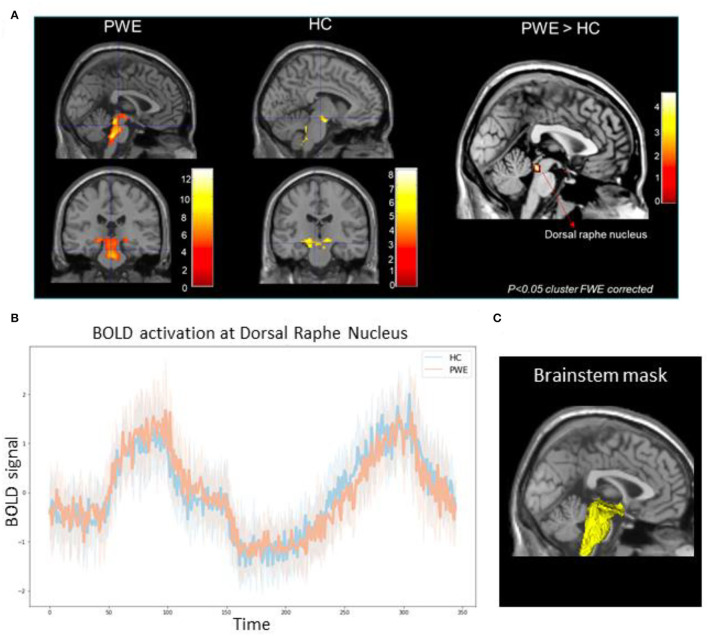
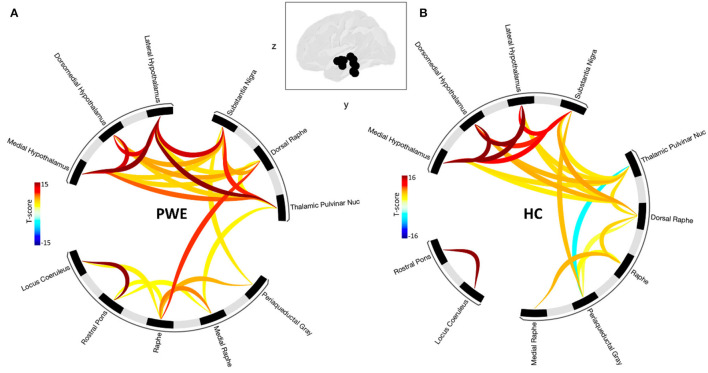
We analyzed fMRI BOLD activation and brain connectivity in 10 PWE and 10 age- and sex-matched HCs during precisely metered iso-oxic, hypercapnic breathing challenges. Segmented brainstem responses were of particular interest, along with characterization of functional connectivity metrics between these structures. Regional BOLD activations during hypercapnic challenges were convolved with hemodynamic responses, and the resulting activation maps were passed on to group-level analyses. For the functional connectivity analysis, significant clusters from BOLD results were used as seeds. Each individual seed time-series activation map was extracted for bivariate correlation coefficient analyses to study changes in brain connectivity between PWE and HCs.
(1) Greater brainstem BOLD activations in PWE were observed compared to HC during hypercapnic challenges in several structures with respiratory/chemosensing properties. Group comparison between PWE vs. HC showed significantly greater activation in the dorsal raphe among PWE ( < 0.05) compared to HCs. (2) PWE had significantly greater seed-seed connectivity and recruited more structures during hypercapnia compared to HC.
The results of this study show that BOLD responses to hypercapnia in human brainstem are detectable and different in PWE compared to HC. Increased dorsal raphe BOLD activation in PWE and increased seed-seed connectivity between brainstem and adjacent subcortical areas may indicate abnormal chemosensing in these individuals. Imaging investigation of brainstem respiratory centers involved in respiratory regulation in PWE is an important step toward identifying suspected dysfunction of brainstem breathing control that culminates in SUDEP and deserve further study as potential imaging SUDEP biomarkers.
癫痫猝死(SUDEP)是一种灾难性的癫痫结局,目前尚无可靠的生前风险影像生物标志物。在监测到的SUDEP和接近SUDEP的病例中可见珀西瓦尔呼吸抑制,并且认为血液中二氧化碳(CO)升高时的异常化学感受起了作用。在SUDEP的结构成像和神经病理学研究中已证实脑干呼吸控制和化学感受结构受损。我们假设在癫痫患者(PWE)的脑干中可检测到与异常化学感受相关的功能磁共振成像(fMRI),且与健康对照(HC)不同。
我们在精确计量的等氧、高碳酸血症呼吸挑战期间分析了10名PWE和10名年龄及性别匹配的HC的fMRI血氧水平依赖(BOLD)激活和脑连接性。分段的脑干反应特别受关注,同时还对这些结构之间的功能连接指标进行了表征。高碳酸血症挑战期间的局部BOLD激活与血流动力学反应进行卷积,然后将所得的激活图用于组水平分析。对于功能连接性分析,将BOLD结果中的显著簇用作种子。提取每个个体种子时间序列激活图进行双变量相关系数分析,以研究PWE和HC之间脑连接性的变化。
(1)在高碳酸血症挑战期间,与HC相比,在具有呼吸/化学感受特性的几个结构中观察到PWE的脑干BOLD激活更大。PWE与HC的组间比较显示,与HC相比,PWE中中缝背核的激活明显更大(<0.05)。(2)与HC相比,PWE在高碳酸血症期间具有明显更大的种子-种子连接性,并且募集了更多结构。
本研究结果表明,与HC相比,人脑干对高碳酸血症的BOLD反应在PWE中是可检测到的且有所不同。PWE中缝背核BOLD激活增加以及脑干与相邻皮质下区域之间种子-种子连接性增加可能表明这些个体存在异常化学感受。对参与PWE呼吸调节的脑干呼吸中枢进行成像研究是朝着识别最终导致SUDEP的脑干呼吸控制疑似功能障碍迈出的重要一步,作为潜在的SUDEP影像生物标志物值得进一步研究。