Dai Shuang-Feng, Zhu Xun-Ge, Hutang Ge-Rang, Li Jia-Yue, Tian Jia-Qi, Jiang Xian-Hui, Zhang Dan, Gao Li-Zhi
Institution of Genomics and Bioinformatics, South China Agricultural University, Guangzhou, China.
Plant Germplasm and Genomics Center, Kunming Institute of Botany, Chinese Academy of Sciences, Kunming, China.
Front Plant Sci. 2022 Jul 7;13:921937. doi: 10.3389/fpls.2022.921937. eCollection 2022.
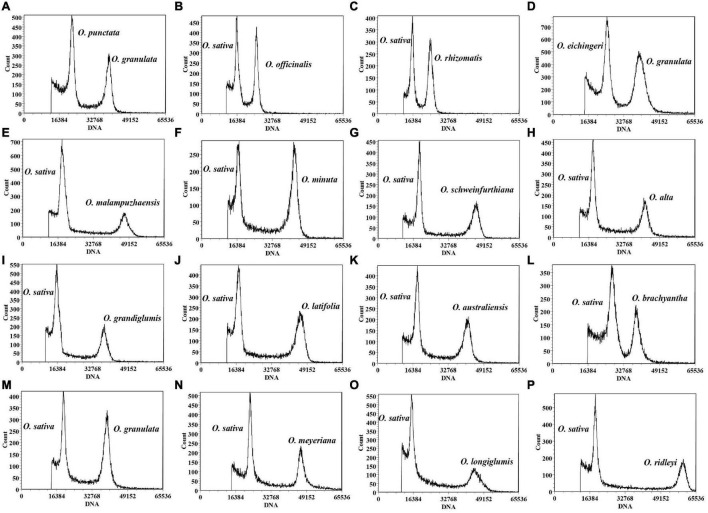
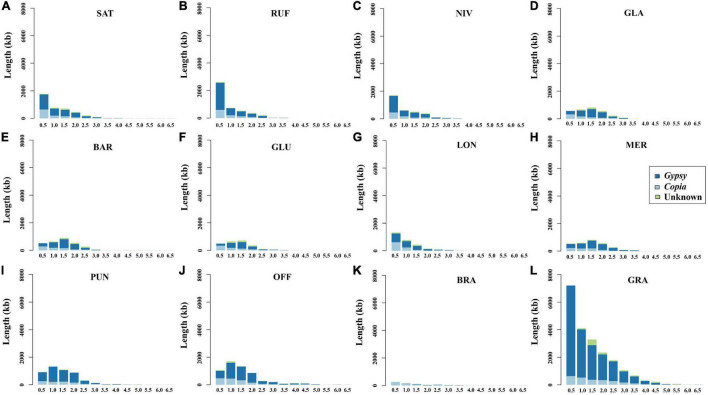
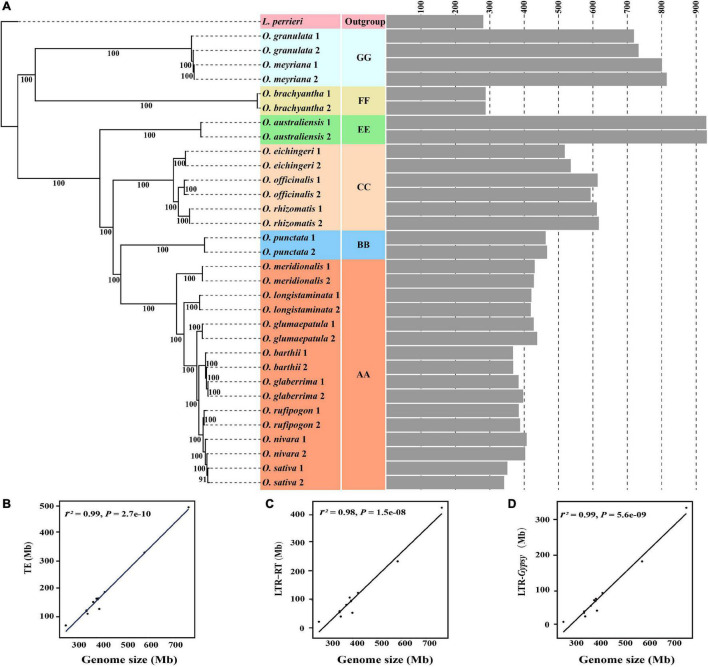
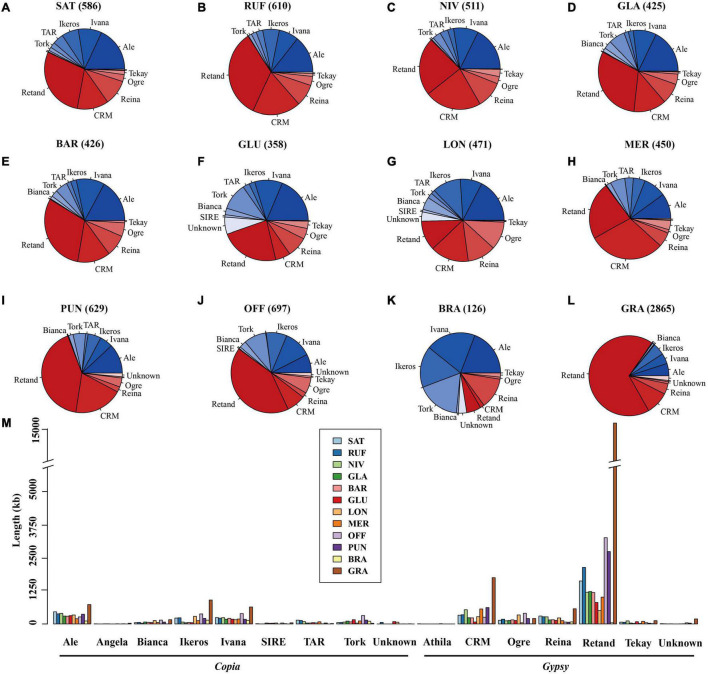
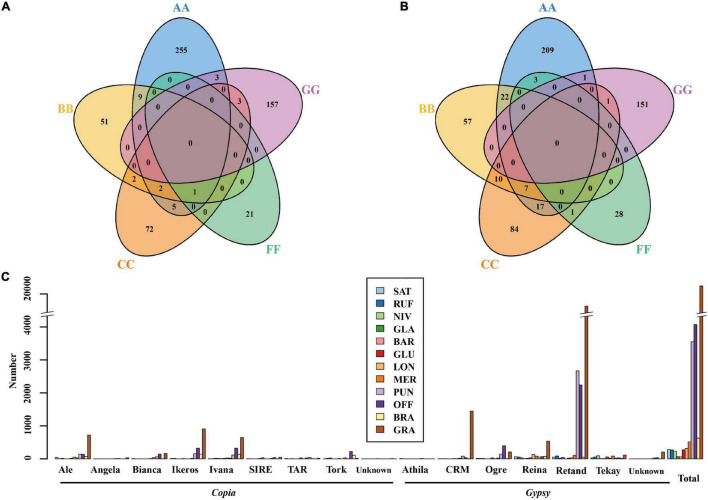
Genome size variation and evolutionary forces behind have been long pursued in flowering plants. The genus , consisting of approximately 25 wild species and two cultivated rice, harbors eleven extant genome types, six of which are diploid (AA, BB, CC, EE, FF, and GG) and five of which are tetraploid (BBCC, CCDD, HHJJ, HHKK, and KKLL). To obtain the most comprehensive knowledge of genome size variation in the genus , we performed flow cytometry experiments and estimated genome sizes of 166 accessions belonging to 16 non-AA genome species. -mer analyses were followed to verify the experimental results of the two accessions for each species. Our results showed that genome sizes largely varied fourfold in the genus , ranging from 279 Mb in (FF) to 1,203 Mb in (HHJJ). There was a 2-fold variation (ranging from 570 to 1,203 Mb) in genome size among the tetraploid species, while the diploid species had 3-fold variation, ranging from 279 Mb in (FF) to 905 Mb in (EE). The genome sizes of the tetraploid species were not always two times larger than those of the diploid species, and some diploid species even had larger genome sizes than those of tetraploids. Nevertheless, we found that genome sizes of newly formed allotetraploids (BBCC-) were almost equal to totaling genome sizes of their parental progenitors. Our results showed that the species belonging to the same genome types had similar genome sizes, while genome sizes exhibited a gradually decreased trend during the evolutionary process in the clade with AA, BB, CC, and EE genome types. Comparative genomic analyses further showed that the species with different rice genome types may had experienced dissimilar amplification histories of retrotransposons, resulting in remarkably different genome sizes. On the other hand, the closely related rice species may have experienced similar amplification history. We observed that the contents of transposable elements, long terminal repeats (LTR) retrotransposons, and particularly LTR/ retrotransposons varied largely but were significantly correlated with genome sizes. Therefore, this study demonstrated that LTR retrotransposons act as an active driver of genome size variation in the genus .
开花植物的基因组大小变异及其背后的进化力量一直是人们长期探索的课题。该属包含约25个野生种和两种栽培稻,拥有11种现存的基因组类型,其中6种是二倍体(AA、BB、CC、EE、FF和GG),5种是四倍体(BBCC、CCDD、HHJJ、HHKK和KKLL)。为了全面了解该属的基因组大小变异,我们进行了流式细胞术实验,并估计了属于16个非AA基因组物种的166份材料的基因组大小。随后进行了k-mer分析,以验证每个物种两份材料的实验结果。我们的结果表明,该属的基因组大小差异很大,相差四倍,从(FF)的279 Mb到(HHJJ)的1203 Mb不等。四倍体物种的基因组大小有2倍的差异(从570 Mb到1203 Mb),而二倍体物种有3倍的差异,从(FF)的279 Mb到(EE)的905 Mb。四倍体物种的基因组大小并不总是二倍体物种的两倍,一些二倍体物种的基因组大小甚至比四倍体物种的还大。然而,我们发现新形成的异源四倍体(BBCC-)的基因组大小几乎等于其亲本祖先基因组大小之和。我们的结果表明,属于相同基因组类型的物种具有相似的基因组大小,而在具有AA、BB、CC和EE基因组类型的进化分支中,基因组大小在进化过程中呈现出逐渐下降的趋势。比较基因组分析进一步表明,不同水稻基因组类型的物种可能经历了不同的反转录转座子扩增历史,导致基因组大小显著不同。另一方面,亲缘关系较近的水稻物种可能经历了相似的扩增历史。我们观察到转座元件、长末端重复序列(LTR)反转录转座子,特别是LTR/反转录转座子的含量差异很大,但与基因组大小显著相关。因此,本研究表明LTR反转录转座子是该属基因组大小变异的活跃驱动因素。