Kapeleris Joanna, Müller Bark Juliana, Ranjit Shanon, Irwin Darryl, Hartel Gunter, Warkiani Majid Ebrahimi, Leo Paul, O'Leary Connor, Ladwa Rahul, O'Byrne Kenneth, Hughes Brett G M, Punyadeera Chamindie
Queensland University of Technology, Faculty of Health, School of Biomedical Sciences, Centre for Biomedical Technologies, Saliva and Liquid Biopsy Translational Laboratory Kelvin Grove, QLD, Australia.
Translational Research Institute, Woolloongabba, Brisbane, Australia.
Heliyon. 2022 Jul 19;8(7):e09971. doi: 10.1016/j.heliyon.2022.e09971. eCollection 2022 Jul.
Non-small cell lung cancer (NSCLC) often presents at an incurable stage, and majority of patients will be considered for palliative treatment at some point in their disease. Despite recent advances, the prognosis remains poor, with a median overall survival of 12-18 months. Liquid biopsy-based biomarkers have emerged as potential candidates for predicting prognosis and response to therapy in NSCLC patients. This pilot study evaluated whether combining circulating tumour cells and clusters (CTCs) and cell-free DNA (cfDNA) can predict progression-free survival (PFS) in NSCLC patients.
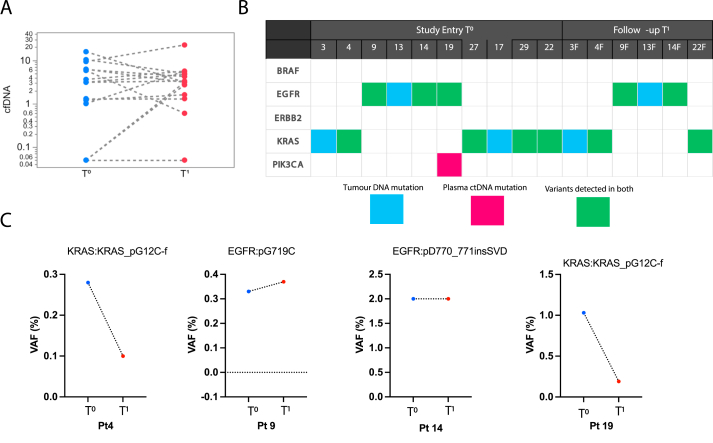
CTC and cfDNA/ctDNA from advanced stage NSCLC patients were measured at study entry (T) and 3-months post-treatment (T). CTCs were enriched using a spiral microfluidic chip and characterised by immunofluorescence. ctDNA was assessed using an UltraSEEK® Lung Panel. Kaplan-Meier plots were generated to investigate the contribution of the presence of CTC/CTC clusters and cfDNA for PFS. Cox proportional hazards analysis compared time to progression versus CTC/CTC cluster counts and cfDNA levels.
Single CTCs were found in 14 out of 25 patients, while CTC clusters were found in 8 out of the 25 patients at T. At T, CTCs were found in 7 out of 18 patients, and CTC clusters in 1 out of the 18 patients. At T, CTC presence and the combination of CTC cluster counts with cfDNA levels were associated with shorter PFS, p = 0.0261, p = 0.0022, respectively.
Combining CTC cluster counts and cfDNA levels could improve PFS assessment in NSCLC patients. Our results encourage further investigation on the combined effect of CTC/cfDNA as a prognostic biomarker in a large cohort of advanced stage NSCLC patients.
非小细胞肺癌(NSCLC)常处于无法治愈的阶段,大多数患者在疾病的某个阶段会被考虑进行姑息治疗。尽管最近取得了进展,但其预后仍然很差,中位总生存期为12 - 18个月。基于液体活检的生物标志物已成为预测NSCLC患者预后和治疗反应的潜在候选指标。这项前瞻性研究评估了循环肿瘤细胞和簇(CTC)与游离DNA(cfDNA)相结合是否能预测NSCLC患者的无进展生存期(PFS)。
在研究入组时(T)和治疗后3个月(T)测量晚期NSCLC患者的CTC和cfDNA/ctDNA。使用螺旋微流控芯片富集CTC,并通过免疫荧光进行表征。使用UltraSEEK®肺癌检测板评估ctDNA。生成Kaplan-Meier曲线以研究CTC/CTC簇和cfDNA的存在对PFS的影响。Cox比例风险分析比较进展时间与CTC/CTC簇计数和cfDNA水平。
25例患者中有14例在T时发现单个CTC,25例患者中有8例发现CTC簇。在T时,18例患者中有7例发现CTC,18例患者中有1例发现CTC簇。在T时,CTC的存在以及CTC簇计数与cfDNA水平的组合与较短的PFS相关,p分别为0.0261和0.0022。
结合CTC簇计数和cfDNA水平可改善NSCLC患者的PFS评估。我们的结果鼓励在一大群晚期NSCLC患者中进一步研究CTC/cfDNA作为预后生物标志物的联合作用。