He Xuanhong, Wang Yitian, Ye Qiang, Wang Yang, Min Li, Luo Yi, Zhou Yong, Tu Chongqi
Department of Orthopedics, Orthopedic Research Institute, West China Hospital, Sichuan University, Chengdu, China.
Front Surg. 2022 Jul 8;9:923427. doi: 10.3389/fsurg.2022.923427. eCollection 2022.
The lung immune prognostic index (LIPI), composed of serum lactate dehydrogenase (LDH) and the derived neutrophil to lymphocyte ratio (dNLR), is a novel prognostic factor of lung cancer. The prognostic effect of the LIPI has never been verified in osteosarcoma.
We retrospectively reviewed the osteosarcoma patients with metachronous metastasis from January 2016 to January 2021 in West China Hospital. We collected and analyzed the clinical data and constructed the LIPI for osteosarcoma. The correlation between the LIPI and metastasis was analyzed according to the Kaplan-Meier method and Cox regression analysis with hazard ratios (HRs) and 95% confidence intervals (CIs). Univariate analysis and multivariate analysis were conducted to clarify the independent risk factors of metastasis. The nomogram model was established by R software, version 4.1.0.
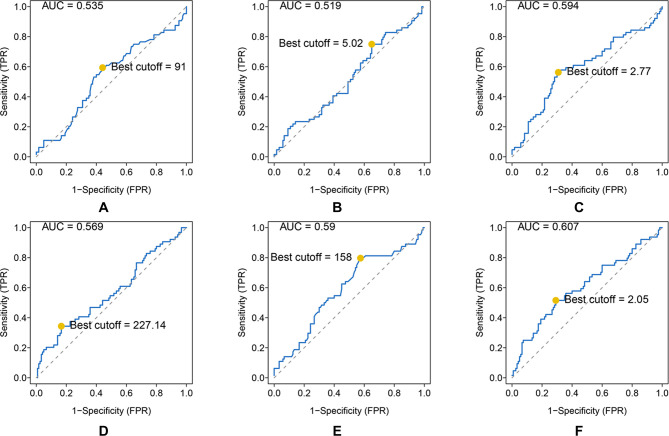
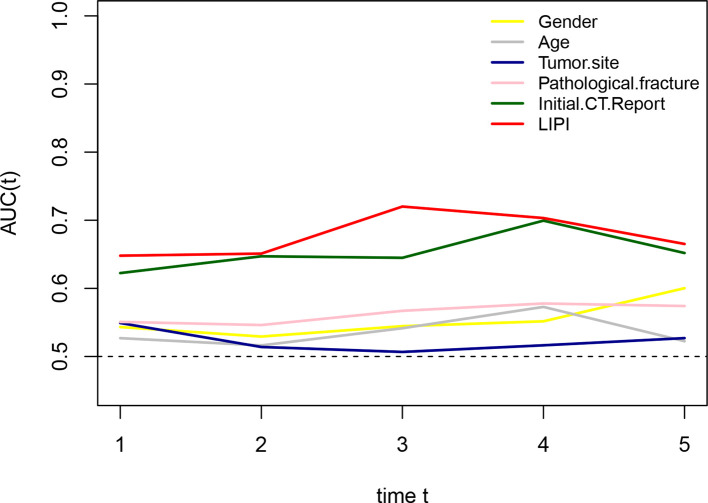
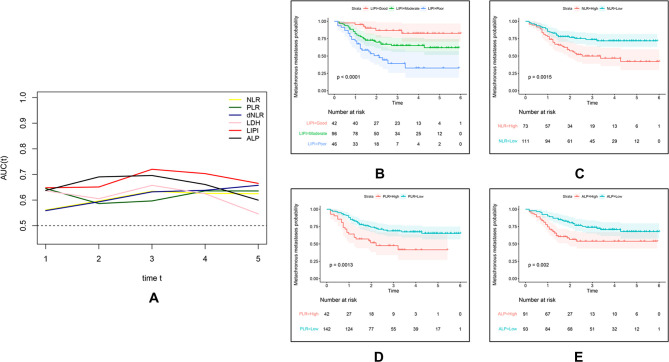
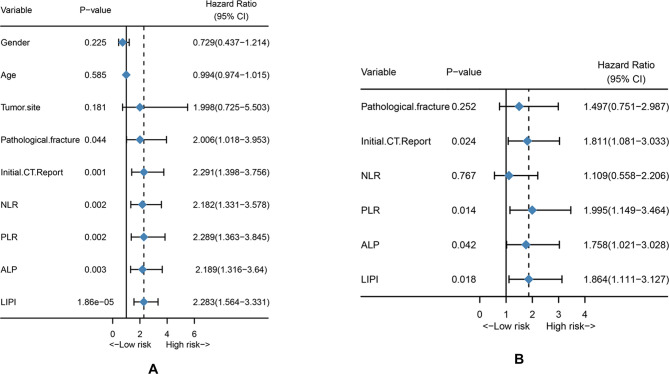
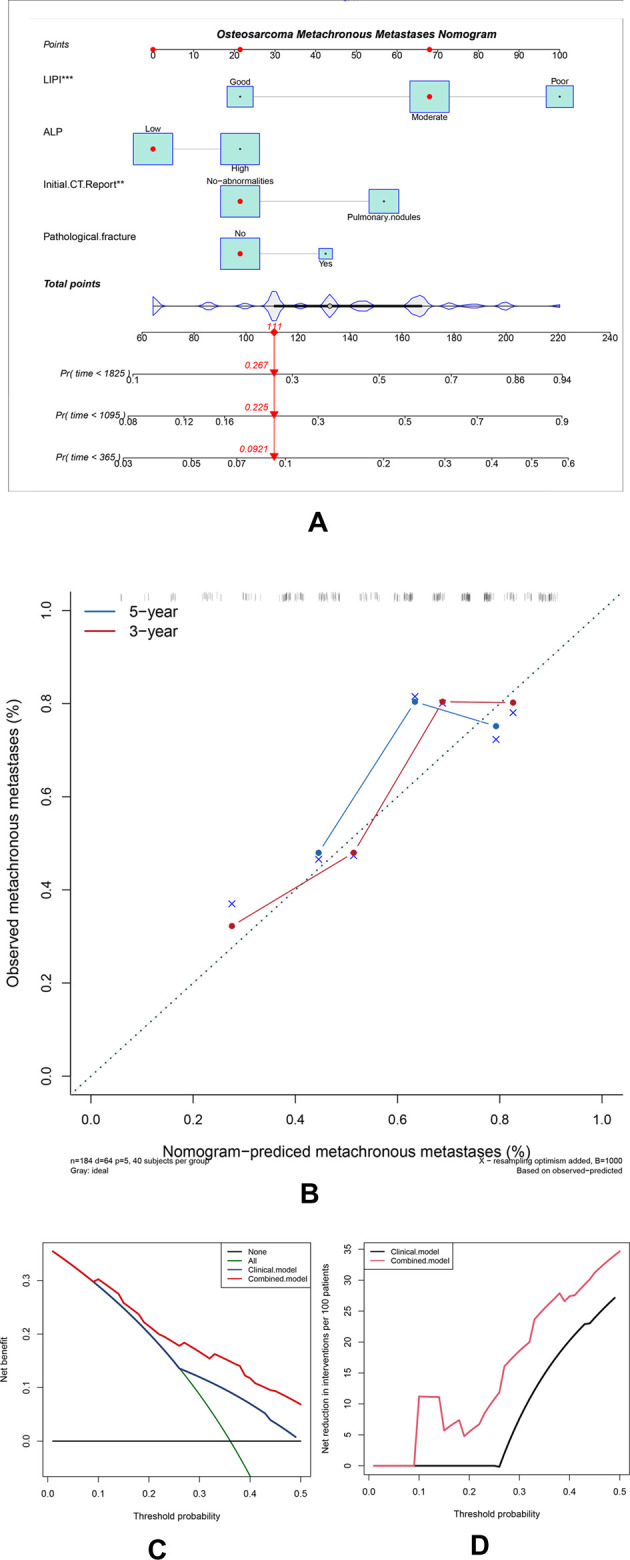
The area under the curve (AUC) and best cutoff value were 0.535 and 91, 0.519, and 5.02, 0.594 and 2.77, 0.569 and 227.14, 0.59 and 158, and 0.607 and 2.05 for ALP, LMR, NLR, PLR, LDH, and dNLR, respectively. The LIPI was composed of LDH and dNLR and showed a larger AUC than other hematological factors in the time-dependent operator curve (t-ROC). In total, 184 patients, 42 (22.8%), 96 (52.2%), and 46 (25.0%) patients had LIPIs of good, moderate, and poor, respectively ( < 0.0001). Univariate analysis revealed that pathological fracture, the initial CT report of suspicious nodule, and the NLR, PLR, ALP, and the LIPI were significantly associated with metastasis, and multivariate analysis showed that the initial CT report of suspicious nodule and the PLR, ALP, and LIPI were dependent risk factors for metastasis. Metastatic predictive factors were selected and incorporated into the nomogram construction, including the LIPI, ALP, PLR, initial CT report, and pathological fracture. The C-index of our model was 0.71. According to the calibration plot, this predictive nomogram could accurately predict 3- and 5-year metachronous metastasis. Based on the result of decision curve and clinical impact curve, this predictive nomogram could also help patients obtain significant net benefits.
We first demonstrated the metastatic predictive effect of the LIPI on osteosarcoma. This LIPI-based model is useful for clinicians to predict metastasis in osteosarcoma patients and could help conduct timely intervention and facilitate personalized management of osteosarcoma patients.
肺免疫预后指数(LIPI)由血清乳酸脱氢酶(LDH)和衍生的中性粒细胞与淋巴细胞比值(dNLR)组成,是肺癌的一种新型预后因素。LIPI在骨肉瘤中的预后作用尚未得到验证。
我们回顾性分析了2016年1月至2021年1月在华西医院发生异时性转移的骨肉瘤患者。我们收集并分析了临床数据,并构建了骨肉瘤的LIPI。根据Kaplan-Meier法和Cox回归分析,分析LIPI与转移之间的相关性,并计算风险比(HRs)和95%置信区间(CIs)。进行单因素分析和多因素分析以阐明转移的独立危险因素。使用R软件4.1.0版建立列线图模型。
碱性磷酸酶(ALP)、淋巴细胞与单核细胞比值(LMR)、中性粒细胞与淋巴细胞比值(NLR)、血小板与淋巴细胞比值(PLR)、LDH和dNLR的曲线下面积(AUC)及最佳截断值分别为0.535和91、0.519和5.02、0.594和2.77、0.569和227.14、0.59和158、0.607和2.05。LIPI由LDH和dNLR组成,在时间依赖性操作曲线(t-ROC)中显示出比其他血液学因素更大的AUC。总共184例患者中,LIPI良好、中等和较差的患者分别有42例(22.8%)、96例(52.2%)和46例(25.0%)(<0.0001)。单因素分析显示,病理性骨折、可疑结节的初始CT报告以及NLR、PLR、ALP和LIPI与转移显著相关,多因素分析表明,可疑结节的初始CT报告以及PLR、ALP和LIPI是转移的独立危险因素。选择转移预测因素并纳入列线图构建,包括LIPI、ALP、PLR、初始CT报告和病理性骨折。我们模型的C指数为0.71。根据校准图,该预测列线图可以准确预测3年和5年异时性转移。根据决策曲线和临床影响曲线的结果,该预测列线图还可以帮助患者获得显著的净效益。
我们首次证明了LIPI对骨肉瘤的转移预测作用。这种基于LIPI的模型有助于临床医生预测骨肉瘤患者的转移情况,并有助于及时进行干预,促进骨肉瘤患者的个性化管理。