Centre of Excellence for Health, Immunity, and Infections, Rigshospitalet, Copenhagen University Hospital, Copenhagen, Denmark.
Center for Genomic Medicine, Rigshospitalet, Copenhagen University Hospital, Copenhagen, Denmark.
Front Immunol. 2022 Jun 30;13:906328. doi: 10.3389/fimmu.2022.906328. eCollection 2022.
Knowledge of the genetic variation underlying Primary Immune Deficiency (PID) is increasing. Reanalysis of genome-wide sequencing data from undiagnosed patients with suspected PID may improve the diagnostic rate.
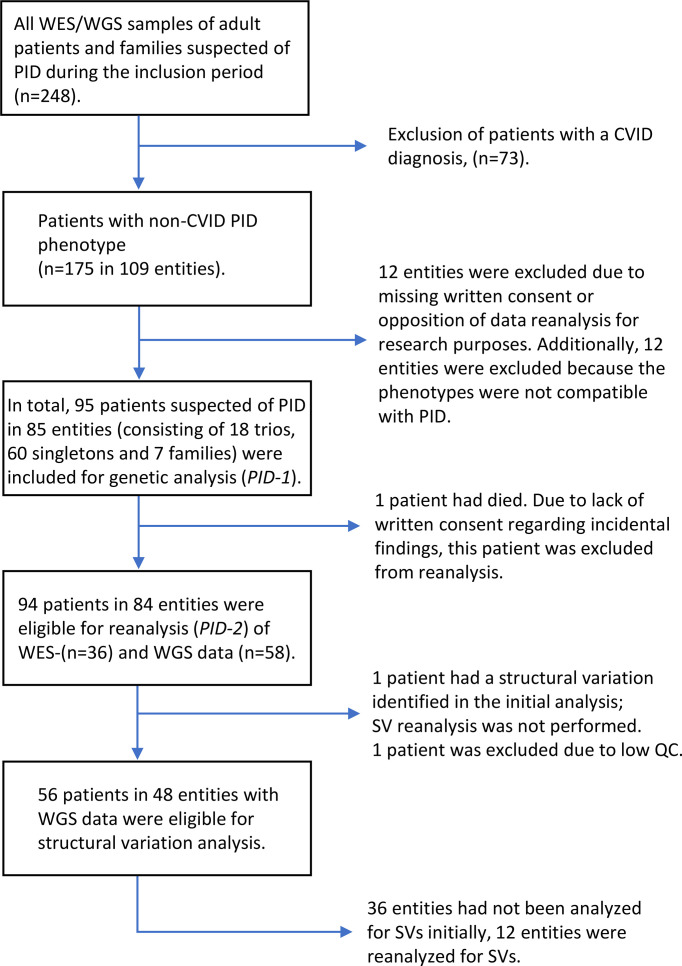
We included patients monitored at the Department of Infectious Diseases or the Child and Adolescent Department, Rigshospitalet, Denmark, for a suspected PID, who had been analysed previously using a targeted PID gene panel (457 PID-related genes) on whole exome- (WES) or whole genome sequencing (WGS) data. A literature review was performed to extend the PID gene panel used for reanalysis of single nucleotide variation (SNV) and small indels. Structural variant (SV) calling was added on WGS data.
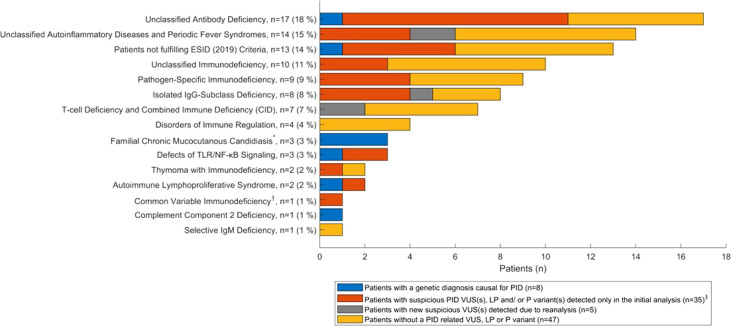
Genetic data from 94 patients (86 adults) including 36 WES and 58 WGS was reanalysed a median of 23 months after the initial analysis. The extended gene panel included 208 additional PID-related genes. Genetic reanalysis led to a small increase in the proportion of patients with new suspicious PID related variants of uncertain significance (VUS). The proportion of patients with a causal genetic diagnosis was constant. In total, five patients (5%, including three WES and two WGS) had a new suspicious PID VUS identified due to reanalysis. Among these, two patients had a variant added due to the expansion of the PID gene panel, and three patients had a variant reclassified to a VUS in a gene included in the initial PID gene panel. The total proportion of patients with PID related VUS, likely pathogenic, and pathogenic variants increased from 43 (46%) to 47 (50%), as one patient had a VUS detected in both initial- and reanalysis. In addition, we detected new suspicious SNVs and SVs of uncertain significance in PID candidate genes with unknown inheritance and/or as heterozygous variants in genes with autosomal recessive inheritance in 8 patients.
These data indicate a possible diagnostic gain of reassessing WES/WGS data from patients with suspected PID. Reasons for the possible gain included improved knowledge of genotype-phenotype correlation, expanding the gene panel, and adding SV analyses. Future studies of genotype-phenotype correlations may provide additional knowledge on the impact of the new suspicious VUSs.
原发性免疫缺陷病(PID)的遗传变异知识正在增加。重新分析疑似 PID 患者的全基因组测序数据可以提高诊断率。
我们纳入了在丹麦哥本哈根的里格医院传染病科或儿科监测的疑似 PID 患者,这些患者之前曾使用靶向 PID 基因panel(457 个 PID 相关基因)进行过全外显子组(WES)或全基因组测序(WGS)数据分析。我们进行了文献复习,以扩展用于重新分析单核苷酸变异(SNV)和小插入缺失的 PID 基因 panel。WGS 数据添加了结构变异(SV)调用。
对 94 名患者(86 名成人)的遗传数据进行了中位时间为 23 个月的重新分析,其中包括 36 名 WES 和 58 名 WGS。扩展的基因 panel 包含 208 个额外的 PID 相关基因。遗传重新分析导致具有新的疑似 PID 相关意义不明的变异(VUS)的患者比例略有增加。具有因果遗传诊断的患者比例保持不变。总共,由于重新分析,有 5 名患者(5%,包括 3 名 WES 和 2 名 WGS)发现了新的疑似 PID VUS。其中,2 名患者因 PID 基因 panel 的扩展而增加了变异,3 名患者因初始 PID 基因 panel 中的基因的变异重新分类为 VUS 而增加了变异。由于初始分析和重新分析都检测到 VUS 的患者,具有 PID 相关 VUS、可能致病性和致病性变异的患者比例从 43(46%)增加到 47(50%)。此外,我们在 8 名患者的 PID 候选基因中发现了新的疑似 SNV 和 SV,这些变异的遗传方式未知或为常染色体隐性遗传基因的杂合变异。
这些数据表明,重新评估疑似 PID 患者的 WES/WGS 数据可能具有诊断收益。可能的收益原因包括对基因型-表型相关性的了解提高、基因 panel 的扩展以及 SV 分析的增加。对基因型-表型相关性的进一步研究可能会提供有关新的疑似 VUS 影响的更多知识。