Department of Immunology, Laboratory Medical Immunology, Erasmus MC, University Medical Center, Rotterdam, Netherlands.
Pediatric Allergy & Clinical Immunology Research Unit, Division of Allergy and Immunology, Department of Pediatrics, Faculty of Medicine, Chulalongkorn University, King Chulalongkorn Memorial Hospital, The Thai Red Cross Society, Bangkok, Thailand.
Front Immunol. 2020 Apr 15;11:614. doi: 10.3389/fimmu.2020.00614. eCollection 2020.
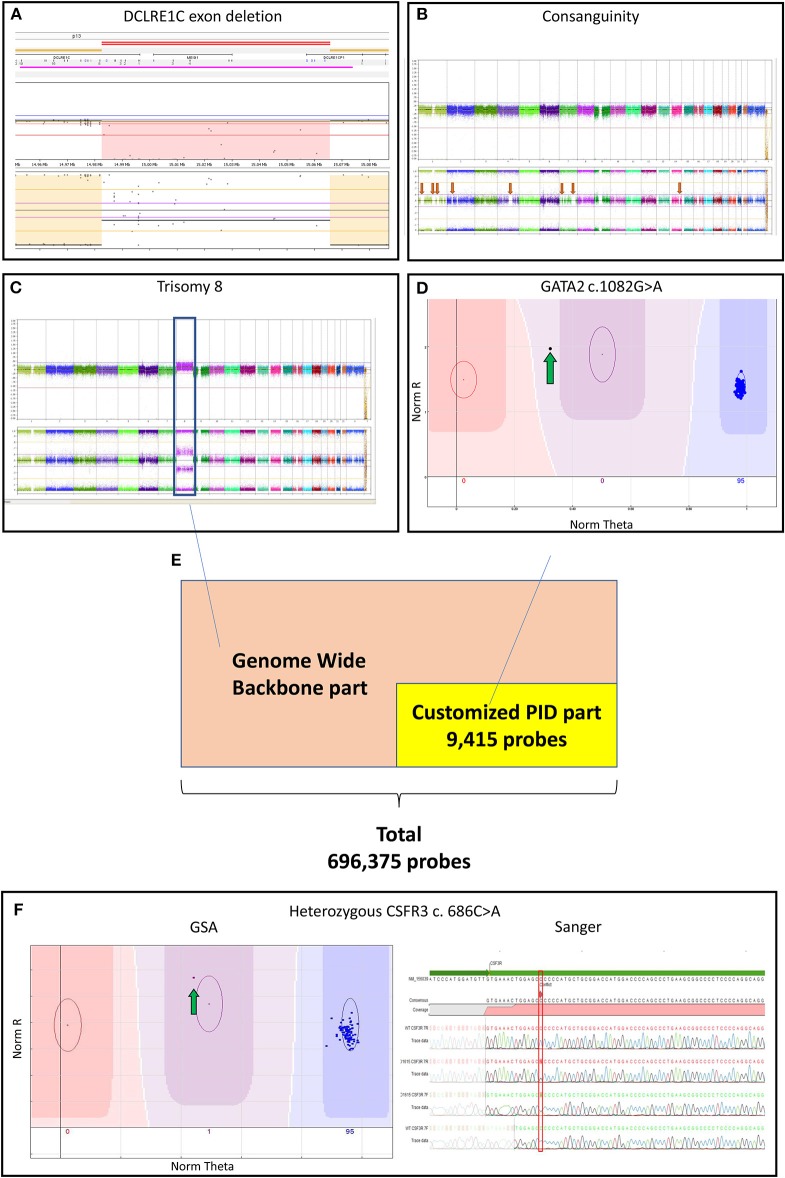
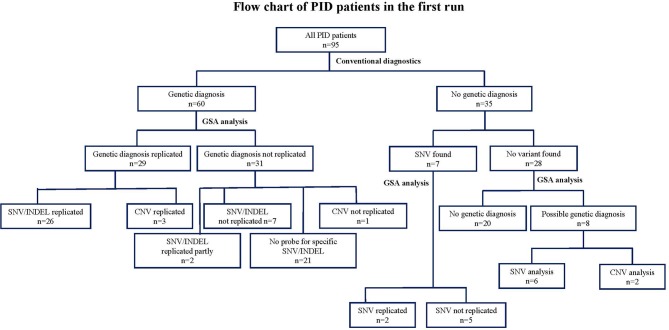
Genetic tests for primary immunodeficiency disorders (PIDs) are expensive, time-consuming, and not easily accessible in developing countries. Therefore, we studied the feasibility of a customized single nucleotide variant (SNV) microarray that we developed to detect disease-causing variants and copy number variation (CNV) in patients with PIDs for only 40 Euros. Probes were custom-designed to genotype 9,415 variants of 277 PID-related genes, and were added to the genome-wide Illumina Global Screening Array (GSA). Data analysis of GSA was performed using Illumina GenomeStudio 2.0, Biodiscovery Nexus 10.0, and R-3.4.4 software. Validation of genotype calling was performed by comparing the GSA with whole-genome sequencing (WGS) data of 56 non-PID controls. DNA samples of 95 clinically diagnosed PID patients, of which 60 patients (63%) had a genetically established diagnosis (by Next-Generation Sequencing (NGS) PID panels or Sanger sequencing), were analyzed to test the performance of the GSA. The additional SNVs detected by GSA were validated by Sanger sequencing. Genotype calling of the customized array had an accuracy rate of 99.7%. The sensitivity for detecting rare PID variants was high (87%). The single sample replication in two runs was high (94.9%). The customized GSA was able to generate a genetic diagnosis in 37 out of 95 patients (39%). These 37 patients included 29 patients in whom the genetic variants were confirmed by conventional methods (26 patients by SNV and 3 by CNV analysis), while in 8 patients a new genetic diagnosis was established (6 patients by SNV and 2 patients suspected for leukemia by CNV analysis). Twenty-eight patients could not be detected due to the limited coverage of the custom probes. However, the diagnostic yield can potentially be increased when newly updated variants are added. Our robust customized GSA seems to be a promising first-line rapid screening tool for PIDs at an affordable price, which opens opportunities for low-cost genetic testing in developing countries. The technique is scalable, allows numerous new genetic variants to be added, and offers the potential for genetic testing not only in PIDs, but also in many other genetic diseases.
原发性免疫缺陷病(PID)的基因检测既昂贵又耗时,在发展中国家也不容易获得。因此,我们研究了一种定制的单核苷酸变异(SNV)微阵列的可行性,该微阵列的开发旨在仅花费 40 欧元检测 PID 患者的致病变异和拷贝数变异(CNV)。 探针是为基因分型 277 个 PID 相关基因中的 9415 个变体而定制设计的,并添加到全基因组 Illumina 全球筛选阵列(GSA)中。使用 Illumina GenomeStudio 2.0、Biodiscovery Nexus 10.0 和 R-3.4.4 软件对 GSA 数据进行分析。通过将 GSA 与 56 名非 PID 对照的全基因组测序(WGS)数据进行比较,对基因型调用的验证进行了评估。对 95 名临床诊断为 PID 的患者的 DNA 样本进行了分析,其中 60 名患者(63%)通过下一代测序(NGS)PID 面板或 Sanger 测序进行了基因诊断。该研究检测了 GSA 的性能。通过 Sanger 测序验证了 GSA 检测到的额外 SNV。定制阵列的基因型调用准确率为 99.7%。检测罕见 PID 变异的灵敏度较高(87%)。两次运行的单个样本重复率较高(94.9%)。定制 GSA 能够在 95 名患者中的 37 名(39%)患者中生成遗传诊断。这 37 名患者包括 29 名通过传统方法(26 名通过 SNV,3 名通过 CNV 分析)确认遗传变异的患者,而 8 名患者建立了新的遗传诊断(6 名通过 SNV,2 名疑似 CNV 分析的白血病患者)。由于定制探针的覆盖范围有限,28 名患者无法被检测到。然而,当添加新的更新变体时,诊断率可能会提高。 我们稳健的定制 GSA 似乎是一种有前途的一线快速筛查工具,价格实惠,为发展中国家提供了低成本的基因检测机会。该技术具有可扩展性,允许添加许多新的遗传变异,并且不仅可以在 PID 中,而且可以在许多其他遗传疾病中进行基因检测。