Li Jinfei, Chen Shuangyi, Liao Yuxuan, Wang Hongyi, Zhou Dawei, Zhang Bo
Department of Stomatology, Third Xiangya Hospital of Central South University, Changsha, China.
Xiangya School of Medicine, Central South University, Changsha, China.
Front Oncol. 2022 Jul 7;12:925743. doi: 10.3389/fonc.2022.925743. eCollection 2022.
Metastatic disease remains the primary cause of death in patients with oral squamous cell carcinoma (OSCC), especially those who use betel nut. The different steps of the metastatic cascade rely on reciprocal interactions between cancer cells and the tumor microenvironment (TME). Cancer-associated fibroblasts (CAFs) are regarded as a significant component in the TME of OSCC. However, the precise mechanisms regulating CAFs in OSCC are poorly understood.
Thirteen genes related to the arecoline were analyzed to explore the significant ones involved in arecoline-related OSCC metastasis. The GSE139869 (n = 10) and The Cancer Genome Atlas (TCGA)-OSCC data (n = 361) were mined for the identification of the differentially expressed genes. The least absolute shrinkage and selection operator (LASSO) regression was performed to identify the independent prognostic signatures. Gene Ontology (GO) and Kyoto Encyclopedia of Genes and Genomes (KEGG) analyses were conducted to explore the functional enrichment of selected genes, and gene set enrichment analysis of cuproptosis-related genes was completed. Spearman's analysis and Tumor Immune Estimation Resource (TIMER) were used to visualize the correlation between the infiltration of CAFs and the gene expression. The correlation analysis of the cells and different genes, including CAF infiltration and transcripts per million expression, was assessed. The relationship between arecoline and CAFs was confirmed by cell counting kit-8 assay (CCK-8). CancerSEA was searched to identify the single-cell phenotype.
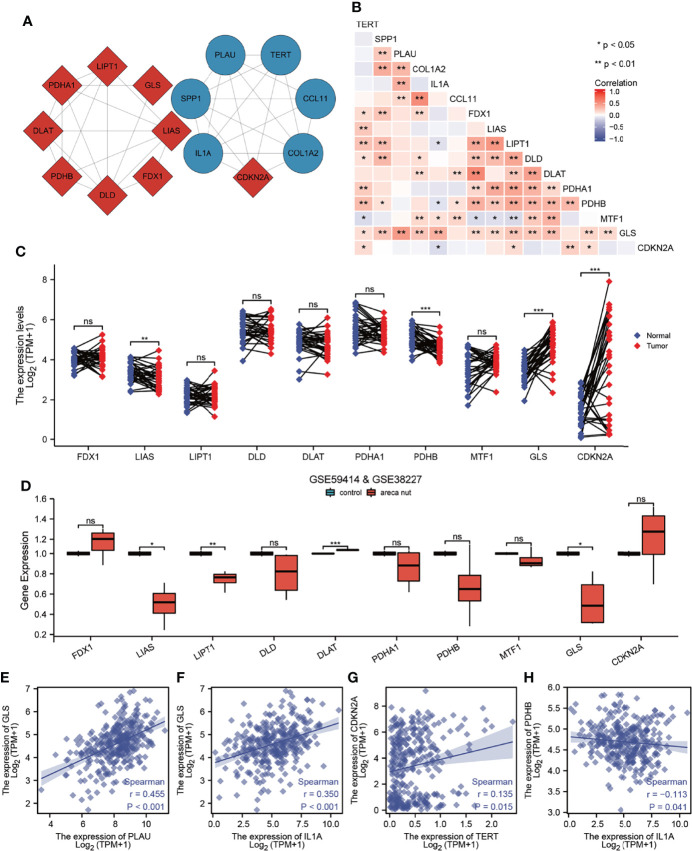
Arecoline-associated fibrosis-related OSCC differentially expressed genes (AFOC-DEGs), namely, PLAU, IL1A, SPP1, CCL11, TERT, and COL1A2, were screened out and selected from the Gene Expression Omnibus (GEO) database and TCGA database. AFOC-DEGs were highly expressed in OSCC, which led to poor survival of patients. Functional enrichment analysis, protein-protein interaction network construction, and Spearman's correlation analysis all suggested that AFOC-DEGs were closely associated with cuproptosis. Cellular experiments demonstrated that arecoline stimulation could significantly increase the cell viability of CAFs. Single-sample Gene Set Enrichment Analysis (ssGSEA) results showed that GLS and MTF1 were highly expressed when fibroblasts proliferated at high enrichment levels. In addition, analysis of single-cell sequencing results suggested that OSCC cells with high expression of AFOC-DEGs were associated with OSCC metastasis.
We found a close association between arecoline, cuproptosis, and CAFs, which might play an important role in the metastasis of OSCC.
转移性疾病仍然是口腔鳞状细胞癌(OSCC)患者的主要死亡原因,尤其是那些嚼槟榔的患者。转移级联反应的不同步骤依赖于癌细胞与肿瘤微环境(TME)之间的相互作用。癌症相关成纤维细胞(CAFs)被认为是OSCC肿瘤微环境的重要组成部分。然而,OSCC中调节CAFs的精确机制尚不清楚。
分析13个与槟榔碱相关的基因,以探索参与槟榔碱相关OSCC转移的重要基因。挖掘GSE139869(n = 10)和癌症基因组图谱(TCGA)-OSCC数据(n = 361)以鉴定差异表达基因。进行最小绝对收缩和选择算子(LASSO)回归以识别独立的预后特征。进行基因本体(GO)和京都基因与基因组百科全书(KEGG)分析以探索所选基因的功能富集,并完成铜死亡相关基因的基因集富集分析。使用Spearman分析和肿瘤免疫估计资源(TIMER)来可视化CAFs浸润与基因表达之间的相关性。评估细胞与不同基因之间的相关性分析,包括CAF浸润和每百万转录本表达。通过细胞计数试剂盒-8检测(CCK-8)确认槟榔碱与CAFs之间的关系。搜索CancerSEA以识别单细胞表型。
从基因表达综合数据库(GEO)和TCGA数据库中筛选并选择了槟榔碱相关纤维化相关OSCC差异表达基因(AFOC-DEGs),即PLAU、IL1A、SPP1、CCL11、TERT和COL1A2。AFOC-DEGs在OSCC中高表达,这导致患者生存率较低。功能富集分析、蛋白质-蛋白质相互作用网络构建和Spearman相关性分析均表明AFOC-DEGs与铜死亡密切相关。细胞实验表明,槟榔碱刺激可显著提高CAFs的细胞活力。单样本基因集富集分析(ssGSEA)结果表明,当成纤维细胞在高富集水平增殖时,GLS和MTF1高表达。此外,单细胞测序结果分析表明,AFOC-DEGs高表达的OSCC细胞与OSCC转移相关。
我们发现槟榔碱、铜死亡和CAFs之间存在密切关联,这可能在OSCC转移中起重要作用。