Ali Abdulmalik Mariam, Al-Kuwari Mohamed Ghaith, Haj Bakri Ahmad, Ahmad Al Abdulla Samya, Chettiyam Kandy Mujeeb, Yousef Abdulla Maha, Michael Gibb John
Primary Health Care Corporation, Doha, Qatar E-mail:
Qatar Med J. 2022 Jul 11;2022(3):23. doi: 10.5339/qmj.2022.23. eCollection 2022.
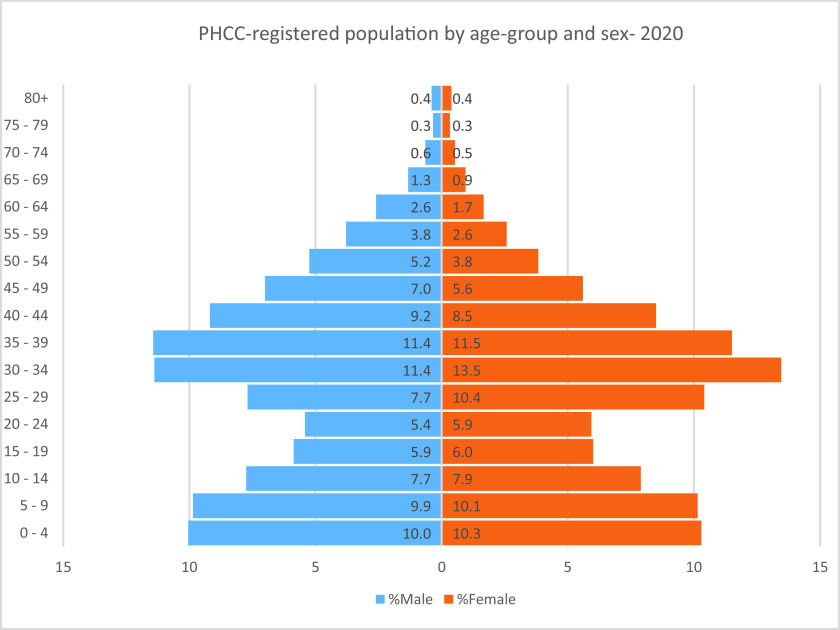
In March 2020, Qatar started reporting increased numbers of severe acute respiratory syndrome coronavirus 2 (SARS-CoV-2), causing coronavirus disease 2019 (COVID-19). National preventive measures were implemented, and a testing plan was developed to respond to the pandemic with the Primary Health Care Corporation (PHCC) as the central element. PHCC is the main public primary healthcare provider in Qatar and it operates in 27 health centers with around 1.4 million registered individuals as of January 1, 2020. The latter population was distributed across four main nationality groups; Middle Eastern and North African (51.5%), Asian (41.2%), African (2.4%), and others (5.1%). At the primary healthcare level in Qatar, this study describes the epidemiological characteristics of individuals registered at PHCC who had contracted COVID-19 in 2020 during the first wave before the vaccination phase and examines the factors associated with the positivity rate.
Retrospective data analysis was conducted for persons screened for SARS-CoV-2 in primary healthcare health centers in Qatar between March 11 and December 31, 2020. The study analyzed the demographic characteristics of the tested persons and noncommunicable disease burden, positivity rate by month, nationality, and age-group, and the factors associated with the positivity rate.
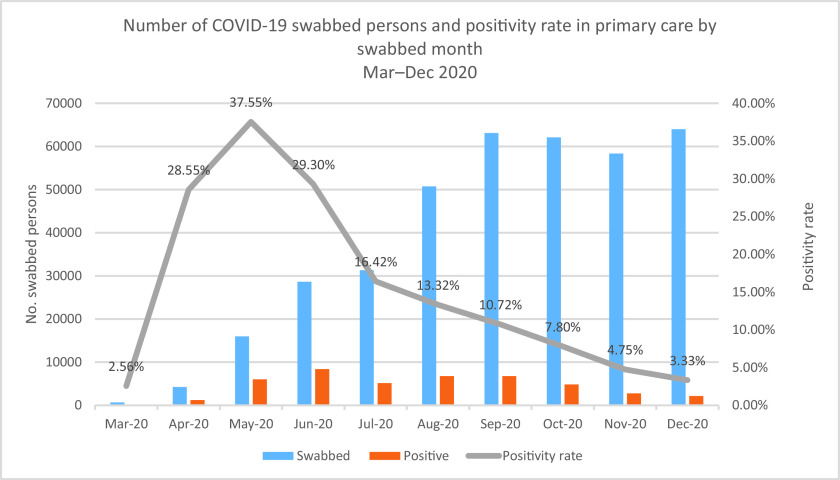
Between March 11 and December 31, 2020, PHCC tested 379,247 persons for SARS-CoV-2, with a median age (IQR) of 32 (21-42) years. Of these, 57.0% were from the Middle East and North Africa, and 32.5% were originally from Asia. Overall, 10.9% had diabetes mellitus and 11.3% had hypertension. The epidemiological curve showed a steep increase in the positivity rate from March till May 2020, at the highest rate of 37.5% in May 2020. The highest positivity rate was observed among Asian males at 15.7%. The positivity rate was the lowest among the age-group aged 60 years and above. It was almost the same among the tested persons for SARS-CoV-2 in the three main age groups (0-18, 19-39, 40-59) at 10.1%, 12.3%, and 12.2%, respectively. In a multi regression model, being a male was associated with a higher risk (OR 1.15; 95% CI 1.13-1.17). Asians were at higher risk than those originally from the Middle East and North Africa (OR 1.29; 95% CI 1.27-1.32). COVID-19 infection was higher among those presenting clinical symptoms than asymptomatic individuals (OR. 4.52; 95% CI 4.42-4.64).
The epidemic among the PHCC-registered population predominantly affected younger ages and males, namely, coming from Asia. At the primary healthcare level, the COVID-19 infection rate was higher among those who presented with clinical symptoms. The lowest positivity rate among individuals >60 years may reflect the effectiveness of public health measures related to the high-risk group. Scaled-up testing at the primary healthcare level helped to detect more cases during the peak of the first wave and was reflected in a steady increase in the positivity rate flattened later due to the established public health measures.
2020年3月,卡塔尔开始报告严重急性呼吸综合征冠状病毒2(SARS-CoV-2)感染病例数增加,该病毒引发了2019冠状病毒病(COVID-19)。卡塔尔实施了国家预防措施,并制定了一项检测计划,以应对这场大流行,其中初级卫生保健公司(PHCC)是核心要素。PHCC是卡塔尔主要的公共初级卫生保健服务提供者,截至2020年1月1日,它在27个健康中心开展业务,登记在册的个人约有140万。这些人群分布在四个主要国籍群体中;中东和北非(51.5%)、亚洲(41.2%)、非洲(2.4%)和其他(5.1%)。在卡塔尔的初级卫生保健层面,本研究描述了在疫苗接种阶段之前的第一波疫情期间,2020年在PHCC登记感染COVID-19的个人的流行病学特征,并研究了与阳性率相关的因素。
对2020年3月11日至12月31日期间在卡塔尔初级卫生保健健康中心接受SARS-CoV-2检测的人员进行回顾性数据分析。该研究分析了受测人员的人口统计学特征和非传染性疾病负担、按月、国籍和年龄组划分的阳性率,以及与阳性率相关的因素。
在2020年3月11日至12月31日期间,PHCC对379247人进行了SARS-CoV-2检测,年龄中位数(IQR)为32(21 - 42)岁。其中,57.0%来自中东和北非,32.5%原籍亚洲。总体而言,10.9%的人患有糖尿病,11.3%的人患有高血压。流行病学曲线显示,从2020年3月到5月阳性率急剧上升,2020年5月达到最高,为37.5%。亚洲男性的阳性率最高,为15.7%。60岁及以上年龄组的阳性率最低。在三个主要年龄组(0 - 18岁、19 - 39岁、40 - 59岁)接受SARS-CoV-2检测的人员中,阳性率几乎相同,分别为10.1%、12.3%和12.2%。在多元回归模型中,男性与较高风险相关(OR 1.15;95% CI 1.13 - 1.17)。亚洲人比中东和北非原籍的人风险更高(OR 1.29;95% CI 1.27 - 1.32)。出现临床症状的人感染COVID-19的比例高于无症状个体(OR 4.52;95% CI 4.42 - 4.64)。
在PHCC登记的人群中的疫情主要影响年轻人和男性,即来自亚洲的人群。在初级卫生保健层面,出现临床症状的人感染COVID-19的比例更高。60岁以上个体中最低的阳性率可能反映了针对高危群体的公共卫生措施的有效性。在初级卫生保健层面扩大检测有助于在第一波疫情高峰期间发现更多病例,并且由于已制定的公共卫生措施,阳性率随后稳步上升并趋于平稳。