Fu Guangtao, Zhong Guoqing, Yang Zehong, Cheng Shi, Ma Limin, Zhang Yu
Department of Orthopedics, Guangdong Provincial People's Hospital, Guangdong Academy of Medical Sciences, Guangzhou, China.
Shantou University Medical Colleges, Shantou, China.
Front Bioeng Biotechnol. 2022 Jul 7;10:891338. doi: 10.3389/fbioe.2022.891338. eCollection 2022.
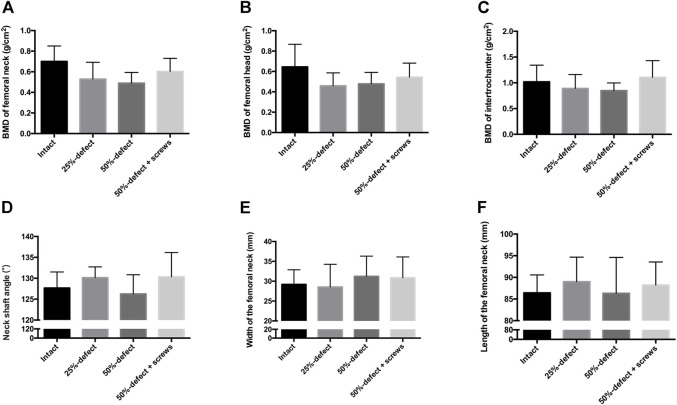
Two cannulated screws were proposed for prophylactic fixation in adult patients with an aggressive benign femoral neck lesion in recent literature. However, the biomechanical properties of this intervention have not yet been investigated. After the evaluation of the heterogeneity of bone mineral density and geometry quantitative computed tomography, 24 embalmed adult human cadaver femurs were randomized into the control, inferior half of the anterior cortical (25%) bone defect, entire anterior cortical (50%) bone defect, and the 50% bone defect and two cannulated screw group. Biomechanical analysis was conducted to compare the stiffness and failure load among the four groups when mimicking a one-legged stance. A CT-based finite element analysis (FEA) was performed to mimic the cortical and cancellous bone defect and the implantation of two cannulated screws of the four groups. Measurements of the maximal displacement and von Mises stress were conducted with the longitudinal load force and boundary conditions being established for a one-leg-standing status. We noted a significant improvement in the failure load after the insertion of two 6.5 mm cannulated screws in femurs with 50% bone defect (+95%, = 0.048), and no significant difference was found between the screw group and the intact femur. Similar trends were also found in the measurements of stiffness (+23%, > 0.05) biomechanical testing and the von Mises stresses (-71%, = 0.043) by FEA when comparing the screw group and the 50% bone defect group. Our findings suggest that two cannulated screws provided sufficient biomechanical strength for prophylactic fixation in adult patients with an aggressive benign femoral neck lesion even when the entire anterior cortical bone is involved.
近期文献提出使用两枚空心螺钉对患有侵袭性良性股骨颈病变的成年患者进行预防性固定。然而,这种干预措施的生物力学特性尚未得到研究。在通过定量计算机断层扫描评估骨矿物质密度和几何形状的异质性后,将24具防腐处理的成年人体股骨随机分为对照组、前皮质下半部(25%)骨缺损组、整个前皮质(50%)骨缺损组以及50%骨缺损加两枚空心螺钉组。进行生物力学分析以比较四组在模拟单腿站立时的刚度和破坏载荷。进行基于CT的有限元分析(FEA)以模拟四组的皮质和松质骨缺损以及两枚空心螺钉的植入。在建立单腿站立状态的纵向载荷力和边界条件下,测量最大位移和冯·米塞斯应力。我们注意到,在50%骨缺损的股骨中插入两枚6.5毫米空心螺钉后,破坏载荷有显著改善(+95%, = 0.048),并且螺钉组与完整股骨之间未发现显著差异。在比较螺钉组和50%骨缺损组时,在生物力学测试的刚度测量(+23%, > 0.05)和FEA的冯·米塞斯应力测量(-71%, = 0.043)中也发现了类似趋势。我们的研究结果表明,即使整个前皮质骨受累,两枚空心螺钉也能为患有侵袭性良性股骨颈病变的成年患者提供足够的生物力学强度用于预防性固定。