Funaro Alessia, Shim Vickie, Crouzier Marion, Mylle Ine, Vanwanseele Benedicte
Human Movement Biomechanics Research Group, KU Leuven, Leuven, Belgium.
Auckland Bioengineering Institute, University of Auckland, Auckland, New Zealand.
Front Bioeng Biotechnol. 2022 Jul 6;10:914137. doi: 10.3389/fbioe.2022.914137. eCollection 2022.
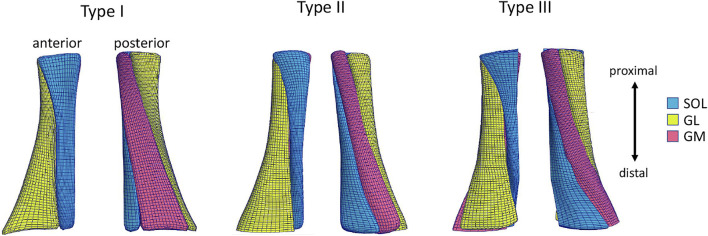
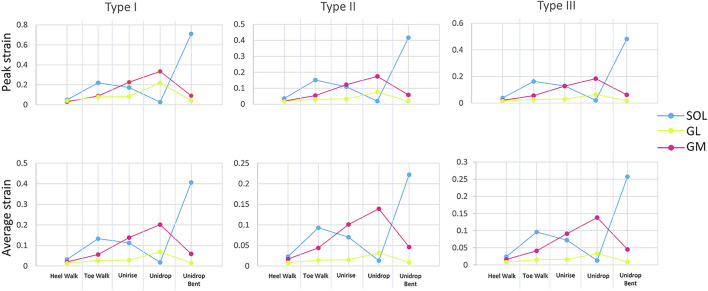
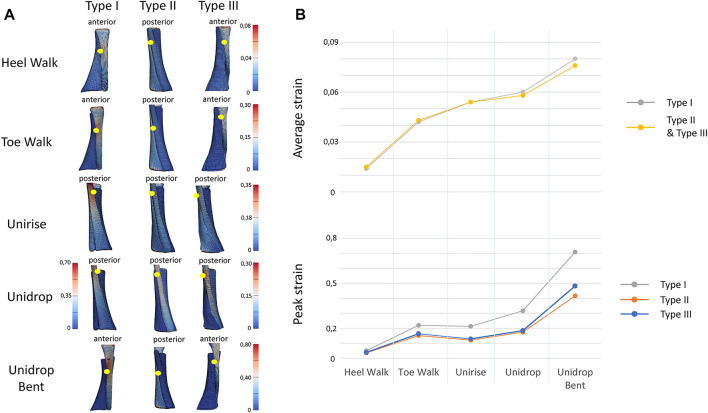
The Achilles tendon (AT) is the largest tendon of the human body and has a primary role in locomotor activities. The complex structure of the AT includes twisting of three sub-tendons, non-uniform tissue deformations and differential triceps surae muscle forces. The main aim of this study was to investigate the impact of commonly used rehabilitation exercises (walking on heels, walking on toes, unilateral heel rise, heel drop with extended knee and heel drop with the knee bent) and different twists on AT strains. 3D freehand ultrasound based subject-specific geometry and subject-specific muscle forces during different types of rehabilitation exercises were used to determine tendon strains magnitudes and differences in strains between the sub-tendons. In addition, three Finite Element models were developed to investigate the impact of AT twist. While walking on heels developed the lowest average strain, heel drop with knee bent exhibited the highest average strain. The eccentric heel drop resulted in higher peak and average strain, compared to concentric heel rise for all the three models. The isolated exercises (heel rise and heel drop) presented higher average strains compared to the functional exercises (walking tasks). The amount of twist influences the peak strains but not the average. Type I consistently showed highest peak strains among the five rehabilitation exercises. The ranking of the exercises based on the AT strains was independent of AT twist. These findings might help clinicians to prescribe rehabilitation exercises for Achilles tendinopathy based on their impact on the AT strains.
跟腱(AT)是人体最大的肌腱,在运动活动中起主要作用。跟腱的复杂结构包括三个子肌腱的扭转、不均匀的组织变形和腓肠肌三头肌的不同力量。本研究的主要目的是调查常用康复锻炼(足跟行走、足尖行走、单侧足跟抬起、伸直膝关节的足跟下落和弯曲膝关节的足跟下落)以及不同扭转对跟腱应变的影响。在不同类型的康复锻炼过程中,基于三维徒手超声的个体特异性几何形状和个体特异性肌肉力量被用于确定肌腱应变的大小以及子肌腱之间应变的差异。此外,还开发了三个有限元模型来研究跟腱扭转的影响。足跟行走时平均应变最低,而弯曲膝关节的足跟下落平均应变最高。对于所有三个模型,与向心足跟抬起相比,离心足跟下落导致更高的峰值应变和平均应变。与功能性锻炼(行走任务)相比,孤立锻炼(足跟抬起和足跟下落)的平均应变更高。扭转量会影响峰值应变,但不会影响平均应变。在五种康复锻炼中,I型始终表现出最高的峰值应变。基于跟腱应变的锻炼排名与跟腱扭转无关。这些发现可能有助于临床医生根据康复锻炼对跟腱应变的影响为跟腱病开出处方。