College of Medicine, King Saud Bin Abdulaziz University for Health Sciences (KSAU-HS), Ministry of the National Guard-Health Affairs, Riyadh 14611, Saudi Arabia.
King Abdullah International Medical Research Center, Ministry of the National Guard-Health Affairs, Riyadh 11481, Saudi Arabia.
Curr Oncol. 2022 Jul 13;29(7):4941-4955. doi: 10.3390/curroncol29070393.
Cancer survival has improved significantly, which reflects the achievements in screening, diagnosis, and treatment. As a consequence, multiple primary malignancies are diagnosed more frequently, with an incidence ranging from 0.52-11.7%. The types of malignancy that coexist and survival patterns vary notably in different countries and geographical areas. Due to the limited literature in Saudi Arabia, a baseline of prevalent malignancy combinations and their survival patterns would support early detection and disease management.
This was a retrospective descriptive study conducted from 1993-2022 at King Abdulaziz Medical City, Department of Medical Oncology, Riyadh, Saudi Arabia. Patients with at least two biopsy-proven solid malignancies were included. Patients with hematological malignancies, missing data, or an uncertain or indecisive pathology report were excluded.
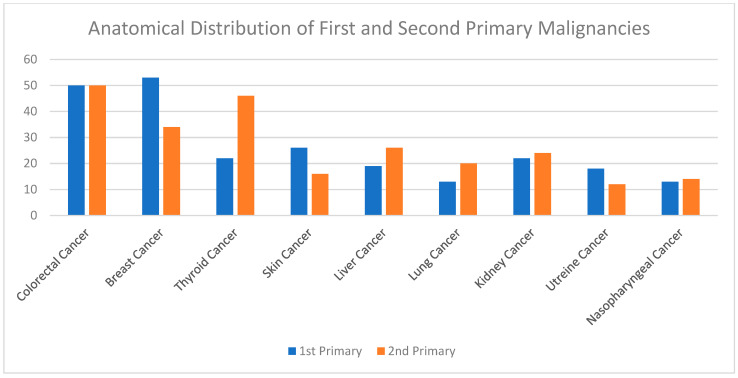
In total, 321 patients were analyzed. More than half (57.3%) of the patients were female. A third (33%) of the cases were synchronous, and 67% were metachronous. The most frequent site of the first primary malignancy was breast cancer, followed by colorectal, skin, and thyroid cancers. The most frequent site of the second primary malignancy was colorectal cancer, followed by thyroid, breast, and liver cancers. Only 4% of the cases had a third primary malignancy, with colorectal and appendiceal cancers being the most frequent. The most frequently observed histopathology in the synchronous and metachronous malignancies was adenocarcinoma. Breast-colorectal, breast-thyroid, and kidney-colorectal were the most frequently observed malignancy combinations.
The current study offers a baseline of multiple primary malignancies in Saudi Arabia and provides supporting evidence that the pattern of multiple primary malignancies varies among different countries and ethnicities. The possibility of developing another primary malignancy should be considered when treating and monitoring cancer patients.
癌症患者的存活率显著提高,这反映了在筛查、诊断和治疗方面取得的成就。因此,越来越多的患者被诊断出患有多种原发性恶性肿瘤,其发病率在 0.52%-11.7%之间。不同国家和地区共存的恶性肿瘤类型和生存模式差异显著。由于沙特阿拉伯的相关文献有限,了解常见的恶性肿瘤组合及其生存模式有助于早期发现和疾病管理。
这是一项回顾性描述性研究,于 1993 年至 2022 年在沙特阿拉伯利雅得阿卜杜勒阿齐兹国王医疗城医学肿瘤科进行。纳入至少有两种经活检证实的实体恶性肿瘤的患者。排除患有血液恶性肿瘤、数据缺失或病理报告不确定或犹豫不决的患者。
共分析了 321 名患者。超过一半(57.3%)的患者为女性。三分之一(33%)的病例为同时性,67%为异时性。首次原发性恶性肿瘤最常见的部位是乳腺癌,其次是结直肠癌、皮肤癌和甲状腺癌。第二次原发性恶性肿瘤最常见的部位是结直肠癌,其次是甲状腺癌、乳腺癌和肝癌。只有 4%的病例发生了第三次原发性恶性肿瘤,其中结直肠癌和阑尾癌最为常见。同时性和异时性恶性肿瘤中最常观察到的组织病理学是腺癌。乳腺癌-结直肠癌、乳腺癌-甲状腺癌和肾癌-结直肠癌是最常见的恶性肿瘤组合。
本研究为沙特阿拉伯的多种原发性恶性肿瘤提供了基线数据,并提供了支持性证据,表明多种原发性恶性肿瘤的模式在不同国家和种族之间存在差异。在治疗和监测癌症患者时,应考虑发生另一种原发性恶性肿瘤的可能性。