College of Medical and Dental Sciences, University of Birmingham, Birmingham, UK
College of Medical and Dental Sciences, University of Birmingham, Birmingham, UK.
BMJ Open. 2022 Jul 25;12(7):e061865. doi: 10.1136/bmjopen-2022-061865.
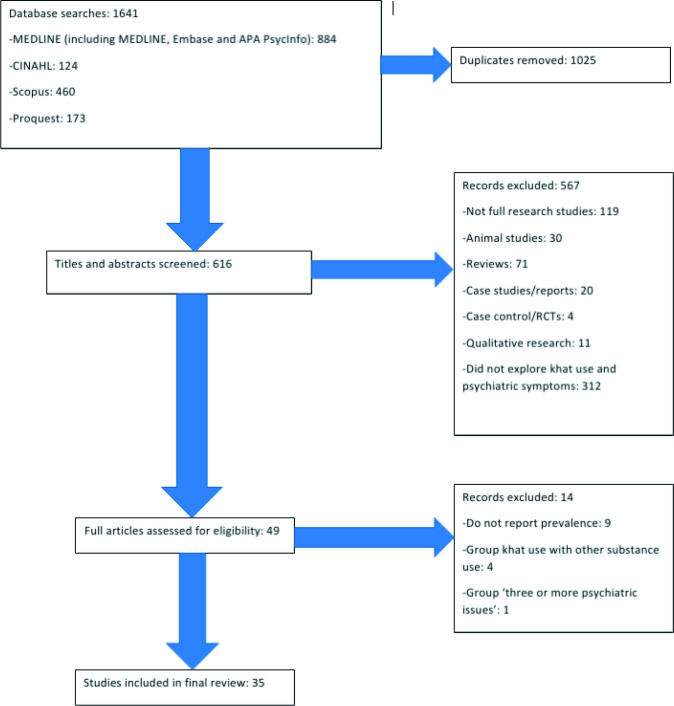
Consumption of the drug khat is high across East Africa and the South-Western Arabian Peninsula despite evidence for its adverse psychiatric effects. This systematic review aims to explore cross-sectional research in the field to determine the strength of the association between khat use and psychiatric symptoms METHODS: Six databases were searched in October 2021-Ovid Medline, Embase, APA PsycINFO, CINAHL, Scopus and Proquest-using the following search terms: "khat" OR "qat" OR "qaad" OR "catha" OR "miraa" OR "mairungi" AND "depression" OR "anxiety" OR "mania" OR "psych*" OR "schiz*" OR "mental" OR "hallucinations" OR "delusions" OR "bipolar". Eligible studies were cross-sectional studies of any population or setting comparing the prevalence of psychiatric symptoms in long term or dependent khat users with non-users. The quality of each study was appraised by the Newcastle-Ottawa scale. A meta-analysis was planned using a random effects model to produce an OR with 95% CIs-using the Mantel-Haenszel method-alongside an I statistic to represent heterogeneity. The quality of this meta-analysis was appraised using the Grading of Recommendations, Assessment, Development and Evaluations (GRADE) scoring system.
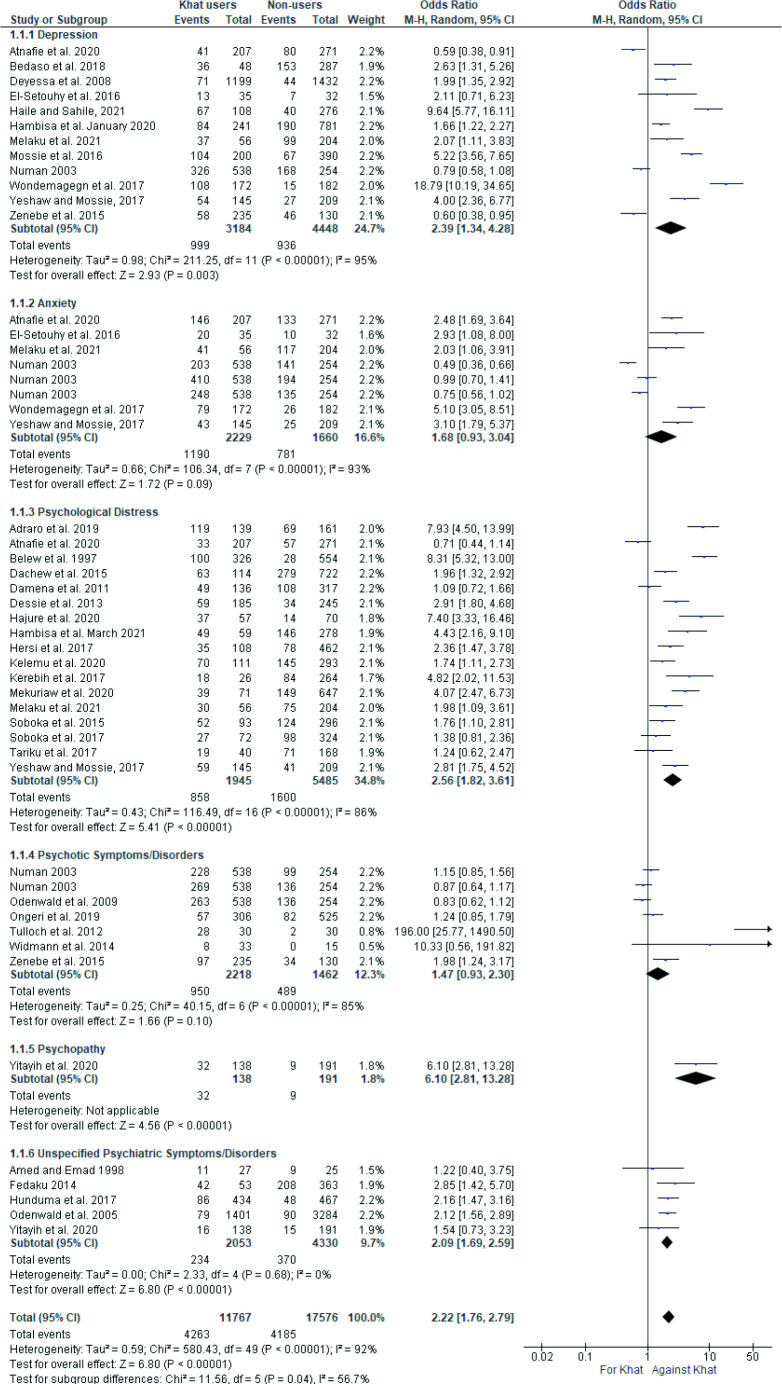
35 studies were eligible for inclusion (total participants=31 893), spanning 5 countries (Ethiopia, Somalia, Kenya, Saudi Arabia, UK). Meta-analysis suggests that khat use is associated with an 122% increased prevalence of psychiatric symptoms (OR 2.22, 95% CIs 1.76 to 2.79, p<0.00001, GRADE score: 'very low').
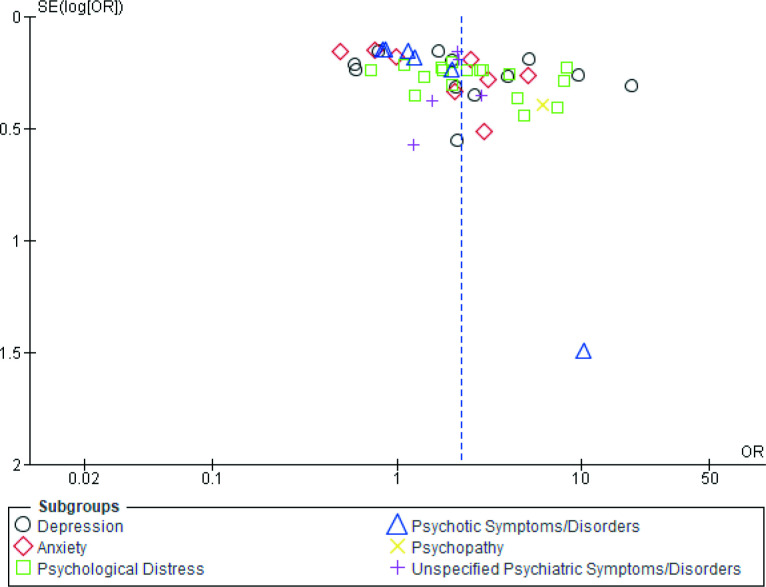
The high heterogeneity of the meta-analysis is likely due to the wide variation between the studies within the evidence base. To perform a more accurate systematic review, further primary studies are needed with standardised measurements of variables, particularly khat consumption.
CRD42020224510.
尽管有证据表明其对精神健康有不良影响,但东非和西南阿拉伯半岛的药物卡特草的消耗量仍然很高。本系统评价旨在探索该领域的横断面研究,以确定卡特草使用与精神症状之间关联的强度。
2021 年 10 月,在 Ovid Medline、Embase、APA PsycINFO、CINAHL、Scopus 和 Proquest 数据库中使用以下搜索词进行搜索:“卡特草”或“qat”或“qaad”或“catha”或“miraa”或“mairungi”和“抑郁”或“焦虑”或“躁狂”或“精神*”或“精神分裂症*”或“精神”或“幻觉”或“妄想”或“双相*”。合格的研究是比较长期或依赖卡特草使用者与非使用者的精神症状患病率的任何人群或环境的横断面研究。使用纽卡斯尔-渥太华量表评估每项研究的质量。计划使用随机效应模型进行荟萃分析,采用 Mantel-Haenszel 方法生成 OR 和 95%CI-同时使用 I 统计量表示异质性。使用推荐评估、制定与评价分级(GRADE)评分系统评估此荟萃分析的质量。
35 项研究符合纳入标准(总参与者=31893),涵盖 5 个国家(埃塞俄比亚、索马里、肯尼亚、沙特阿拉伯、英国)。荟萃分析表明,卡特草的使用与精神症状的患病率增加 122%相关(OR 2.22,95%CI 1.76 至 2.79,p<0.00001,GRADE 评分:“极低”)。
荟萃分析的高度异质性可能是由于证据基础内研究之间的差异很大。为了进行更准确的系统评价,需要进一步进行具有变量标准化测量的初级研究,特别是卡特草的使用。
PROSPERO 注册号:CRD42020224510。