Department of Biosystems Science and Engineering, ETH Zürich, Mattenstrasse 26, 4058, Basel, Switzerland.
Nat Commun. 2022 Jul 25;13(1):4305. doi: 10.1038/s41467-022-31263-x.
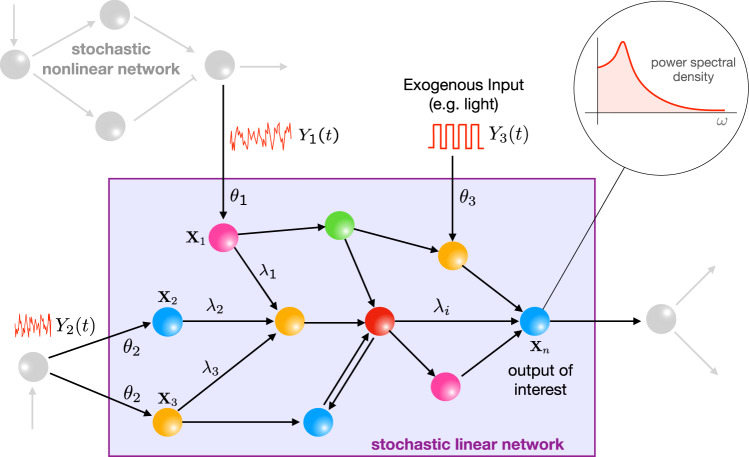
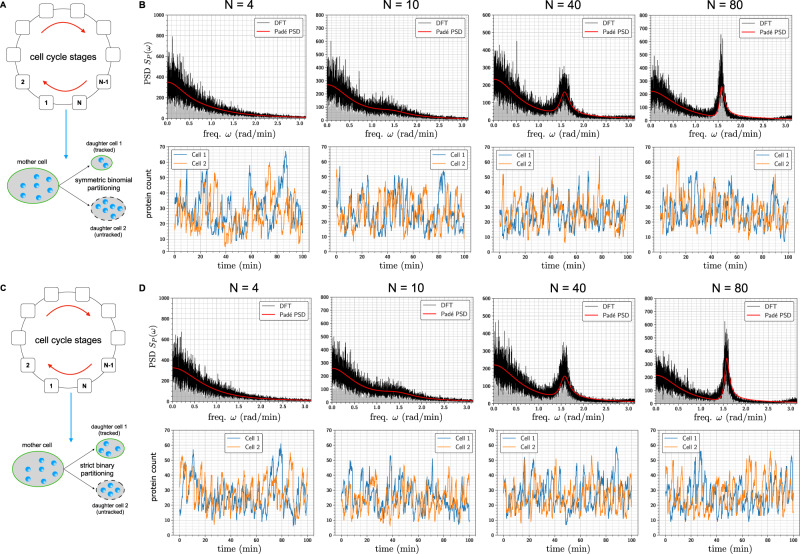
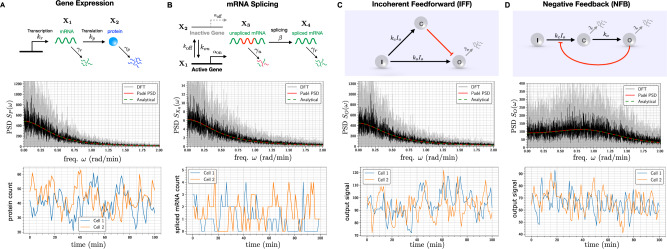
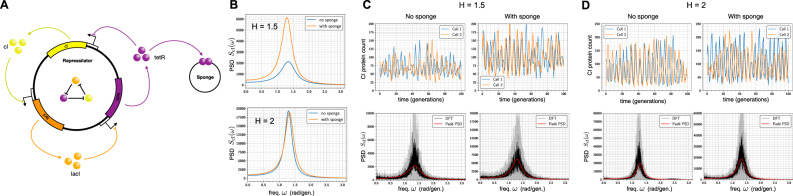
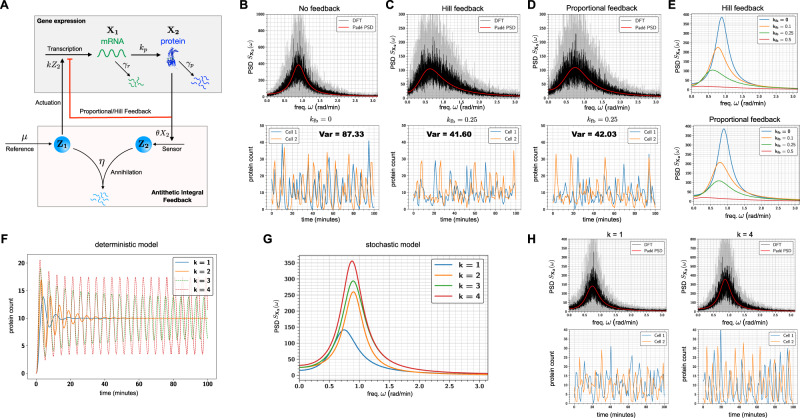
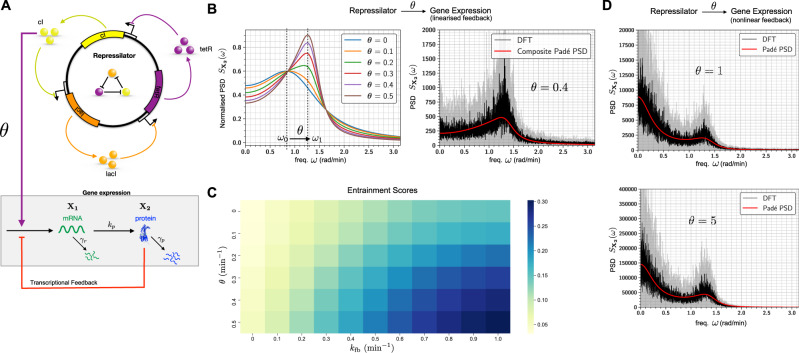
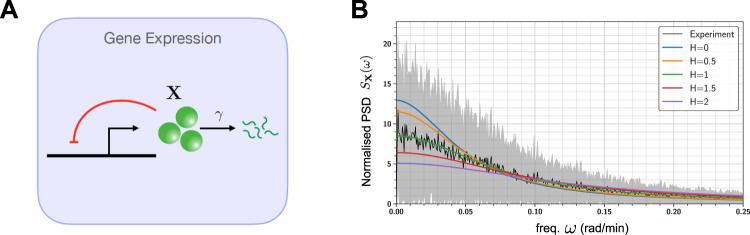
The invention of the Fourier integral in the 19th century laid the foundation for modern spectral analysis methods. This integral decomposes a temporal signal into its frequency components, providing deep insights into its generating process. While this idea has precipitated several scientific and technological advances, its impact has been fairly limited in cell biology, largely due to the difficulties in connecting the underlying noisy intracellular networks to the frequency content of observed single-cell trajectories. Here we develop a spectral theory and computational methodologies tailored specifically to the computation and analysis of frequency spectra of noisy intracellular networks. Specifically, we develop a method to compute the frequency spectrum for general nonlinear networks, and for linear networks we present a decomposition that expresses the frequency spectrum in terms of its sources. Several examples are presented to illustrate how our results provide frequency-based methods for the design and analysis of noisy intracellular networks.
19 世纪傅里叶积分的发明为现代光谱分析方法奠定了基础。该积分将时间信号分解为其频率分量,为其产生过程提供了深入的了解。虽然这个想法促成了几项科学和技术的进步,但它在细胞生物学中的影响相当有限,主要是因为将潜在的嘈杂细胞内网络与观察到的单细胞轨迹的频率内容联系起来存在困难。在这里,我们开发了一种专门针对嘈杂细胞内网络的频率谱计算和分析的谱理论和计算方法。具体来说,我们开发了一种用于计算一般非线性网络频率谱的方法,对于线性网络,我们提出了一种分解,用其源表示频率谱。提出了几个例子来说明我们的结果如何为设计和分析嘈杂的细胞内网络提供基于频率的方法。