Oxford University Museum of Natural History, University of Oxford, Oxford, UK.
Department of Earth Sciences, University of Cambridge, Cambridge, UK.
Nat Ecol Evol. 2022 Aug;6(8):1095-1104. doi: 10.1038/s41559-022-01807-x. Epub 2022 Jul 25.
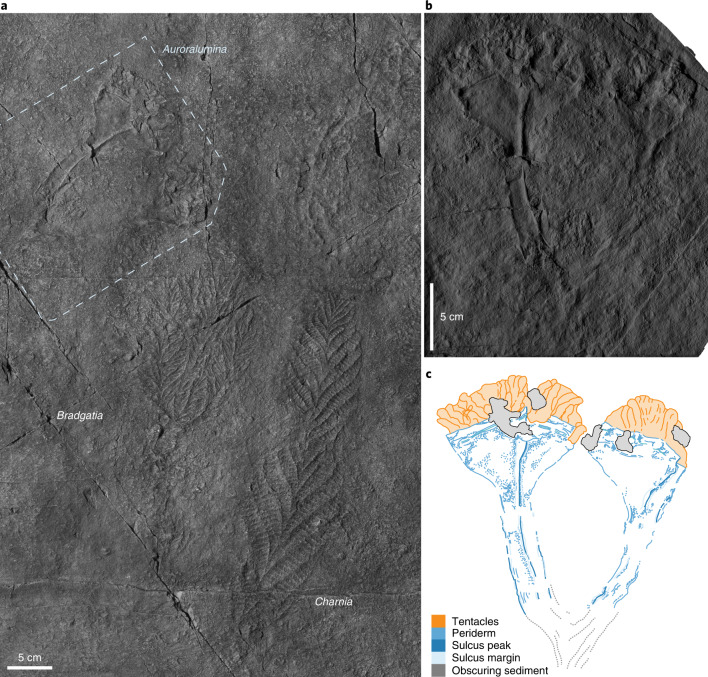
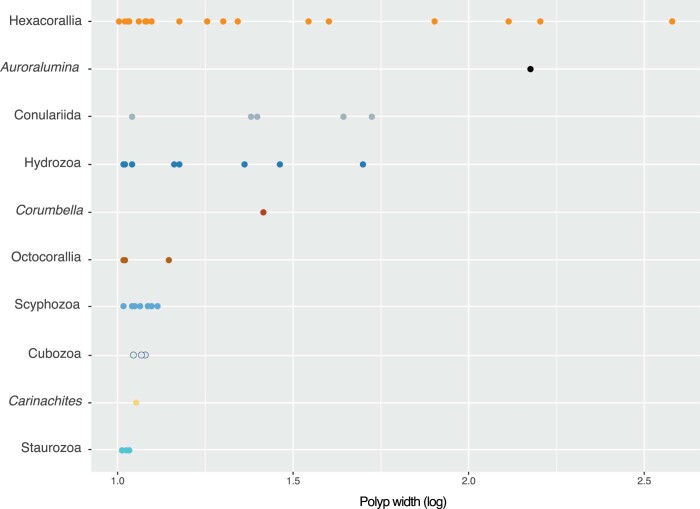
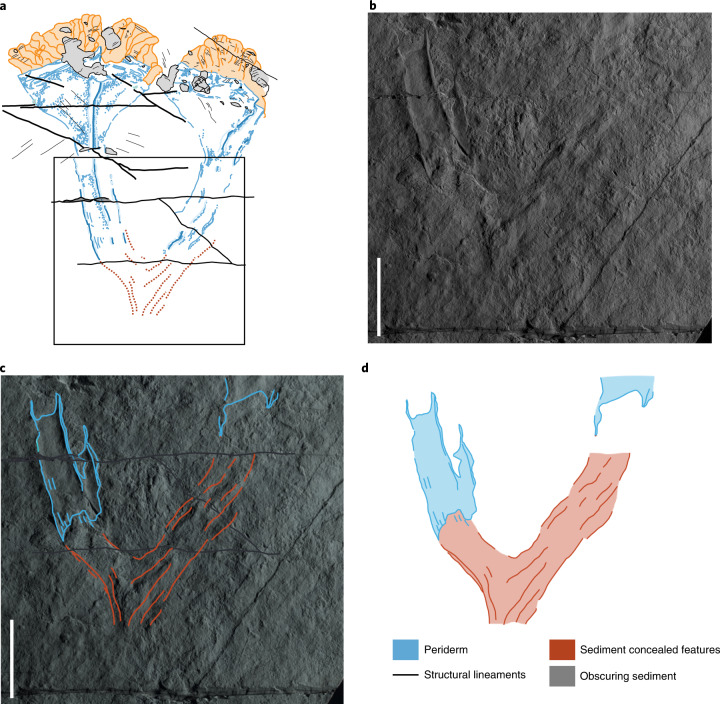
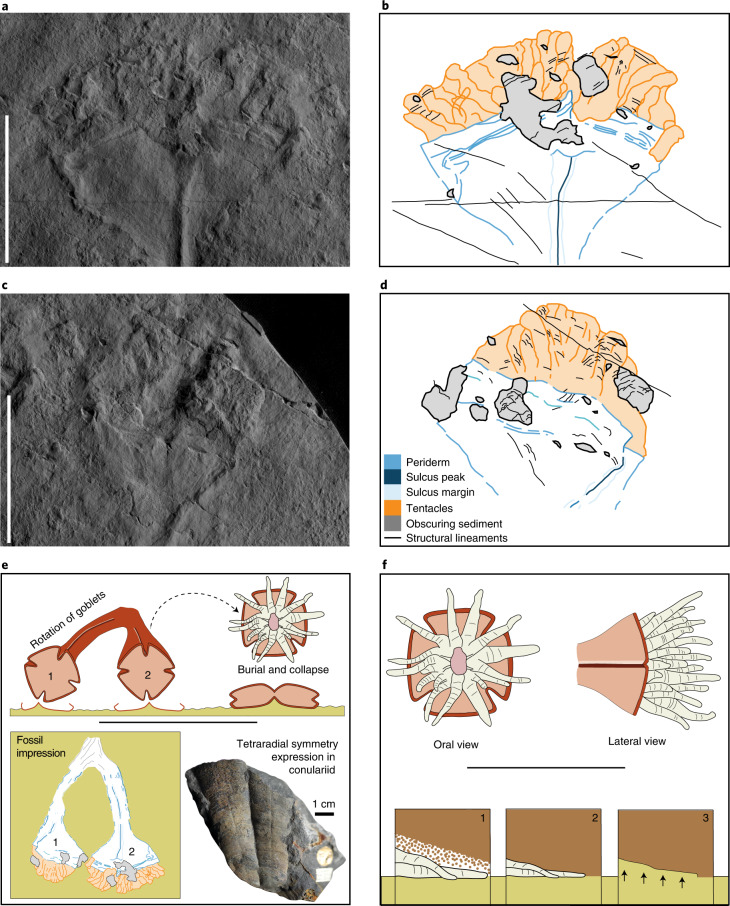
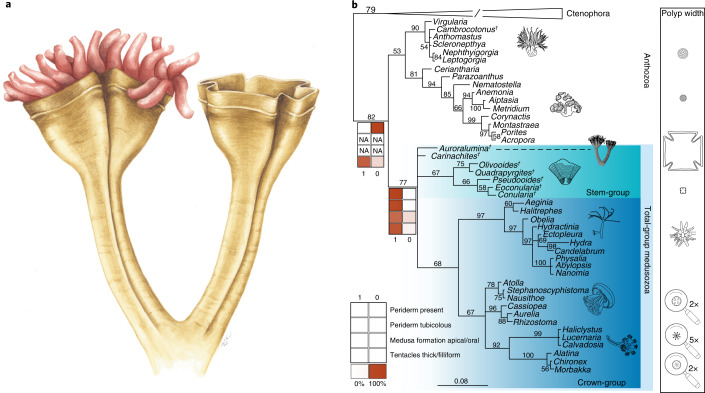
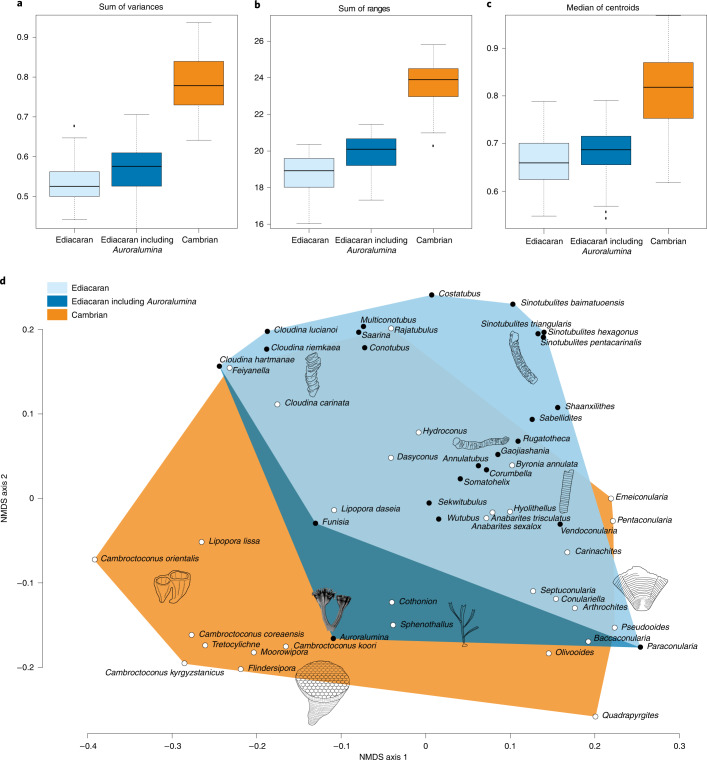
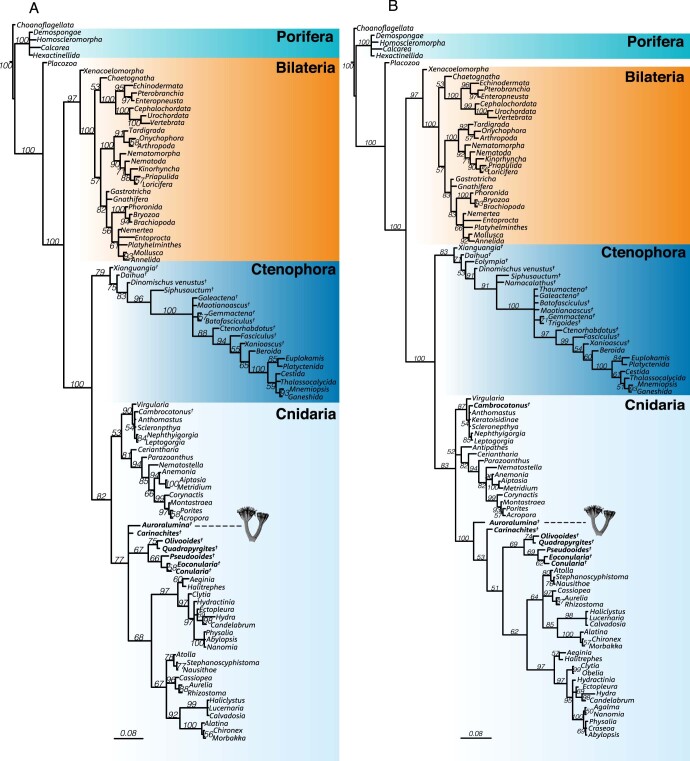
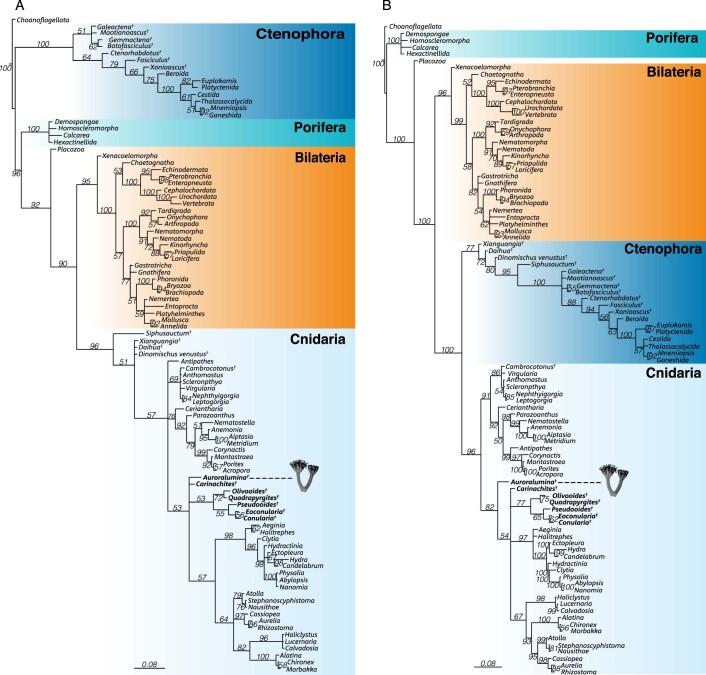
Cnidarians are a disparate and ancient phylum, encompassing corals and jellyfish, and occupy both the pelagic and benthic realms. They have a rich fossil record from the Phanerozoic eon lending insight into the early history of the group but, although cnidarians diverged from other animals in the Precambrian period, their record from the Ediacaran period (635-542 million years ago) is controversial. Here, we describe a new fossil cnidarian-Auroralumina attenboroughii gen. et sp. nov.-from the Ediacaran of Charnwood Forest (557-562 million years ago) that shows two bifurcating polyps enclosed in a rigid, polyhedral, organic skeleton with evidence of simple, densely packed tentacles. Auroralumina displays a suite of characters allying it to early medusozoans but shows others more typical of Anthozoa. Phylogenetic analyses recover Auroralumina as a stem-group medusozoan and, therefore, the oldest crown-group cnidarian. Auroralumina demonstrates both the establishment of the crown group of an animal phylum and the fixation of its body plan tens of millions of years before the Cambrian diversification of animal life.
刺胞动物门是一个多样化且古老的门,包括珊瑚和水母,它们同时占据着海洋上层和海底两个生态领域。刺胞动物在显生宙时期有着丰富的化石记录,为该类群的早期历史提供了深入的了解,但尽管刺胞动物在元古代时期就与其他动物分化开来,但它们在埃迪卡拉纪(6.35-5.42 亿年前)的记录却存在争议。在这里,我们描述了一种来自恰恩伍德森林埃迪卡拉纪(5.57-5.62 亿年前)的新型化石刺胞动物——极光阿滕伯勒尼亚(Auroralumina attenboroughii),gen. et sp. nov.,它显示了两个分叉的息肉被包裹在一个坚硬的、多面体的有机骨架中,并有简单的、密集的触手的证据。极光阿滕伯勒尼亚展示了一套与早期水母动物群相关的特征,但也显示出其他更典型的珊瑚动物群的特征。系统发育分析将极光阿滕伯勒尼亚归为早期水母动物群的茎群,因此是最古老的冠群刺胞动物。极光阿滕伯勒尼亚既展示了动物门的冠群的建立,也展示了其身体计划的固定,这发生在寒武纪动物生命多样化的数千万年前。