Department of Pathology, the Second Affiliated Hospital & Yuying Children's Hospital of Wenzhou Medical University, Wenzhou, Zhejiang, China.
Guangdong Provincial Key Laboratory of Malignant Tumor Epigenetics and Gene Regulation, Sun Yat-Sen Memorial Hospital, Sun Yat-Sen University, 510120, Guangzhou, China.
BMC Cancer. 2022 Jul 25;22(1):817. doi: 10.1186/s12885-022-09884-8.
Urothelial carcinoma (UC) is among the most prevalent malignancies. The muscle-invasive bladder cancer (MIBC) shows an invasive feature and has poor prognosis, while the non-muscle invasive bladder cancer (NMIBC) shows a better prognosis as compared with the MIBC. However, a significant proportion (10%-30%) of NMIBC cases progress to MIBC. Identification of efficient biomarkers for the prediction of the course of UC remains challenging nowadays. Recently, there is an emerging study showed that post-translational modifications (PTMs) by glycosylation is an important process correlated with tumor angiogenesis, invasion and metastasis. Herein, we reported a data-driven discovery and experimental validation of GANAB, a key regulator of glycosylation, as a novel prognostic marker in UC.
In the present study, we conducted immunohistochemistry (IHC) assay to evaluate the correlation between the expression levels of GANAB protein and the prognosis of UC in our cohort of 107 samples using whole slide image (WSI) analysis. In vitro experiments using RNAi were also conducted to investigate the biological functions of GANAB in UC cell lines.
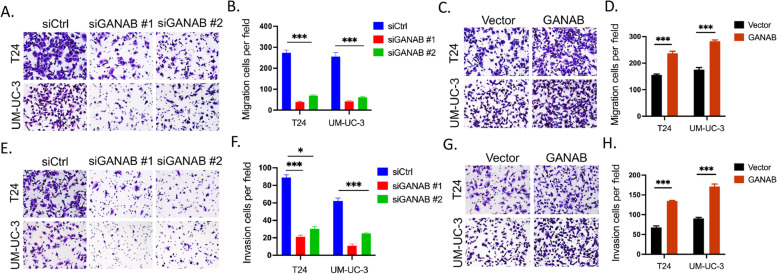
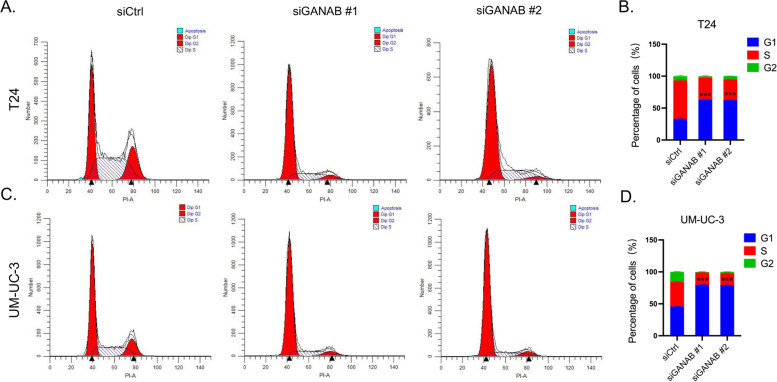
We observed that positive GANAB protein expression was significantly correlated with poor prognosis of UC in our cohort, with p-value of 0.0017 in Log-rank test. Notably, tumor cells at the invasive front of the tumor margin showed stronger GANAB expression than the tumor cells inside the tumor body in UCs. We further validated that the elevated expression levels of GANAB were significantly correlated with high grade tumors (p-values of 1.72 × 10), advanced stages (6.47 × 10), and elevated in luminal molecular subtypes. Moreover, knocking-down GANAB using RNAi in UM-UC-3 and T24 cells inhibited cell proliferation and migration in vitro. Knockdown of GANAB resulted in cell cycle arrest at G1 phase. We demonstrated that GANAB mediated HIF1A and ATF6 transcriptional activation in the ER stress signaling, and regulated the gene expression of cell cycle-related transcriptional factors E2F7 and FOXM1.
The elevated expression of GANAB is a novel indicator of poorer prognosis of UC. Our data suggests that GANAB is not only a new and promising prognostic biomarker for UC, but also may provide important cues for the development of PTM-based therapeutics for UC treatment.
尿路上皮癌(UC)是最常见的恶性肿瘤之一。肌层浸润性膀胱癌(MIBC)具有侵袭性特征,预后不良,而非肌层浸润性膀胱癌(NMIBC)与 MIBC 相比预后较好。然而,相当一部分(10%-30%)的 NMIBC 病例会进展为 MIBC。目前,仍难以找到有效的生物标志物来预测 UC 的病程。最近,有一项新的研究表明,糖基化的翻译后修饰(PTMs)是与肿瘤血管生成、侵袭和转移相关的重要过程。在此,我们报道了一种基于数据驱动的发现和实验验证,即糖基转移酶关键调节因子 GANAB 作为 UC 的一种新型预后标志物。
在本研究中,我们通过全切片图像(WSI)分析,对 107 例标本进行免疫组化(IHC)检测,评估 GANAB 蛋白表达水平与 UC 预后的相关性。还通过 RNAi 进行了体外实验,以研究 GANAB 在 UC 细胞系中的生物学功能。
我们发现,在我们的队列中,阳性 GANAB 蛋白表达与 UC 的不良预后显著相关,对数秩检验的 p 值为 0.0017。值得注意的是,在 UC 中,肿瘤边缘侵袭前沿的肿瘤细胞比肿瘤体内的肿瘤细胞表达更强的 GANAB。我们进一步验证,GANAB 表达水平升高与高级别肿瘤(p 值为 1.72×10)、晚期(6.47×10)和管腔分子亚型升高显著相关。此外,在 UM-UC-3 和 T24 细胞中,使用 RNAi 敲低 GANAB 可抑制体外细胞增殖和迁移。GANAB 敲低导致细胞周期停滞在 G1 期。我们证明,GANAB 在 ER 应激信号通路中介导 HIF1A 和 ATF6 的转录激活,并调节细胞周期相关转录因子 E2F7 和 FOXM1 的基因表达。
GANAB 的高表达是 UC 预后不良的一个新指标。我们的数据表明,GANAB 不仅是 UC 的一个新的有前途的预后生物标志物,而且可能为基于 PTM 的 UC 治疗提供重要线索。