School of Nursing, Department of Social and Behavioral Sciences, University of California, San Francisco, San Francisco, CA, USA.
UCSF Benioff Homelessness and Housing Initiative at ZSFG Hospital and Trauma Center, San Francisco, CA, USA.
Harm Reduct J. 2022 Jul 25;19(1):82. doi: 10.1186/s12954-022-00646-0.
Internationally, strategies focusing on reducing alcohol-related harms in homeless populations with severe alcohol use disorder (AUD) continue to gain acceptance, especially when conventional modalities focused on alcohol abstinence have been unsuccessful. One such strategy is the managed alcohol program (MAP), an alcohol harm reduction program managing consumption by providing eligible individuals with regular doses of alcohol as a part of a structured program, and often providing resources such as housing and other social services. Evidence to the role of MAPs for individuals with AUD, including how MAPs are developed and implemented, is growing. Yet there has been limited collective review of literature findings.
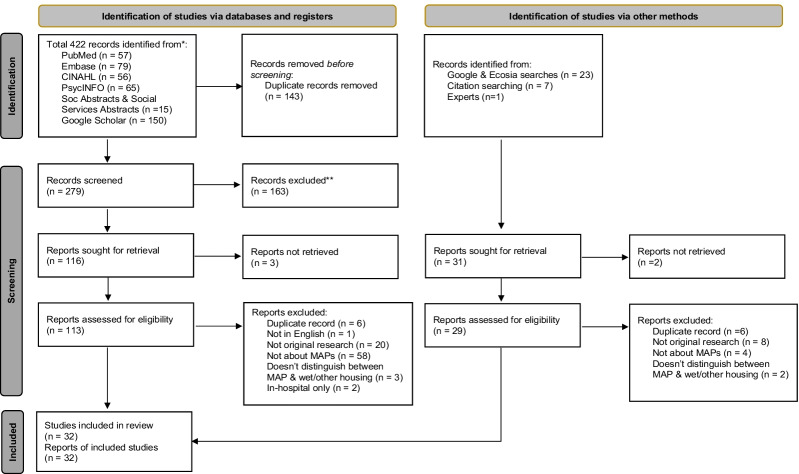
We conducted a scoping review to answer, "What is being evaluated in studies of MAPs? What factors are associated with a successful MAP, from the perspective of client outcomes? What are the factors perceived as making them a good fit for clients and for communities?" We first conducted a systematic search in PubMed, Embase, PsycINFO, CINAHL, Sociological Abstracts, Social Services Abstracts, and Google Scholar. Next, we searched the gray literature (through focused Google and Ecosia searches) and references of included articles to identify additional studies. We also contacted experts to ensure relevant studies were not missed. All articles were independently screened and extracted.
We included 32 studies with four categories of findings related to: (1) client outcomes resulting from MAP participation, (2) client experience within a MAP; (3) feasibility and fit considerations in MAP development within a community; and (4) recommendations for implementation and evaluation. There were 38 established MAPs found, of which 9 were featured in the literature. The majority were located in Canada; additional research works out of Australia, Poland, the USA, and the UK evaluate potential feasibility and fit of a MAP.
The growing literature showcases several outcomes of interest, with increasing efforts aimed at systematic measures by which to determine the effectiveness and potential risks of MAP. Based on a harm reduction approach, MAPs offer a promising, targeted intervention for individuals with severe AUD and experiencing homelessness. Research designs that allow for longitudinal follow-up and evaluation of health- and housing-sensitive outcomes are recommended.
在国际上,专注于减少有严重酗酒问题的无家可归者中与酒精相关的伤害的策略继续得到认可,特别是当专注于戒酒的传统模式不成功时。其中一种策略是管理酒精计划(MAP),这是一种减少酒精危害的计划,通过为符合条件的个人提供定期的酒精剂量来管理消费,作为结构化计划的一部分,并经常提供住房和其他社会服务等资源。关于 MAP 对 AUD 患者的作用的证据,包括 MAP 是如何制定和实施的,正在不断增加。然而,对文献发现的综合审查有限。
我们进行了范围界定审查,以回答“在 MAP 研究中评估了哪些内容?从客户结果的角度来看,哪些因素与成功的 MAP 相关?哪些因素被认为适合客户和社区?”我们首先在 PubMed、Embase、PsycINFO、CINAHL、社会学摘要、社会服务摘要和 Google Scholar 中进行了系统搜索。接下来,我们在灰色文献(通过重点 Google 和 Ecosia 搜索)和包含文章的参考文献中搜索,以确定其他研究。我们还联系了专家,以确保没有遗漏相关研究。所有文章均由独立筛选和提取。
我们纳入了 32 项研究,分为四类:(1)参与 MAP 后客户的结果,(2)客户在 MAP 中的体验;(3)在社区中开发 MAP 时的可行性和适应性考虑因素;(4)实施和评估的建议。发现了 38 个已建立的 MAP,其中 9 个在文献中有所介绍。其中大多数位于加拿大;来自澳大利亚、波兰、美国和英国的额外研究工作评估了 MAP 的潜在可行性和适应性。
不断增长的文献展示了几个感兴趣的结果,并且越来越努力通过系统的措施来确定 MAP 的有效性和潜在风险。基于减少伤害的方法,MAP 为有严重 AUD 和无家可归的个人提供了一种有前途的针对性干预措施。建议使用允许对健康和住房敏感结果进行纵向随访和评估的研究设计。