Oud Lavi, Garza John
Division of Pulmonary and Critical Care Medicine, Department of Internal Medicine, Texas Tech University Health Sciences Center at the Permian Basin, 701 W. 5th Street, Odessa, TX, 79763, USA.
Texas Tech University Health Sciences Center at the Permian Basin, 701 W. 5th Street, Odessa, TX, 79763, USA.
J Intensive Care. 2022 Jul 25;10(1):36. doi: 10.1186/s40560-022-00628-1.
Multiple sclerosis (MS) is associated with increased risk of sepsis and higher sepsis-related mortality, compared to the general population. However, the evidence on the prognostic impact of MS in sepsis has been scarce. We aimed to evaluate the population-level association of MS with short-term mortality in sepsis.
We performed a retrospective population-based cohort study using a statewide data set to identify hospitalizations aged ≥ 18 years in Texas with sepsis, with and without MS during 2010-2017. Multilevel logistic models were fit to estimate the association of MS with short-term mortality among all sepsis hospitalizations, and for sensitivity analyses among hospitalizations with septic shock and those admitted to ICU.
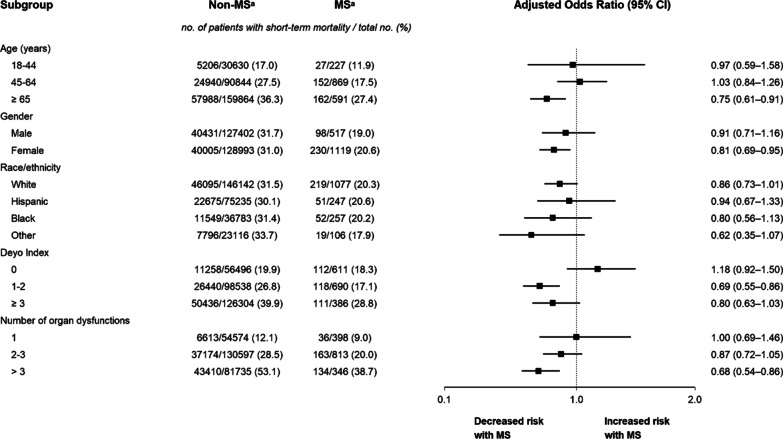
Among 283,025 sepsis hospitalizations, 1687 (0.6%) had MS. Compared to sepsis hospitalizations without MS, those with MS were younger (aged ≥ 65 years 35.0% vs 56.8%), less commonly racial/ethnic minority (36.2% vs 48.1%), and had lower mean Deyo comorbidity index (1.6 vs 2.7). The rates of septic shock and ICU admission were similar for sepsis hospitalizations with and without MS (58.7% vs 59.6% and 46.7% vs 46.0%, respectively). The unadjusted short-term mortality among sepsis hospitalizations with and without MS for the whole cohort, among those with septic shock, and among ICU admissions were 20.2% vs 31.3%, 25.6% vs 40.0%, and 24.0% vs 34.8%, respectively. On adjusted analyses, MS was associated with 17% lower odds of short-term mortality (adjusted odds ratio [aOR] 0.828 [95% CI 0.723-0.947]). Similar findings were observed on sensitivity analyses of patients with septic shock (aOR 0.764 [95% CI 0.651-0.896]), but MS was not associated with mortality among sepsis hospitalizations admitted to ICU (aOR 0.914 [95% CI 0.759-1.101]).
MS was associated with lower short-term mortality among septic patients, with findings consistent among the subset with septic shock. Among septic patients admitted to ICU, MS was not associated with mortality.
与普通人群相比,多发性硬化症(MS)患者发生脓毒症的风险增加,且脓毒症相关死亡率更高。然而,关于MS对脓毒症预后影响的证据一直很少。我们旨在评估MS与脓毒症短期死亡率之间的人群水平关联。
我们使用全州数据集进行了一项基于人群的回顾性队列研究,以确定2010 - 2017年期间德克萨斯州年龄≥18岁的脓毒症住院患者,包括患有和未患有MS的患者。采用多水平逻辑模型来估计MS与所有脓毒症住院患者短期死亡率之间的关联,并对感染性休克患者和入住重症监护病房(ICU)的患者进行敏感性分析。
在283,025例脓毒症住院患者中,1687例(0.6%)患有MS。与未患MS的脓毒症住院患者相比,患MS的患者更年轻(≥65岁的患者比例为35.0%对56.8%),种族/族裔少数群体的比例更低(36.2%对48.1%),且平均Deyo合并症指数更低(1.6对2.7)。患MS和未患MS脓毒症住院患者的感染性休克发生率和ICU入住率相似(分别为58.7%对59.6%和46.7%对46.0%)。整个队列中,患MS和未患MS的脓毒症住院患者、感染性休克患者以及ICU入住患者的未调整短期死亡率分别为20.2%对31.3%、25.6%对40.0%和24.0%对34.8%。经调整分析,MS与短期死亡率降低了17%相关(调整后的优势比[aOR]为0.828[95%置信区间0.723 - 0.947])。在感染性休克患者的敏感性分析中也观察到了类似结果(aOR 0.764[95%置信区间0.651 - 0.896]),但MS与入住ICU的脓毒症住院患者的死亡率无关(aOR 0.914[95%置信区间0.759 - 1.101])。
MS与脓毒症患者较低的短期死亡率相关,在感染性休克亚组中结果一致。在入住ICU的脓毒症患者中,MS与死亡率无关。