Limsawasd Charinee, Athigakunagorn Nathee, Khathawatcharakun Phattadon, Boonmee Atiwat
Department of Civil Engineering, Faculty of Engineering at Kamphaeng Saen, Kasetsart University, Nakhon Pathom, 73140, Thailand.
Department of Industrial Engineering, Faculty of Engineering at Kamphaeng Saen, Kasetsart University, Nakhon Pathom, 73140, Thailand.
Transp Policy (Oxf). 2022 Sep;126:225-238. doi: 10.1016/j.tranpol.2022.07.014. Epub 2022 Jul 21.
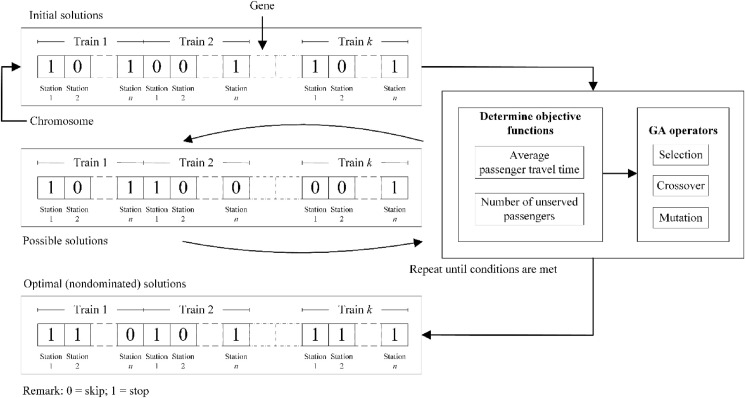
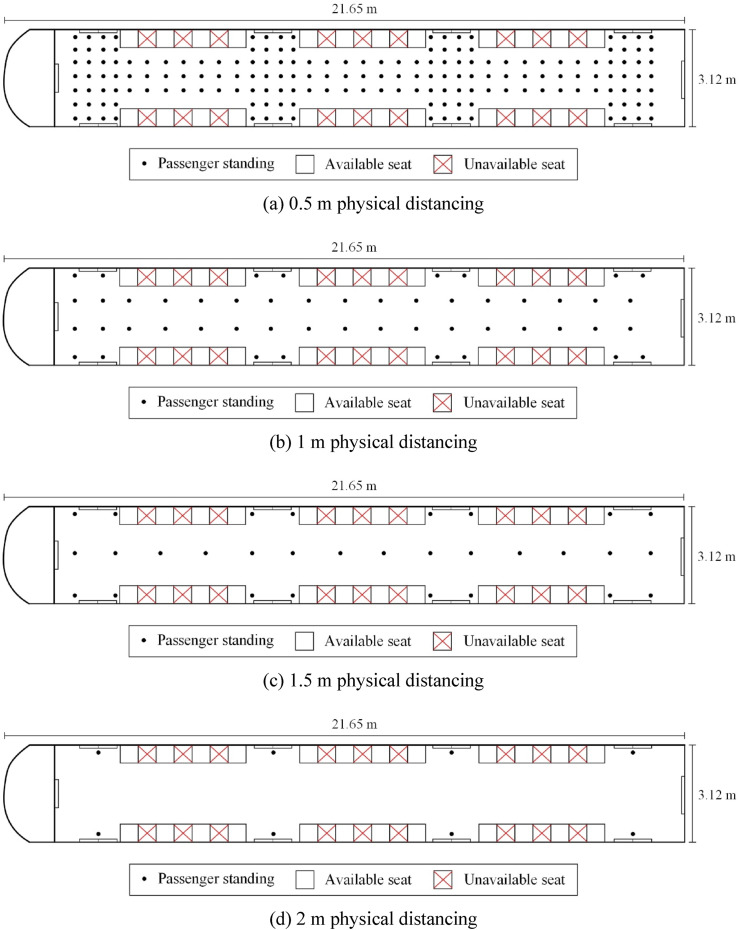
After the widespread impact of the COVID-19 pandemic, all public transport, including urban rail transit, inevitably adopted a vigorous physical-distancing policy to prevent the disease from spreading among passengers. Adoption of this measure resulted in a substantial reduction in train service capability and required control of the risk contact exposure duration. Thus, this paper proposes the Skip-Stop Strategy Patterns (3S-P) decision-support model to incorporate social distancing constraints in train operations. The 3S-P model is a two-stage, multi-objective optimization model for scheduling train skip-stop patterns to satisfy the study's two main objectives of minimizing the average passenger travel time and unserved passengers. In the proposed model, the first optimization identifies the optimal train skip-stop patterns, while the second assigns these patterns to establish an hourly train schedule. The paper's case study uses data from the Bangkok Mass Transit System (BTS) SkyTrain Silom Line in Bangkok, Thailand and considers the 0.5, 1, 1.5, and 2 m social distancing schemes. The results reveal that the optimal train skip-stop patterns are superior to the all-stop alternative with, on average, a 13.4% faster travel time at the same level of unserved passengers. Furthermore, the non-dominated schedules from the second optimization decrease the numbers of unserved passengers given equal average passenger travel times.
在新冠疫情产生广泛影响之后,包括城市轨道交通在内的所有公共交通都不可避免地采取了严格的物理距离政策,以防止疾病在乘客之间传播。采取这一措施导致列车服务能力大幅下降,并需要控制风险接触暴露时长。因此,本文提出了跳停策略模式(3S-P)决策支持模型,以便在列车运营中纳入社交距离限制。3S-P模型是一个两阶段多目标优化模型,用于安排列车跳停模式,以实现将乘客平均出行时间和未服务乘客数量最小化这两个主要目标。在所提出的模型中,第一次优化确定最优列车跳停模式,而第二次优化则分配这些模式以制定每小时的列车时刻表。本文的案例研究使用了泰国曼谷曼谷大众运输系统(BTS)素坤逸线的数据,并考虑了0.5米、1米、1.5米和2米的社交距离方案。结果表明,最优列车跳停模式优于全站停靠方案,在未服务乘客数量相同的情况下,平均出行时间快13.4%。此外,第二次优化得到的非支配时刻表在平均乘客出行时间相同的情况下减少了未服务乘客的数量。