Faculdades Pequeno Príncipe (FPP), Curitiba, Paraná, Brazil.
Instituto de Pesquisa Pelé Pequeno Príncipe (IPPPP), Curitiba, Paraná, Brazil.
Microbiol Spectr. 2022 Aug 31;10(4):e0246921. doi: 10.1128/spectrum.02469-21. Epub 2022 Jul 26.
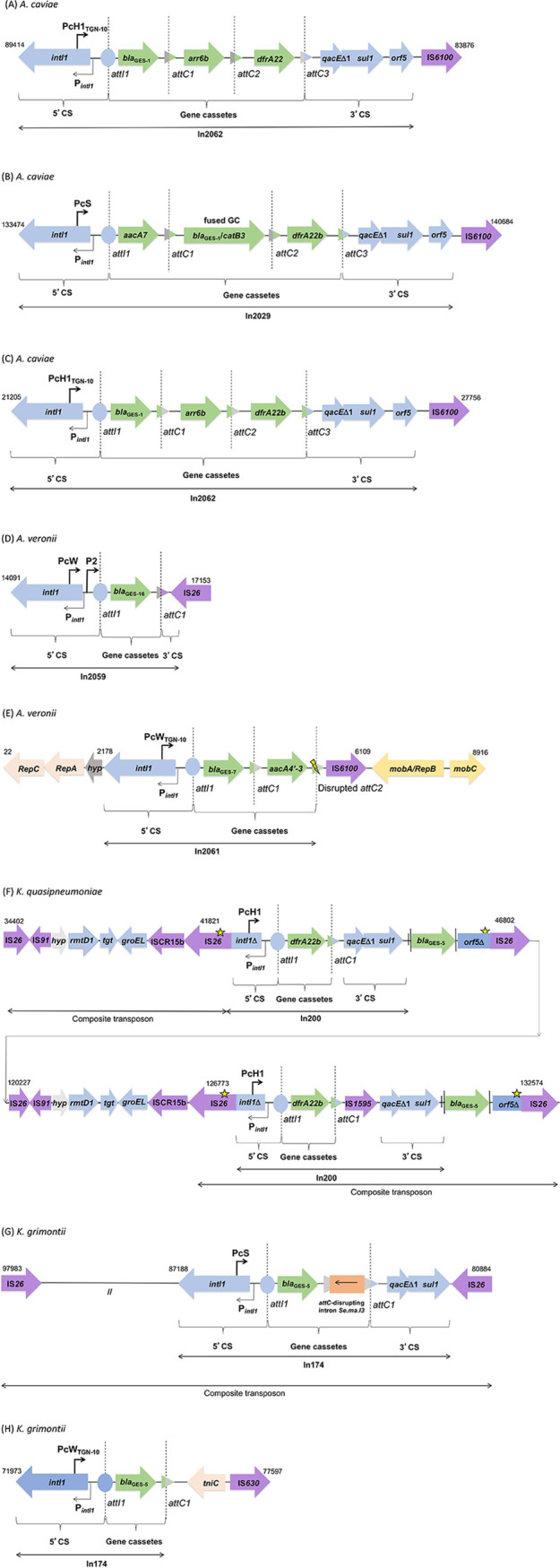
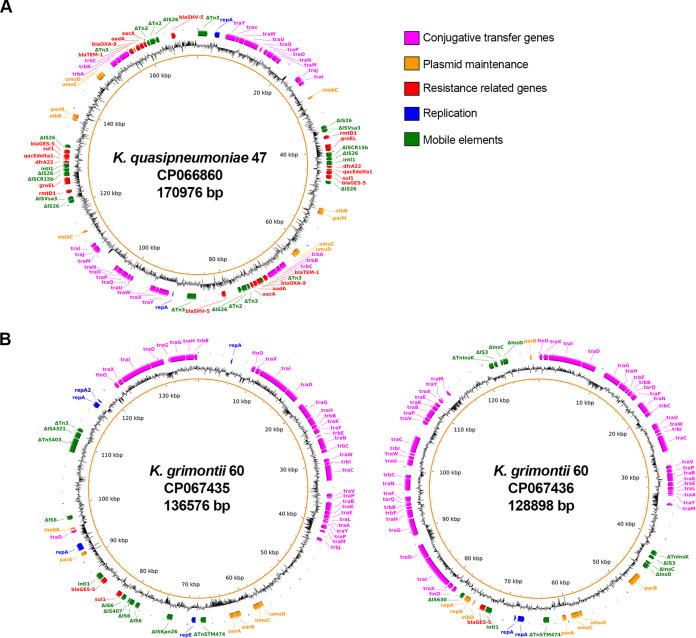
Mobile genetic elements contribute to the emergence and spread of multidrug-resistant bacteria by enabling the horizontal transfer of acquired antibiotic resistance among different bacterial species and genera. This study characterizes the genetic backbone of in spp. and Klebsiella spp. isolated from untreated hospital effluents. Plasmids ranging in size from 9 to 244 kb, sequenced using Illumina and Nanopore platforms, revealed representatives of plasmid incompatibility groups IncP6, IncQ1, IncL/M1, IncFII, and IncFII-FIA. Different GES enzymes (GES-1, GES-7, and GES-16) were located in novel class 1 integrons in spp. and GES-5 in previously reported class 1 integrons in Klebsiella spp. Furthermore, in Klebsiella quasipneumoniae, was found in tandem as a coding sequence that disrupted the 3' conserved segment (CS). In Klebsiella grimontii, was observed in two different plasmids, and one of them carried multiple IncF replicons. Three Aeromonas caviae isolates presented , one Aeromonas veronii isolate presented , and another A. veronii isolate presented . Multilocus sequence typing (MLST) analysis revealed novel sequence types for and Klebsiella species. The current findings highlight the large genetic diversity of these species, emphasizing their great adaptability to the environment. The results also indicate a public health risk because these antimicrobial-resistant genes have the potential to reach wastewater treatment plants and larger water bodies. Considering that they are major interfaces between humans and the environment, they could spread throughout the community to clinical settings. In the "One Health" approach, which encompasses human, animal, and environmental health, emerging issues of antimicrobial resistance are associated with hospital effluents that contain clinically relevant antibiotic-resistant bacteria along with a wide range of antibiotic concentrations, and lack regulatory status for mandatory prior and effective treatment. genes have been reported in aquatic environments despite the low detection of these genes among clinical isolates within the studied hospitals. Carbapenemase enzymes, which are relatively unusual globally, such as GES type inserted into new integrons on plasmids, are worrisome. Notably, K. grimontii, a newly identified species, carried two plasmids with , and K. quasipneumoniae carried two copies of at the same plasmid. These kinds of plasmids are primarily responsible for multidrug resistance among bacteria in both clinical and natural environments, and they harbor resistant genes against antibiotics of key importance in clinical therapy, possibly leading to a public health problem of large proportion.
移动遗传元件通过促进不同细菌物种和属之间获得的抗生素耐药性的水平转移,促成了多药耐药细菌的出现和传播。本研究描述了未经处理的医院污水中分离的 spp. 和克雷伯氏菌属的遗传骨干。使用 Illumina 和 Nanopore 平台测序的大小在 9 到 244 kb 之间的质粒,揭示了质粒不相容群 IncP6、IncQ1、IncL/M1、IncFII 和 IncFII-FIA 的代表。不同的 GES 酶(GES-1、GES-7 和 GES-16)位于 spp. 的新型类 1 整合子和 Klebsiella spp. 的先前报道的类 1 整合子中的 GES-5 中。此外,在肺炎克雷伯菌中, 作为一个编码序列被发现串联排列,破坏了 3'保守片段 (CS)。在阴沟肠杆菌中,观察到 存在于两个不同的质粒中,其中一个质粒携带多个 IncF 复制子。三个豚鼠气单胞菌分离株呈现 ,一个维罗纳气单胞菌分离株呈现 ,另一个维罗纳气单胞菌分离株呈现 。多位点序列分型 (MLST) 分析显示 和克雷伯氏菌种的新序列类型。目前的研究结果突出了这些物种的巨大遗传多样性,强调了它们对环境的巨大适应性。结果还表明存在公共卫生风险,因为这些抗微生物基因有可能到达废水处理厂和更大的水体。考虑到它们是人类与环境之间的主要界面,它们可能会在整个社区传播到临床环境。在涵盖人类、动物和环境健康的“同一健康”方法中,与含有临床相关抗生素耐药细菌以及广泛抗生素浓度的医院污水相关的新出现的抗微生物耐药问题,并且缺乏强制性预先和有效治疗的监管地位。 基因已在水生环境中报道,尽管在所研究医院的临床分离株中这些基因的检测率较低。相对较少见的全球碳青霉烯酶,如插入质粒上新整合子的 GES 型,令人担忧。值得注意的是,一种新发现的物种阴沟肠杆菌,携带两个带有 的质粒,而肺炎克雷伯菌在同一个质粒上携带两个 拷贝。这些类型的质粒主要负责临床和自然环境中细菌的多药耐药性,并且它们携带对临床治疗中具有关键重要性的抗生素的耐药基因,可能导致较大比例的公共卫生问题。