Ota Yusuke, Prah Isaac, Mahazu Samiratu, Gu Yoshiaki, Nukui Yoko, Koike Ryuji, Saito Ryoichi
Department of Molecular Microbiology and Immunology, Tokyo Medical and Dental University, Tokyo, Japan.
Department of Parasitology and Tropical Medicine, Tokyo Medical and Dental University, Tokyo, Japan.
Front Microbiol. 2023 Aug 17;14:1209195. doi: 10.3389/fmicb.2023.1209195. eCollection 2023.
The prevalence of Guiana extended-spectrum (GES)-type carbapenemase producers is increasing worldwide, and hospital water environments are considered as potential reservoirs. However, the genetic features underlying this resistance are not yet fully understood. This study aimed to characterize -encoding plasmids from a single-hospital sewage sample in Japan.
Carbapenemase producers were screened using carbapenemase-selective agar and polymerase chain reaction. Whole-genome sequencing analyzes were performed on the carbapenemase-producing isolates.
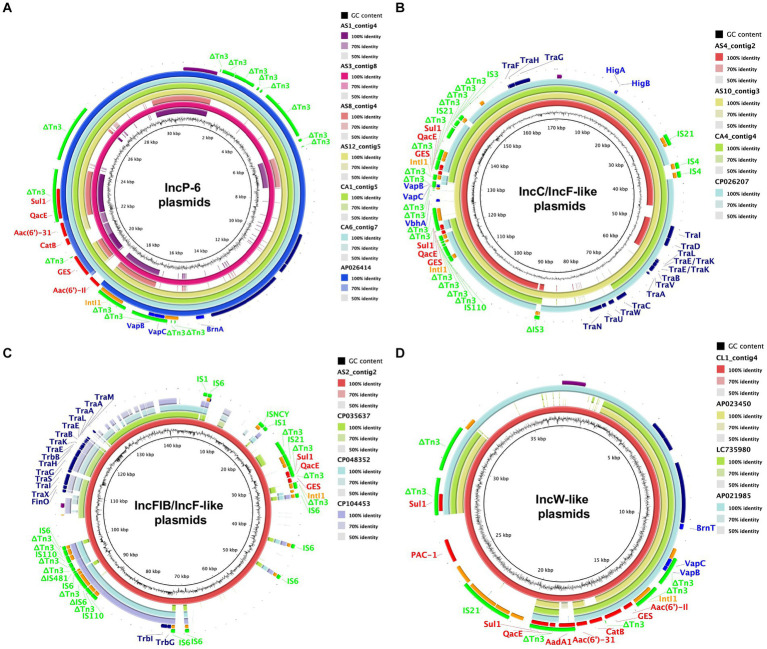
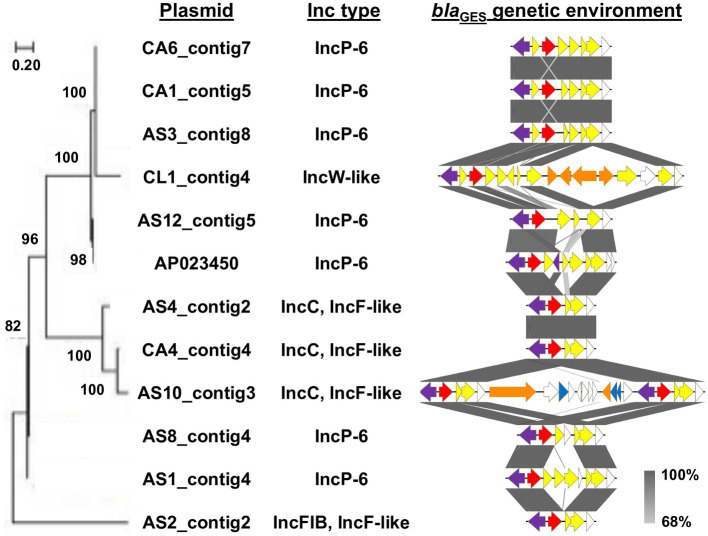
Eleven gram-negative bacteria (four spp., three spp., three spp., and one spp.) with ( = 6), ( = 4), and ( = 1) were isolated from the sewage sample. Five and a were localized in IncP-6 plasmids, whereas three plasmids were localized in IncC plasmids with IncF-like regions. The remaining and were, respectively, localized on IncFIB-containing plasmids with IncF-like regions and a plasmid with an IncW-like replication protein. The IncP-6 and IncW-like plasmids had a close genetic relationship with plasmids from Japan, whereas the IncC/IncF-like and IncFIB/IncF-like plasmids were closely related to those from the United States and Europe. All genes were located on the class 1 integron cassette of the Tn transposon-related region, and the IncC/IncF-like plasmid carried two copies of the integron cassette. Eight of the eleven -encoding plasmids contained toxin-antitoxin system genes.
The findings on the plasmids and the novel genetic content from a single wastewater sample extend our understanding regarding the diversity of resistance and the associated spread of , suggesting their high adaptability to hospital effluents. These findings highlight the need for the continuous monitoring of environmental GES-type carbapenemase producers to control their dissemination.
在全球范围内,圭亚那超广谱(GES)型碳青霉烯酶产生菌的流行率正在上升,医院水环境被认为是潜在的储存库。然而,这种耐药性背后的遗传特征尚未完全明确。本研究旨在对日本一家医院污水样本中编码碳青霉烯酶的质粒进行特征分析。
使用碳青霉烯酶选择性琼脂和聚合酶链反应筛选碳青霉烯酶产生菌。对产碳青霉烯酶的分离株进行全基因组测序分析。
从污水样本中分离出11株革兰氏阴性菌(4株肺炎克雷伯菌、3株大肠埃希菌、3株阴沟肠杆菌和1株弗劳地柠檬酸杆菌),分别产GES-5(n = 6)、GES-1(n = 4)和GES-2(n = 1)。5个GES-5和1个GES-1定位于IncP-6质粒,而3个GES-2质粒定位于带有IncF样区域的IncC质粒。其余的GES-5和GES-1分别定位于带有IncF样区域的含IncFIB质粒和带有IncW样复制蛋白的质粒上。IncP-6和IncW样质粒与来自日本的质粒有密切的遗传关系,而IncC/IncF样和IncFIB/IncF样质粒与来自美国和欧洲的质粒密切相关。所有GES基因均位于Tn转座子相关区域的1类整合子盒上,IncC/IncF样质粒携带两份整合子盒。11个编码GES的质粒中有8个含有毒素-抗毒素系统基因。
来自单一废水样本的质粒和新的遗传内容的研究结果扩展了我们对GES耐药性多样性及其相关传播的理解,表明它们对医院废水具有高度适应性。这些发现凸显了持续监测环境中GES型碳青霉烯酶产生菌以控制其传播的必要性。