Centro de Biologia Marinha, Universidade de São Paulo, São Sebastião, SP 11612-109, Brazil; Tennenbaum Marine Observatories Network and MarineGEO Program, Smithsonian Environmental Research Center, Edgewater, MD 20764, USA.
Lab. Macroecologia e Biogeografia Marinha, Universidade Federal de Santa Catarina, Florianópolis, SC 88040-090, Brazil.
Curr Biol. 2022 Jul 25;32(14):R765-R766. doi: 10.1016/j.cub.2022.06.030.
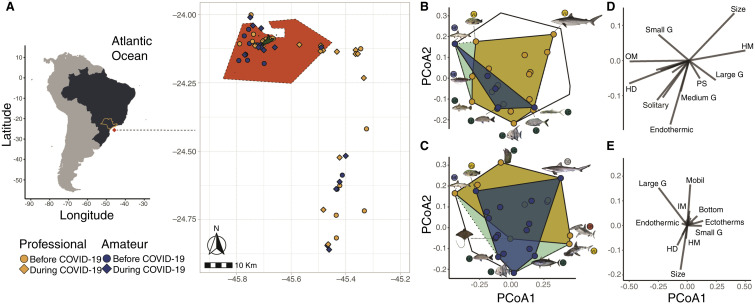
The global COVID-19 pandemic has presented a unique opportunity to explore the consequences of illegal exploitation on wildlife communities, as it continues to have wide-reaching impacts on multiple sectors, including local and national economies, international trade, and conservation enforcement. The ongoing reductions in monitoring and enforcement during the pandemic have allowed increased opportunities for illegal, unreported, and unregulated activities, particularly for small-scale fisheries. Even before the pandemic, policymakers and fisheries managers intent on controlling illegal fishing activities established marine protected areas (MPAs) that restrict or prohibit fishing. Unfortunately, non-compliance with MPAs is often the rule rather than the exception, and less than 10% of the world's MPAs have managed to effectively reduce infringement. The COVID-19 pandemic has exacerbated these management challenges: a recent review of MPAs worldwide has revealed a general decline in tourism revenue to operate park services during the pandemic, especially revenue needed for supporting personnel to monitor, patrol, and enforce restrictions. Here, we compile infraction records of illegal fishing activities by both professional (commercial) and amateur (recreational) boats inside and outside of the Tupinambás Ecological Station and the Alcatrazes Wildlife Refuge (Figure 1A), notable for its high reef-fish biomass and diversity in the Southwestern Atlantic. We show that illegal exploitation has shifted since the onset of the pandemic, targeting larger, higher-value species that contribute disproportionately to the structure and function of reef-fish communities in the region.
全球 COVID-19 大流行为探索非法开发对野生动物群落的后果提供了一个独特的机会,因为它继续对多个部门产生广泛影响,包括地方和国家经济、国际贸易和保护执法。大流行期间监测和执法的持续减少为非法、未报告和不受管制的活动提供了更多机会,特别是对于小规模渔业。即使在大流行之前,有意控制非法捕鱼活动的政策制定者和渔业管理人员也建立了海洋保护区 (MPAs),限制或禁止捕鱼。不幸的是,不遵守 MPA 通常是常态而不是例外,世界上不到 10%的 MPA 成功地有效减少了侵权行为。COVID-19 大流行加剧了这些管理挑战:最近对全球 MPA 的审查显示,大流行期间运营公园服务的旅游收入普遍下降,特别是需要人员来监测、巡逻和执行限制的人员的收入。在这里,我们整理了在 Tupinambás 生态站和 Alcatrazes 野生动物保护区内外非法捕鱼活动的违规记录(图 1A),该保护区以西南大西洋高珊瑚鱼生物量和多样性为特征。我们表明,自大流行开始以来,非法开发的目标已经转移,针对的是体型更大、价值更高的物种,这些物种对该地区珊瑚鱼群落的结构和功能不成比例地做出了贡献。