• 文献检索
  • 文档翻译
  • 深度研究
  • 学术资讯
  • Suppr Zotero 插件Zotero 插件
  • 邀请有礼
  • 套餐&价格
  • 历史记录
应用&插件
Suppr Zotero 插件Zotero 插件浏览器插件Mac 客户端Windows 客户端微信小程序
定价
高级版会员购买积分包购买API积分包
服务
文献检索文档翻译深度研究API 文档MCP 服务
关于我们
关于 Suppr公司介绍联系我们用户协议隐私条款
关注我们

Suppr 超能文献

核心技术专利:CN118964589B侵权必究
粤ICP备2023148730 号-1Suppr @ 2026

文献检索

告别复杂PubMed语法,用中文像聊天一样搜索,搜遍4000万医学文献。AI智能推荐,让科研检索更轻松。

立即免费搜索

文件翻译

保留排版,准确专业,支持PDF/Word/PPT等文件格式,支持 12+语言互译。

免费翻译文档

深度研究

AI帮你快速写综述,25分钟生成高质量综述,智能提取关键信息,辅助科研写作。

立即免费体验

2006 年至 2030 年巴西成年人的时间趋势和预计肥胖流行情况。

Time trends and projected obesity epidemic in Brazilian adults between 2006 and 2030.

机构信息

Department of Preventive Medicine, Escola Paulista de Medicina, Universidade Federal de São Paulo, Sao Paulo, Brazil.

Facultad de Ciencias, Especialidad Medicina del Deporte Y La Actividad Física, Universidad Mayor, Santiago, Chile.

出版信息

Sci Rep. 2022 Jul 26;12(1):12699. doi: 10.1038/s41598-022-16934-5.

DOI:10.1038/s41598-022-16934-5
PMID:35882969
原文链接:https://pmc.ncbi.nlm.nih.gov/articles/PMC9315079/
Abstract

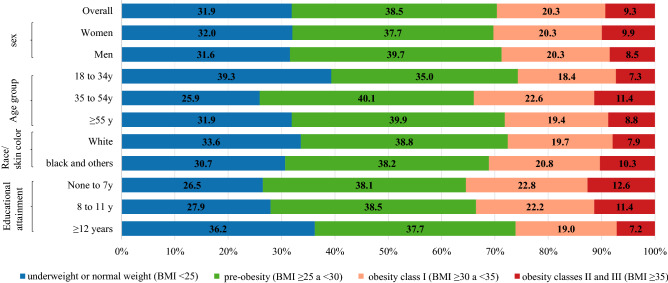
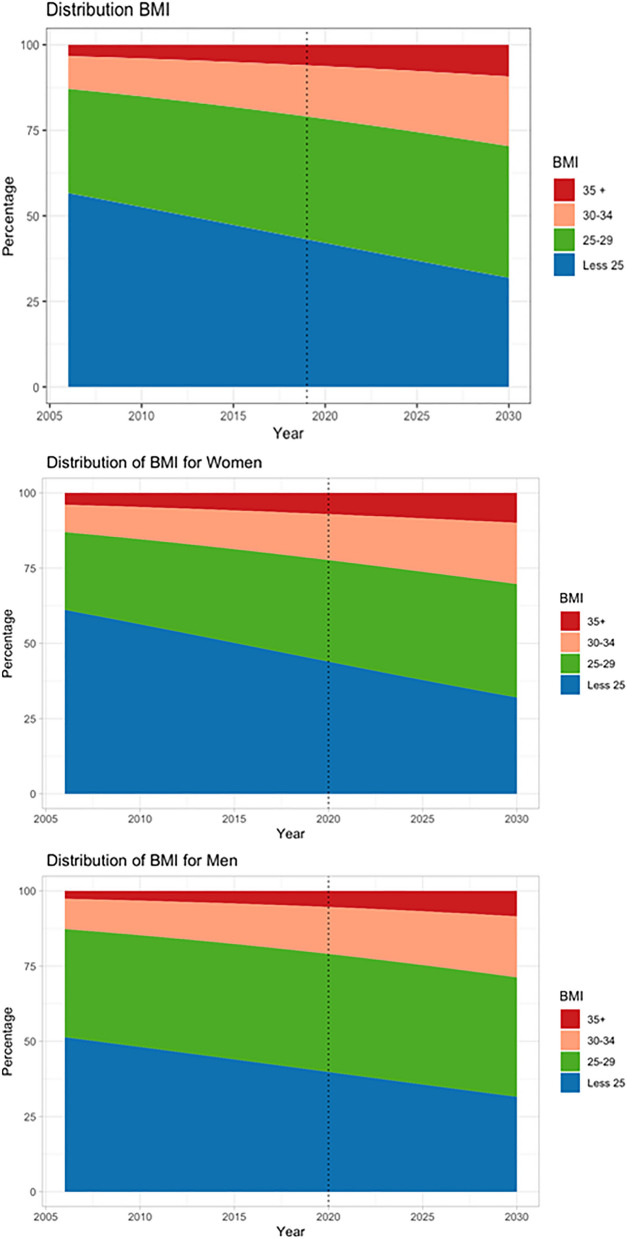
We examined time trends and projected obesity epidemic in Brazilian adults between 2006 and 2030 by sex, race/skin color, educational attainment, and state capitals. Self-reported body weight and height of 730,309 adults (≥ 18 years) from the Vigitel study were collected by telephone interview between 2006 and 2019. A multinomial logistic regression model was used to predict the prevalence of body mass index (BMI) categories as a function of time by 2030. The prevalence of obesity increased from 11.8% in 2006 to 20.3% in 2019. The projected prevalences by 2030 are estimated to be 68.1% for overweight, 29.6% for obesity, and 9.3% for obesity classes II and III. Women, black and other minority ethnicities, middle-aged adults, adults with ≤ 7 years of education, and in Northern and Midwestern capitals are estimated to have higher obesity prevalence by 2030. Our findings indicate a sustained increase in the obesity epidemic in all sociodemographic subgroups and across the country. Obesity may reach three out of 10 adults by 2030.

摘要

我们研究了 2006 年至 2030 年期间巴西成年人中按性别、种族/肤色、教育程度和州府划分的时间趋势和肥胖流行情况。通过电话访谈收集了来自 Vigitel 研究的 730309 名成年人(≥18 岁)的自我报告体重和身高,收集时间为 2006 年至 2019 年。使用多变量逻辑回归模型预测 2030 年时体重指数(BMI)类别随时间的流行情况。肥胖的患病率从 2006 年的 11.8%上升到 2019 年的 20.3%。到 2030 年,超重的预计患病率为 68.1%,肥胖的预计患病率为 29.6%,肥胖 II 级和 III 级的预计患病率为 9.3%。预计到 2030 年,女性、黑人和其他少数族裔、中年成年人、受教育程度≤7 年的成年人以及北部和中西部州府的肥胖患病率更高。我们的研究结果表明,肥胖流行在所有社会人口统计学亚组和全国各地都呈持续上升趋势。到 2030 年,可能每 10 个成年人中就有 3 个肥胖。
https://cdn.ncbi.nlm.nih.gov/pmc/blobs/46f3/9325721/78140e285d88/41598_2022_16934_Fig2_HTML.jpg
https://cdn.ncbi.nlm.nih.gov/pmc/blobs/46f3/9325721/f3973b584dba/41598_2022_16934_Fig1_HTML.jpg
https://cdn.ncbi.nlm.nih.gov/pmc/blobs/46f3/9325721/78140e285d88/41598_2022_16934_Fig2_HTML.jpg
https://cdn.ncbi.nlm.nih.gov/pmc/blobs/46f3/9325721/f3973b584dba/41598_2022_16934_Fig1_HTML.jpg
https://cdn.ncbi.nlm.nih.gov/pmc/blobs/46f3/9325721/78140e285d88/41598_2022_16934_Fig2_HTML.jpg

相似文献

1
Time trends and projected obesity epidemic in Brazilian adults between 2006 and 2030.2006 年至 2030 年巴西成年人的时间趋势和预计肥胖流行情况。
Sci Rep. 2022 Jul 26;12(1):12699. doi: 10.1038/s41598-022-16934-5.
2
Adult body weight trends in 27 urban populations of Brazil from 2006 to 2016: A population-based study.2006 年至 2016 年巴西 27 个城市成年人体重趋势:一项基于人群的研究。
PLoS One. 2019 Mar 6;14(3):e0213254. doi: 10.1371/journal.pone.0213254. eCollection 2019.
3
Trends in prevalence of overweight and obesity in adults in 26 Brazilian state capitals and the Federal District from 2006 to 2012.2006年至2012年巴西26个州首府及联邦区成年人超重和肥胖患病率的趋势
Rev Bras Epidemiol. 2014;17 Suppl 1:267-76. doi: 10.1590/1809-4503201400050021.
4
Time trends in hypertension and diabetes prevalence by body mass index categories in Brazilian adults from 2006 to 2023.2006 年至 2023 年巴西成年人按体重指数类别划分的高血压和糖尿病患病率的时间趋势。
Diabetes Obes Metab. 2024 Oct;26(10):4318-4328. doi: 10.1111/dom.15780. Epub 2024 Jul 22.
5
[Time trend in adult obesity indicators in Brazilian state capitals, 2006-2013].[2006 - 2013年巴西州首府成人肥胖指标的时间趋势]
Cien Saude Colet. 2016 Apr;21(4):1061-9. doi: 10.1590/1413-81232015214.12292015.
6
Prevalence of overweight and obesity and associated factors, Brazil, 2006.超重和肥胖的流行率及其相关因素,巴西,2006 年。
Rev Saude Publica. 2009 Nov;43 Suppl 2:83-9. doi: 10.1590/s0034-89102009000900011.
7
Prevalence trends of overweight, obesity, diabetes and hypertension among Brazilian women of reproductive age based on sociodemographic characteristics.基于社会人口学特征的巴西育龄妇女超重、肥胖、糖尿病和高血压患病率趋势
Health Care Women Int. 2019 Apr;40(4):386-406. doi: 10.1080/07399332.2019.1570516. Epub 2019 Apr 15.
8
Temporal variation in the prevalence of weight and obesity excess in adults: Brazil, 2006 to 2009.2006年至2009年巴西成年人超重和肥胖患病率的时间变化
Rev Bras Epidemiol. 2011 Sep;14 Suppl 1:157-65. doi: 10.1590/s1415-790x2011000500016.
9
Projected U.S. State-Level Prevalence of Adult Obesity and Severe Obesity.预计美国各州成年人肥胖和重度肥胖的流行率。
N Engl J Med. 2019 Dec 19;381(25):2440-2450. doi: 10.1056/NEJMsa1909301.
10
Temporal trend of overweight and obesity prevalence among Brazilian adults, according to sociodemographic characteristics, 2006-2019.2006-2019 年巴西成年人超重和肥胖流行的时间趋势,按社会人口特征分类。
Epidemiol Serv Saude. 2021 Jan-Dec;30(1):e2020294. doi: 10.1590/S1679-49742021000100008.

引用本文的文献

1
Temporal changes in the burden of type 2 diabetes mellitus across the BRICS, 1990-2021: a comprehensive analysis for the global burden of disease study 2021.1990 - 2021年金砖国家2型糖尿病负担的时间变化:2021年全球疾病负担研究的综合分析
BMC Public Health. 2025 Aug 30;25(1):2982. doi: 10.1186/s12889-025-23786-x.
2
Population attributable fractions of modifiable dementia risk factors for cognitive impairment-the ELSA-Brasil cohort study.认知障碍可改变痴呆风险因素的人群归因分数——巴西ELSA队列研究
Lancet Reg Health Am. 2025 Jul 12;49:101184. doi: 10.1016/j.lana.2025.101184. eCollection 2025 Sep.
3
Association between adherence to the Food Guide golden rule and health characteristics among adult Brazilian women: a cross-sectional study with VIGITEL data, 2018-2021.

本文引用的文献

1
The economic burden of overweight and obesity in Brazil: perspectives for the Brazilian Unified Health System.巴西超重和肥胖的经济负担:巴西统一卫生系统的视角。
Public Health. 2022 Jun;207:82-87. doi: 10.1016/j.puhe.2022.03.015. Epub 2022 May 12.
2
Socioeconomic inequalities in physical activity in Brazil: a pooled cross-sectional analysis from 2013 to 2019.巴西身体活动方面的社会经济不平等:2013年至2019年的汇总横断面分析
Int J Equity Health. 2021 Aug 23;20(1):188. doi: 10.1186/s12939-021-01533-z.
3
Educational disparities in hypertension, diabetes, obesity and smoking in Brazil: a trend analysis of 578 977 adults from a national survey, 2007-2018.
巴西成年女性对食物指南黄金法则的依从性与健康特征之间的关联:一项基于2018 - 2021年VIGITEL数据的横断面研究
Epidemiol Serv Saude. 2025 Apr 11;34:e20240232. doi: 10.1590/S2237-96222025v34e20240232.en. eCollection 2025.
4
Qualitative methodological pathway for developing the Instructive for the Obesity Management in the SUS, 2018-2020.2018 - 2020年制定《统一卫生系统肥胖管理指南》的定性方法路径
Epidemiol Serv Saude. 2025 Apr 14;34:e20240365. doi: 10.1590/S2237-96222025v34e20240365.en. eCollection 2025.
5
Exploring the perceptions of obesity, health habits, stigma, and eating behaviors in Brazil.探索巴西对肥胖、健康习惯、污名化及饮食行为的认知。
Diabetol Metab Syndr. 2025 Apr 7;17(1):119. doi: 10.1186/s13098-025-01660-5.
6
Care of patients with obesity in the Emergency Department: a joint position statement from the Brazilian Association of Emergency Medicine (ABRAMEDE) and the Brazilian Association for the Study of Obesity and Metabolic Syndrome (ABESO).急诊科肥胖患者的护理:巴西急诊医学协会(ABRAMEDE)和巴西肥胖与代谢综合征研究协会(ABESO)的联合立场声明。
Arch Endocrinol Metab. 2025 Mar 24;69(1):e240411. doi: 10.20945/2359-4292-2024-0411.
7
Climate change and tuberculosis: an analytical framework.气候变化与结核病:一个分析框架
medRxiv. 2025 Feb 20:2025.02.18.25322451. doi: 10.1101/2025.02.18.25322451.
8
Trends in the prevalence of obesity and estimation of the direct health costs attributable to child and adolescent obesity in Brazil from 2013 to 2022.2013年至2022年巴西儿童和青少年肥胖症患病率趋势及肥胖症所致直接健康成本估算
PLoS One. 2025 Jan 16;20(1):e0308751. doi: 10.1371/journal.pone.0308751. eCollection 2025.
9
Isotemporal substitution of physical activity patterns and sitting time with obesity indicators among workers in São Paulo.圣保罗工人身体活动模式和久坐时间与肥胖指标的等时替代关系
Sci Rep. 2025 Jan 11;15(1):1684. doi: 10.1038/s41598-025-85601-2.
10
Is Income and Racial Residential Segregation Associated with 13-Year Changes in Body Mass Index? A Longitudinal Analysis in the Brazilian Pró-Saúde Cohort Study.收入和种族居住隔离与体重指数的13年变化有关吗?巴西健康促进队列研究的纵向分析。
J Urban Health. 2025 Apr;102(2):250-258. doi: 10.1007/s11524-024-00949-6. Epub 2025 Jan 6.
巴西高血压、糖尿病、肥胖和吸烟方面的教育差距:2007-2018 年全国调查 578977 名成年人的趋势分析。
BMJ Open. 2021 Jul 19;11(7):e046154. doi: 10.1136/bmjopen-2020-046154.
4
Modelling future trajectories of obesity and body mass index in England.模拟英格兰肥胖和体重指数的未来趋势。
PLoS One. 2021 Jun 2;16(6):e0252072. doi: 10.1371/journal.pone.0252072. eCollection 2021.
5
Data Resource Profile: Surveillance System of Risk and Protective Factors for Chronic Diseases by Telephone Survey for adults in Brazil (Vigitel).数据资源简介:巴西成人慢性病风险与保护因素电话调查监测系统(Vigitel)
Int J Epidemiol. 2021 Aug 30;50(4):1058-1063. doi: 10.1093/ije/dyab104.
6
COVID-19 in LMICs: The Need to Place Stigma Front and Centre to Its Response.低收入和中等收入国家的新冠疫情:应对疫情需将污名化问题置于首要和核心位置。
Eur J Dev Res. 2020;32(5):1592-1612. doi: 10.1057/s41287-020-00316-6. Epub 2020 Oct 21.
7
How is Brazil facing the crisis of Food and Nutrition Security during the COVID-19 pandemic?巴西如何应对 COVID-19 大流行期间的粮食和营养安全危机?
Public Health Nutr. 2021 Feb;24(3):561-564. doi: 10.1017/S1368980020003973. Epub 2020 Oct 12.
8
Physical activity: Benefits and challenges during the COVID-19 pandemic.体育活动:新冠疫情期间的益处与挑战
Scand J Med Sci Sports. 2020 Jul;30(7):1291-1294. doi: 10.1111/sms.13710.
9
Society and the slow burn of inequality.社会与不平等的缓慢加剧
Lancet. 2020 May 2;395(10234):1413-1414. doi: 10.1016/S0140-6736(20)30940-5.
10
Three lessons for the COVID-19 response from pandemic HIV.从艾滋病大流行应对措施中汲取的关于新冠疫情应对的三个教训。
Lancet HIV. 2020 May;7(5):e309-e311. doi: 10.1016/S2352-3018(20)30110-7. Epub 2020 Apr 13.