Faculdade de Medicina, Universidade Federal de Uberlandia, Uberlandia, MG, Brazil.
Universidade Federal de São Paulo, Escola Paulista de Medicina, Departamento de Medicina Preventiva, Sao Paulo, SP, Brazil.
BMJ Open. 2021 Jul 19;11(7):e046154. doi: 10.1136/bmjopen-2020-046154.
Our study aimed to assess social inequality trends for hypertension, diabetes mellitus, smoking and obesity from 2007 to 2018 in adults from Brazilian capitals.
Data from the Surveillance of Risk and Protection Factors for Chronic Diseases by Telephone Survey study, a cross-sectional telephone survey, conducted annually from 2007 to 2018.
We used data from 578 977 Brazilian adults (≥18 years).
Cross-sectional surveys conducted annually from 2007 to 2018.
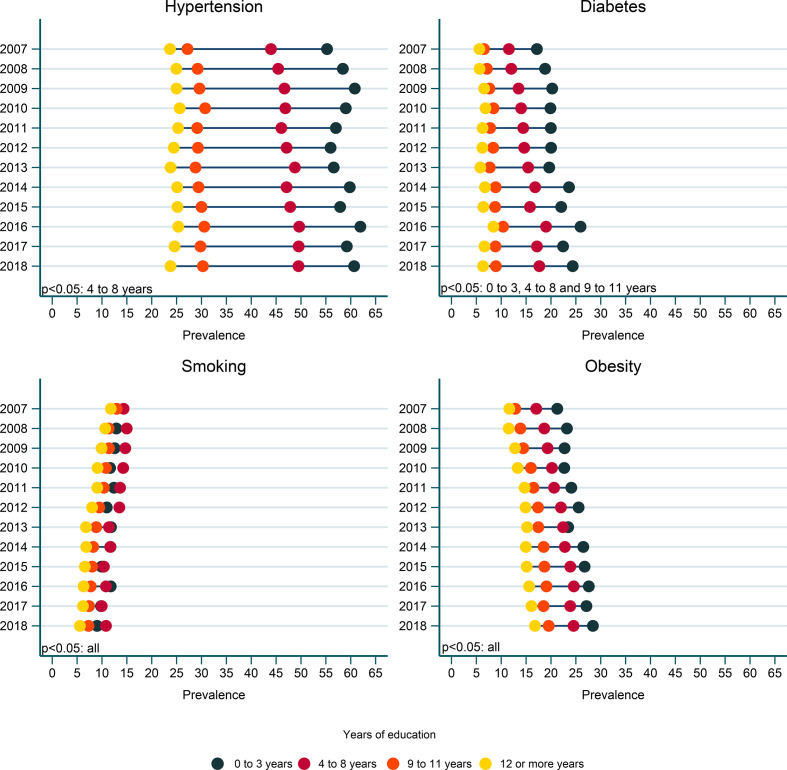
Participants responded to a questionnaire about medical diagnosis of hypertension and diabetes, smoking status, weight and height. Educational inequalities (0-3, 4-8, 9-11 and 12 or more years of study) by sex and skin colour were assessed trough absolute, Slope Index of Inequality (SII) and relative measures of inequality, Concentration Index and trends were tested by Prais-Winsten.
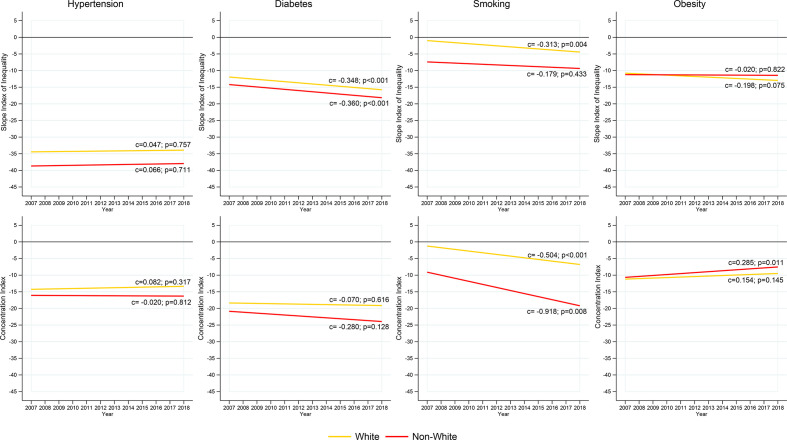
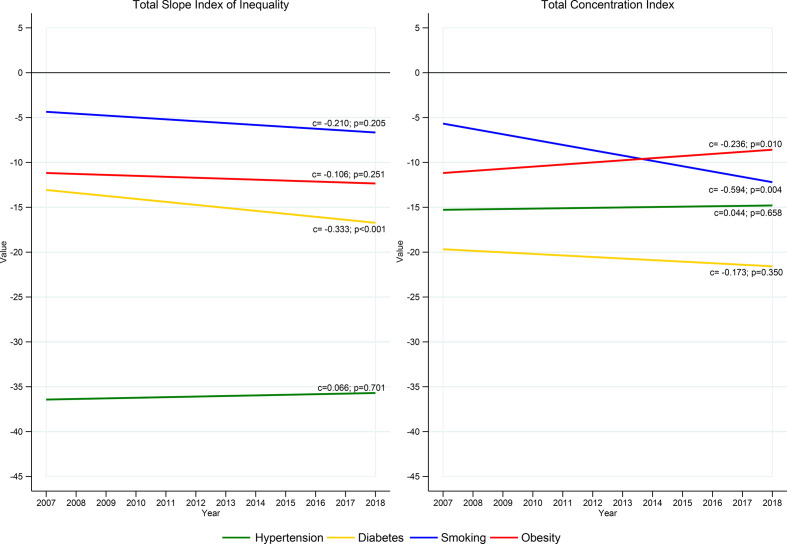
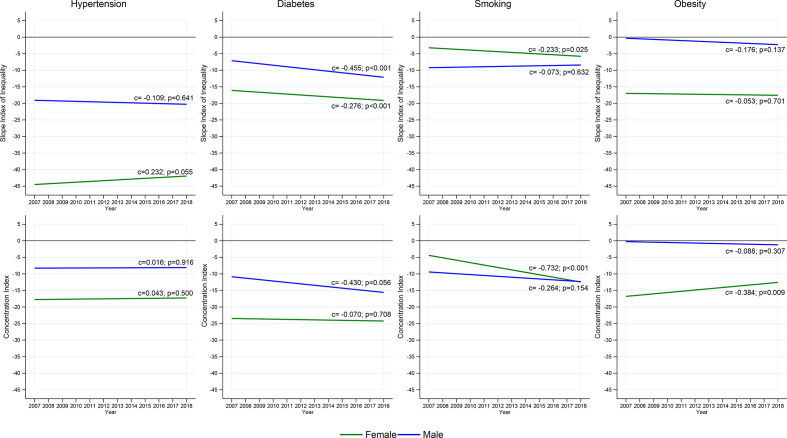
All outcomes were more prevalent in the least educated. The largest absolute educational inequality was observed for hypertension (SII=-37.8 in 2018). During 2007-2018, the total educational disparity remained constant for hypertension, increased for diabetes and smoking, and decreased for obesity. Overall, inequality was higher among women and non-whites, compared with men and whites. We found a reduction in absolute inequality for hypertension among non-whites, an increase for diabetes in all strata, and an increase for smoking in women and non-whites. The relative inequality decreased in women and whites and increased for smoking in all strata, except among men.
The educational inequality reduced for obesity, remained constant for hypertension and increased for diabetes and smoking from 2007 to 2018 in Brazilian adults.
本研究旨在评估 2007 年至 2018 年巴西各首府成年人中高血压、糖尿病、吸烟和肥胖的社会不平等趋势。
数据来自通过电话调查监测慢性病风险和保护因素的研究,这是一项横断面电话调查,每年于 2007 年至 2018 年进行。
我们使用了来自 578977 名巴西成年人(≥18 岁)的数据。
2007 年至 2018 年每年进行的横断面调查。
参与者回答了一份关于高血压和糖尿病的医学诊断、吸烟状况、体重和身高的问卷。通过绝对不平等、不平等斜率指数(SII)和相对不平等衡量指标、集中指数以及 Prais-Winsten 检验趋势,评估了按性别和肤色划分的教育不平等(0-3、4-8、9-11 和 12 年或以上)。
所有结果在受教育程度最低的人群中更为普遍。高血压的最大绝对教育不平等(SII=-37.8,2018 年)。2007-2018 年间,高血压的总教育差异保持不变,糖尿病和吸烟的教育差异增加,肥胖的教育差异减少。总体而言,女性和非白人的不平等程度高于男性和白人。我们发现,非白人的高血压绝对不平等有所减少,所有人群的糖尿病都有所增加,女性和非白人的吸烟有所增加。除男性外,女性和白人的相对不平等有所减少,所有人群的吸烟相对不平等有所增加。
2007 年至 2018 年,巴西成年人中肥胖的教育不平等有所减少,高血压保持不变,糖尿病和吸烟有所增加。