Hertel G, Hochrein A, Suren C, Minzlaff P, Banke I J, Willers J, von Eisenhart-Rothe R, Prodinger P M
Klinik und Poliklinik für Orthopädie und Sportorthopädie, Klinikum rechts der Isar, Technische Universität München, Ismaninger Straße 22, 81675, Munich, Germany.
OCM Orthopädische Chirurgie München, Munich, Germany.
BMC Sports Sci Med Rehabil. 2022 Jul 26;14(1):145. doi: 10.1186/s13102-022-00525-y.
The aim of this study was to analyze incidences and sport-specific injury patterns among users of a bodyweight-based training method instructed by a smartphone app (Freeletics Bodyweight App).
An online questionnaire based on current validated epidemiological observation methods was designed using the statistic website Surveymonkey. Subscribers of the Freeletics Bodyweight App were contacted via an online link. Injury incidence, defined as an event leading to a training pause of at least 1 day, was recorded. The type of injury was reported and classified. Furthermore, all participants were asked whether they recognized any positive or negative effects on their subjective health status. The collected data were analyzed using Surveymonkey statistic services.
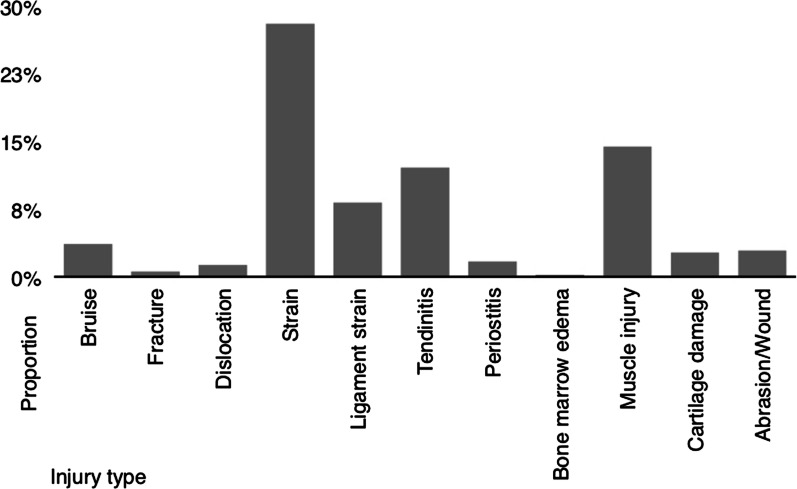
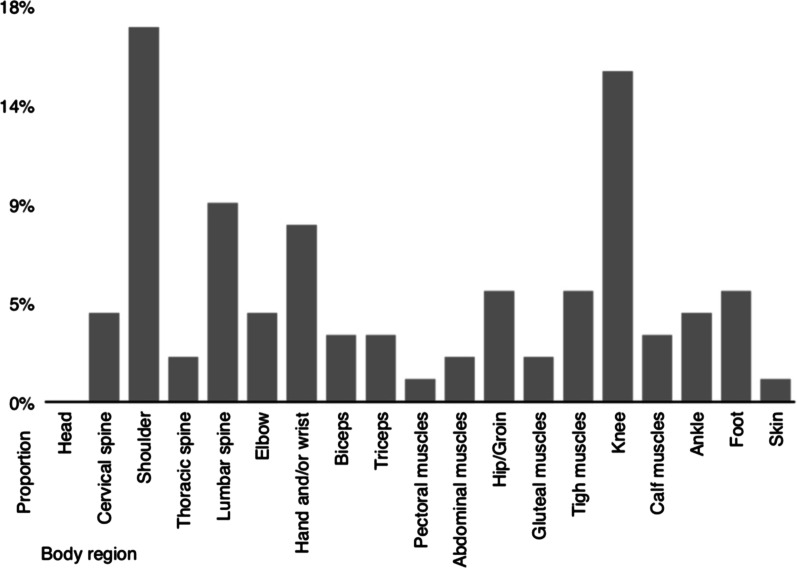
A total of 4365 Freeletics users responded to the questionnaire, 3668 completed forms were subject of further investigation. The injury period prevalence reported by users of the Freeletics App was 24% in men and 21% in women. The most frequently reported site of injury was the shoulder (29%) and the knee joint (28%), with strains (28.5%) and other muscle injuries (14.4%) being the most frequently reported types of injuries. An injury incidence rate of 4.57 per 1000 h was calculated, with injuries occurring less frequently in experienced users. Most participants reported a distinct positive effect of the app-based training on their health status.
In comparison to other sports activities app-based bodyweight training is associated with a comparably low injury period prevalence. The vast majority of injuries were reported to have resolved within one week.
本研究旨在分析使用一款由智能手机应用程序(Freeletics体重训练应用程序)指导的基于自重训练方法的用户的损伤发生率及特定运动损伤模式。
基于当前经过验证的流行病学观察方法,使用统计网站SurveyMonkey设计了一份在线问卷。通过在线链接联系Freeletics体重训练应用程序的订阅者。记录损伤发生率,定义为导致至少1天训练暂停的事件。报告并分类损伤类型。此外,询问所有参与者是否认识到对其主观健康状况有任何积极或消极影响。使用SurveyMonkey统计服务对收集的数据进行分析。
共有4365名Freeletics用户回复了问卷,3668份完整表格进入进一步调查。Freeletics应用程序用户报告的损伤期患病率男性为24%,女性为21%。最常报告的损伤部位是肩部(29%)和膝关节(28%),拉伤(28.5%)和其他肌肉损伤(14.4%)是最常报告的损伤类型。计算出每1000小时的损伤发生率为4.57,经验丰富的用户损伤发生频率较低。大多数参与者报告基于应用程序的训练对其健康状况有明显的积极影响。
与其他体育活动相比,基于应用程序的自重训练损伤期患病率相对较低。绝大多数损伤报告在一周内得到解决。