Prevention Research Branch, National Institute on Drug Abuse, 3WFN MSC 6024, 301 North Stonestreet Ave, Bethesda, MD, 20892, USA.
University of Washington Harborview Medical Center, 325 9th Ave, Box 359931, Seattle, WA, 98106, USA.
Addict Sci Clin Pract. 2022 Jul 26;17(1):38. doi: 10.1186/s13722-022-00322-5.
To characterize and address the opioid crisis disproportionately impacting rural U.S. regions.
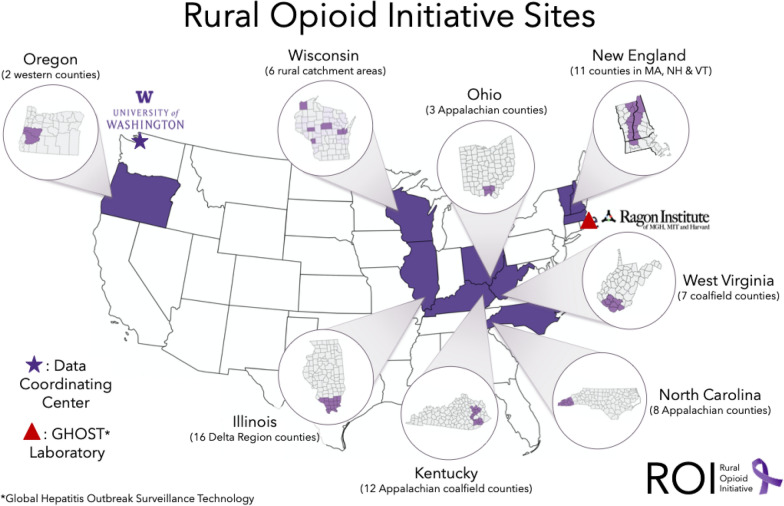
The Rural Opioid Initiative (ROI) is a two-phase project to collect and harmonize quantitative and qualitative data and develop tailored interventions to address rural opioid use. The baseline quantitative survey data from people who use drugs (PWUD) characterizes the current opioid epidemic (2018-2020) in eight geographically diverse regions.
Among 3,084 PWUD, 92% reported ever injecting drugs, 86% reported using opioids (most often heroin) and 74% reported using methamphetamine to get high in the past 30 days; 53% experienced homelessness in the prior 6 months; and 49% had ever overdosed. Syringe service program use varied by region and 53% had ever received an overdose kit or naloxone prescription. Less than half (48%) ever received medication for opioid use disorder (MOUD).
The ROI combines data across eight rural regions to better understand drug use including drivers and potential interventions in rural areas with limited resources. Baseline ROI data demonstrate extensive overlap between opioid and methamphetamine use, high homelessness rates, inadequate access to MOUD, and other unmet needs among PWUD in the rural U.S. By combining data across studies, the ROI provides much greater statistical power to address research questions and better understand the syndemic of infectious diseases and drug use in rural settings including unmet treatment needs.
描述并解决严重影响美国农村地区的阿片类药物危机。
农村阿片类药物倡议(ROI)是一个两阶段项目,旨在收集和协调定量和定性数据,并制定针对农村阿片类药物使用的定制干预措施。从吸毒者(PWUD)收集的基线定量调查数据描绘了当前阿片类药物流行情况(2018-2020 年)在八个地理上多样化的地区。
在 3084 名吸毒者中,92%报告曾经注射过毒品,86%报告使用过阿片类药物(最常见的是海洛因),74%报告在过去 30 天内使用过冰毒来兴奋;53%在过去 6 个月内经历过无家可归;49%曾经过量用药。地区之间的注射器服务项目使用情况存在差异,53%曾经接受过过量药物套件或纳洛酮处方。不到一半(48%)曾经接受过阿片类药物使用障碍的药物治疗(MOUD)。
ROI 结合了八个农村地区的数据,以更好地了解农村地区的药物使用情况,包括驱动因素和潜在干预措施,这些地区资源有限。ROI 的基线数据表明,阿片类药物和冰毒使用之间存在广泛的重叠,高 homelessness 率,MOUD 获得不足以及农村地区 PWUD 的其他未满足需求。通过结合研究数据,ROI 提供了更大的统计能力来解决研究问题,并更好地了解农村地区传染病和药物使用的综合征,包括未满足的治疗需求。