Newman Mackenzie, Connery Heather, Boyd Jonathan
Department of Orthopaedics, School of Medicine, West Virginia University, Morgantown, WV 26506, USA.
Department of Physiology and Pharmacology, Robert C. Byrd Health Sciences Center, West Virginia University, Morgantown, WV 26505, USA.
Antioxidants (Basel). 2022 Jun 27;11(7):1267. doi: 10.3390/antiox11071267.
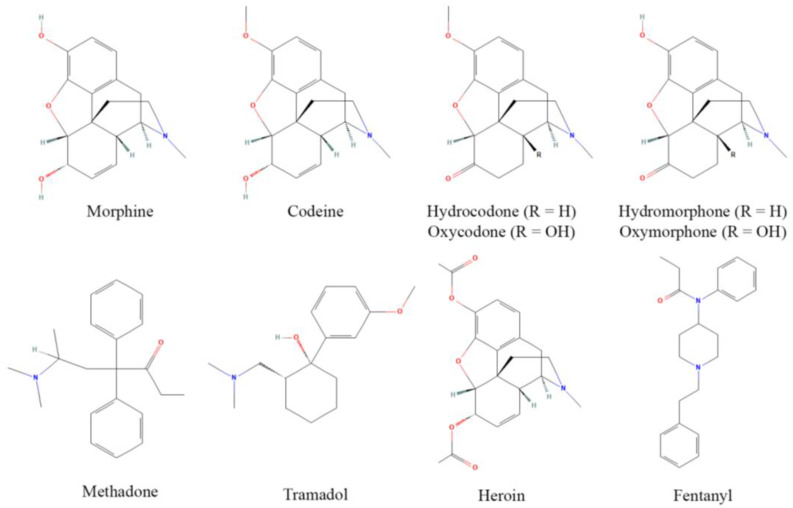
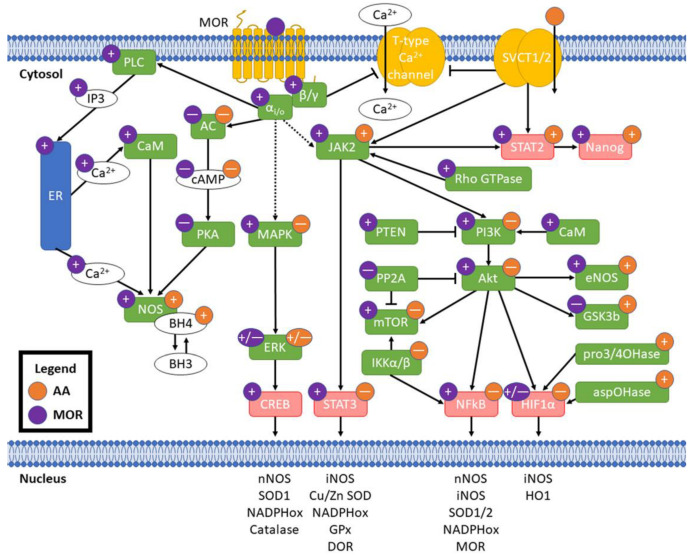
Opioids are among the most widely used classes of pharmacologically active compounds both clinically and recreationally. Beyond their analgesic efficacy via μ opioid receptor (MOR) agonism, a prominent side effect is central respiratory depression, leading to systemic hypoxia and free radical generation. Vitamin C (ascorbic acid; AA) is an essential antioxidant vitamin and is involved in the recycling of redox cofactors associated with inflammation. While AA has been shown to reduce some of the negative side effects of opioids, the underlying mechanisms have not been explored. The present review seeks to provide a signaling framework under which MOR activation and AA may interact. AA can directly quench reactive oxygen and nitrogen species induced by opioids, yet this activity alone does not sufficiently describe observations. Downstream of MOR activation, confounding effects from AA with STAT3, HIF1α, and NF-κB have the potential to block production of antioxidant proteins such as nitric oxide synthase and superoxide dismutase. Further mechanistic research is necessary to understand the underlying signaling crosstalk of MOR activation and AA in the amelioration of the negative, potentially fatal side effects of opioids.
阿片类药物是临床上和娱乐用途中使用最广泛的药理活性化合物类别之一。除了通过μ阿片受体(MOR)激动产生镇痛作用外,一个突出的副作用是中枢性呼吸抑制,导致全身缺氧和自由基生成。维生素C(抗坏血酸;AA)是一种必需的抗氧化维生素,参与与炎症相关的氧化还原辅因子的循环利用。虽然已经证明AA可以减轻阿片类药物的一些负面副作用,但其潜在机制尚未得到探索。本综述旨在提供一个信号框架,在该框架下MOR激活和AA可能相互作用。AA可以直接淬灭由阿片类药物诱导的活性氧和氮物种,但仅这一活性不足以解释观察结果。在MOR激活的下游,AA与信号转导和转录激活因子3(STAT3)、缺氧诱导因子1α(HIF1α)和核因子κB(NF-κB)的混杂效应有可能阻断抗氧化蛋白如一氧化氮合酶和超氧化物歧化酶的产生。有必要进行进一步的机制研究,以了解MOR激活和AA在改善阿片类药物负面的、潜在致命的副作用方面的潜在信号串扰。