Shenzhen Key Laboratory of Advanced Thin Films and Applications, College of Physics and Optoelectronic Engineering, Shenzhen University, Shenzhen 518060, China.
Faculty of Engineering and Environment, Northumbria University, Newcastle upon Tyne NE1 8ST, UK.
Biosensors (Basel). 2022 Jul 18;12(7):536. doi: 10.3390/bios12070536.
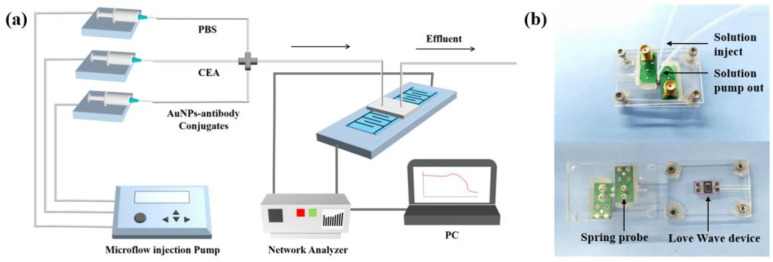
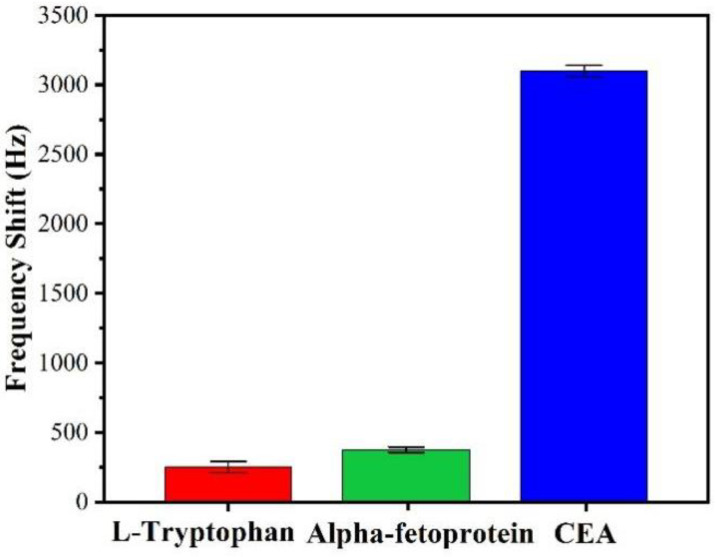
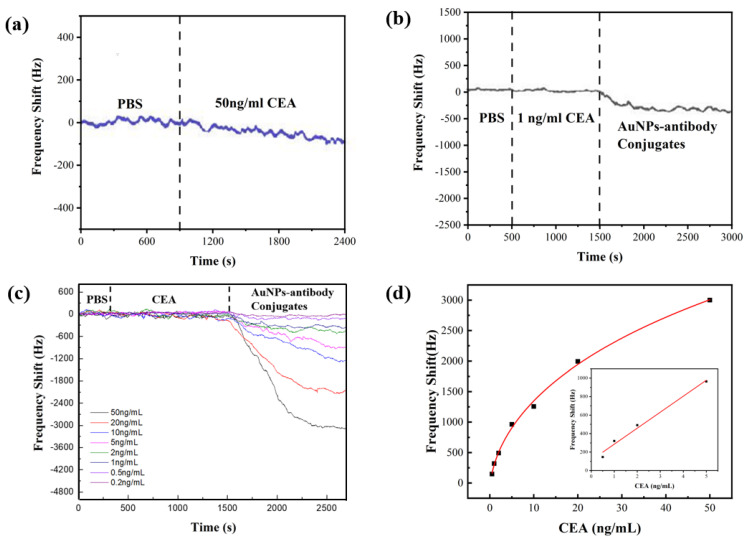
A highly sensitive and precise Love wave mode surface acoustic wave (SAW) immunosensor based on an ST-cut 90°X quartz substrate and an SiO wave-guiding layer was developed to detect cancer-related biomarkers of carcinoembryonic antigens (CEAs). A delay line structure of the SAW device with a resonant frequency of 196 MHz was designed/fabricated, and its surface was functionalized through CEA antibody immobilization. The CEA antibodies were bound with gold nanoparticles and CEA antibodies to form a sandwich structure, which significantly amplified the mass loading effect and enhanced the maximum responses by 30 times. The center frequency of the Love wave immunosensor showed a linear response as a function of the CEA concentration in the range of 0.2-5 ng/mL. It showed a limit of detection of 0.2 ng/mL, and its coefficient of determination was 0.983. The sensor also showed minimal interference from nonspecific adsorptions, thus demonstrating its promise for point-of-care applications for cancer biomarkers.
基于 ST 切 90°X 石英基片和 SiO 波导层,研制出了一种高灵敏度、高精度的声表面波(SAW)免疫传感器,用于检测癌胚抗原(CEA)等癌症相关生物标志物。设计/制造了具有 196 MHz 谐振频率的 SAW 器件延迟线结构,并通过 CEA 抗体固定化对其表面进行功能化。CEA 抗体与金纳米粒子结合,并与 CEA 抗体形成三明治结构,这显著放大了质量加载效应,使最大响应增强了 30 倍。Love 波免疫传感器的中心频率表现出与 CEA 浓度在 0.2-5ng/mL 范围内呈线性响应的关系。它的检测限为 0.2ng/mL,其决定系数为 0.983。该传感器还表现出对非特异性吸附的最小干扰,因此有望用于癌症生物标志物的即时护理应用。