Institute of Chemistry, Faculty of Advanced Technologies and Chemistry, Military University of Technology, 00-908 Warsaw, Poland.
Sensors (Basel). 2023 Sep 6;23(18):7688. doi: 10.3390/s23187688.
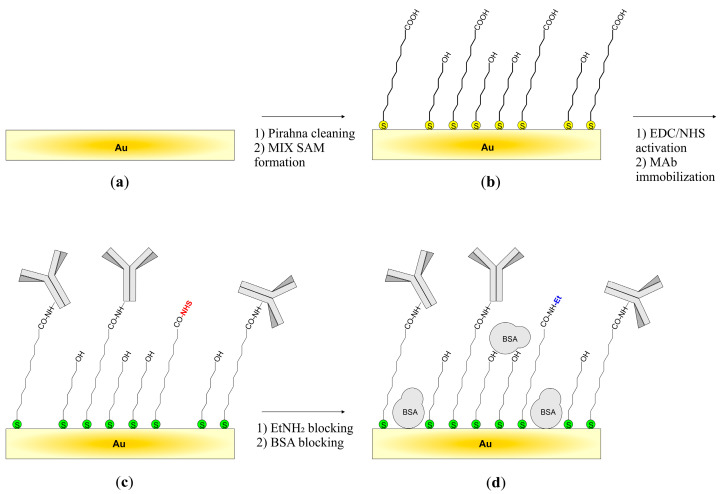
A Love-type acoustic wave sensor (AT-cut quartz substrate, SiO guiding layer) with a center frequency of approximately 120 MHz was used to detect a simulant of pathogenic botulinum neurotoxin type A-recombinant of BoNT-A light chain-in liquid samples. The sensor was prepared by immobilizing monoclonal antibodies specific for botulinum neurotoxin via a thiol monolayer deposited on a gold substrate. Studies have shown that the sensor enables selective analyte detection within a few minutes. In addition, the sensor can be used several times (regeneration of the sensor is possible using a low pH buffer). Nevertheless, the detectability of the analyte is relatively low compared to other analytical techniques that can be used for rapid detection of botulinum neurotoxin. The obtained results confirm the operation of the proposed sensor and give hope for further development of this label-free technique for detecting botulinum neurotoxin.
使用中心频率约为 120MHz 的爱(Love)型声波传感器(AT 切石英基片、SiO 波导层)检测模拟的致病性肉毒梭菌神经毒素 A 型-重组 BoNT-A 轻链在液体样品中的情况。传感器通过在金基底上沉积的硫醇单层固定针对肉毒神经毒素具有特异性的单克隆抗体来制备。研究表明,该传感器可在数分钟内实现对特定分析物的选择性检测。此外,该传感器可重复使用数次(使用低 pH 缓冲液可实现传感器再生)。然而,与其他可用于快速检测肉毒神经毒素的分析技术相比,分析物的检测灵敏度相对较低。所获得的结果证实了所提出的传感器的运行情况,并为进一步开发这种用于检测肉毒神经毒素的无标记技术带来了希望。