Jandas P J, Luo Jingting, Quan Aojie, Li Chong, Fu Chen, Fu Y Q
Shenzhen Key Laboratory of Advanced Thin Films and Applications, College of Physics and Energy, Shenzhen University 518060 Shenzhen PR China
Key Laboratory of Optoelectronic Devices and Systems of Ministry of Education and Guangdong Province, College of Optoelectronic Engineering, Shenzhen University 518060 Shenzhen PR China.
RSC Adv. 2020 Jan 24;10(7):4118-4128. doi: 10.1039/c9ra09963h. eCollection 2020 Jan 22.
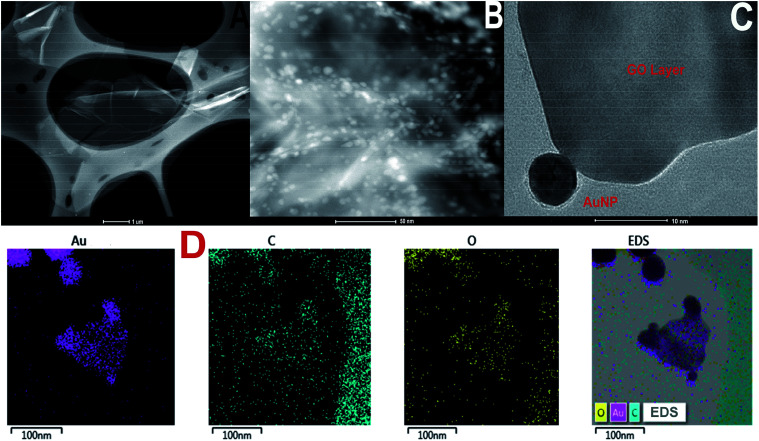
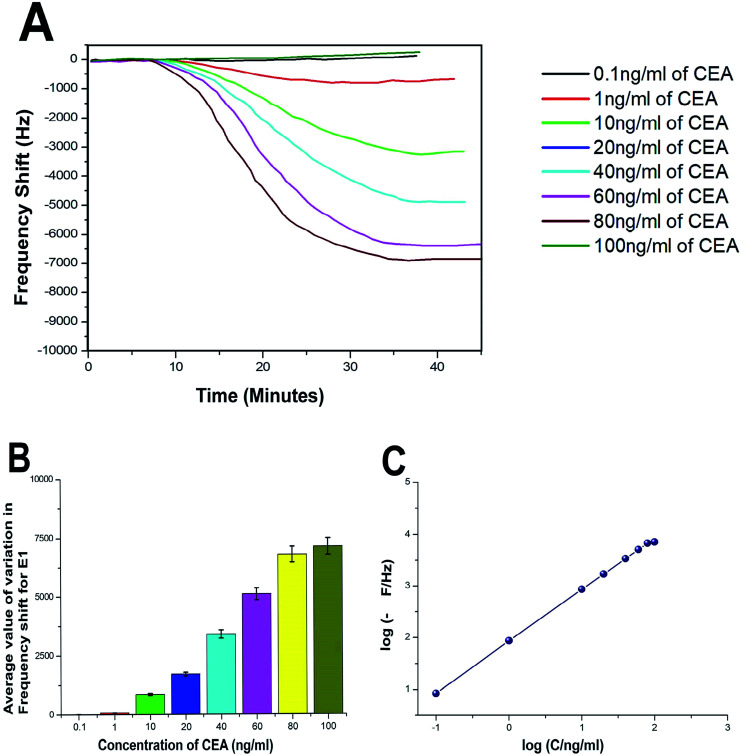
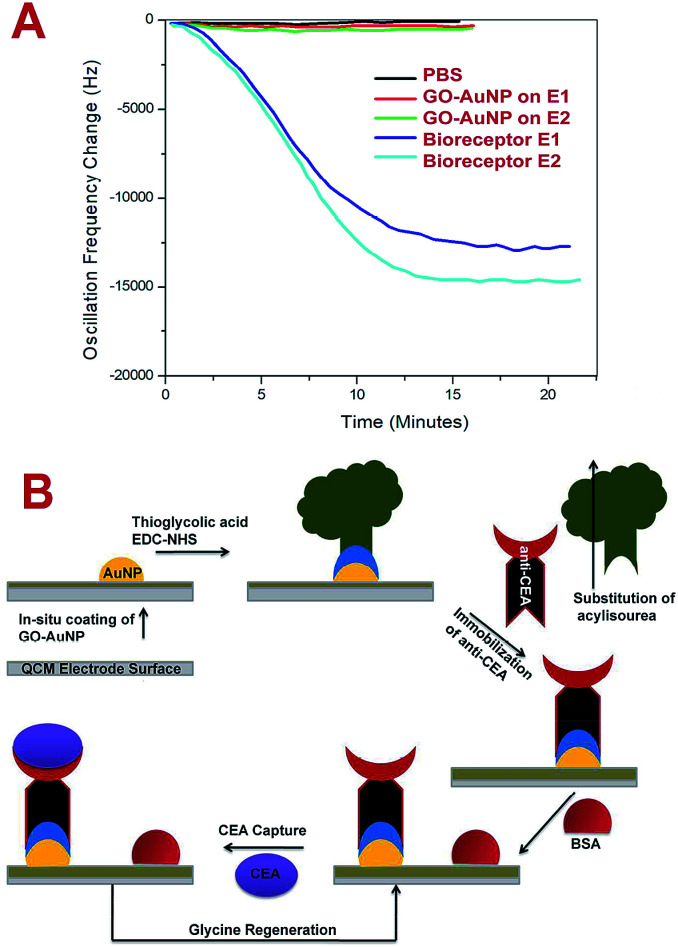
A label-free quartz crystal microbalance (QCM) biosensor was developed for the selective and real-time estimation of carcinoembryonic antigen (CEA) through the present study. Graphene oxide-Au nanoparticles (GO-AuNPs) was synthesised on the surface of the QCM electrode and the antibody of CEA (monoclonal anti-CEA from mouse) was covalently immobilized on this layer as the bioreceptor for CEA. Mercaptoacetic acid-EDC-NHS reaction mechanism was used for anti-CEA immobilization. The effect of oxygen plasma treatment of the QCM electrode surface before bioreceptor preparation on the performance of the biosensor was tested and was found promising. CEA solutions with various concentrations were analysed using the bioreceptors to estimate the sensitivity and detection limit of the biosensor. The biosensors selectively recognized and captured CEA biomolecules with a detection limit of 0.06 and 0.09 ng mL of CEA for oxygen plasma-treated (E2) and untreated (E1) bioreceptors, respectively. The sensitivity was estimated at 102 and 79 Hz, respectively, for E2 and E1. Clinical serum samples were analysed and the results were found in good agreement with the ELISA analysis. Long term stability was also found to be excellent. Langmuir adsorption isotherm was also conducted using the experimental results.
通过本研究,开发了一种无标记石英晶体微天平(QCM)生物传感器,用于选择性实时检测癌胚抗原(CEA)。在QCM电极表面合成了氧化石墨烯-金纳米颗粒(GO-AuNPs),并将CEA抗体(小鼠抗CEA单克隆抗体)共价固定在该层上作为CEA的生物受体。采用巯基乙酸-EDC-NHS反应机制固定抗CEA。测试了生物受体制备前QCM电极表面氧等离子体处理对生物传感器性能的影响,结果很有前景。使用生物受体分析不同浓度的CEA溶液,以评估生物传感器的灵敏度和检测限。对于氧等离子体处理的(E2)和未处理的(E1)生物受体,生物传感器分别以0.06和0.09 ng/mL CEA的检测限选择性识别和捕获CEA生物分子。E2和E1的灵敏度分别估计为102和79 Hz。对临床血清样本进行了分析,结果与ELISA分析结果高度一致。还发现长期稳定性极佳。利用实验结果进行了朗缪尔吸附等温线研究。