Heinzel Alexander, Dedic Daniela, Galldiks Norbert, Lohmann Philipp, Stoffels Gabriele, Filss Christian P, Kocher Martin, Migliorini Filippo, Dillen Kim N H, Geisler Stefanie, Stegmayr Carina, Willuweit Antje, Sabel Michael, Rapp Marion, Eble Michael J, Piroth Marc, Clusmann Hans, Delev Daniel, Bauer Elena K, Ceccon Garry, Dunkl Veronika, Rosen Jurij, Tscherpel Caroline, Werner Jan-Michael, Ruge Maximilian I, Goldbrunner Roland, Hampl Jürgen, Weiss Lucas Carolin, Herrlinger Ulrich, Maurer Gabriele D, Steinbach Joachim P, Mauler Jörg, Worthoff Wieland A, Neumaier Bernd N, Lerche Christoph, Fink Gereon R, Shah Nadim Jon, Mottaghy Felix M, Langen Karl-Josef
Department of Nuclear Medicine, RWTH University Hospital, D-52074 Aachen, Germany.
Institute of Neuroscience and Medicine (INM-3, INM-4, INM-5, INM-11), Forschungszentrum Jülich, D-52425 Jülich, Germany.
Cancers (Basel). 2022 Jul 8;14(14):3336. doi: 10.3390/cancers14143336.
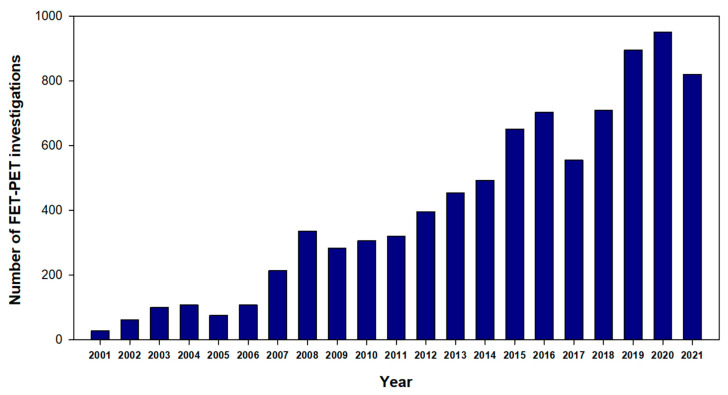
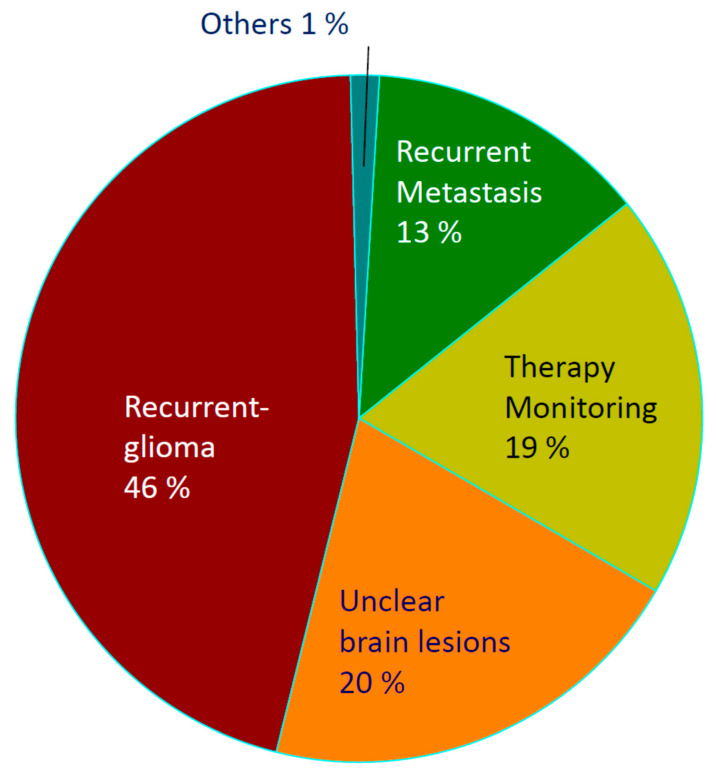
O-(2-[F]fluoroethyl)-L-tyrosine (FET) is a widely used amino acid tracer for positron emission tomography (PET) imaging of brain tumours. This retrospective study and survey aimed to analyse our extensive database regarding the development of FET PET investigations, indications, and the referring physicians' rating concerning the role of FET PET in the clinical decision-making process. Between 2006 and 2019, we performed 6534 FET PET scans on 3928 different patients against a backdrop of growing demand for FET PET. In 2019, indications for the use of FET PET were as follows: suspected recurrent glioma (46%), unclear brain lesions (20%), treatment monitoring (19%), and suspected recurrent brain metastasis (13%). The referring physicians were neurosurgeons (60%), neurologists (19%), radiation oncologists (11%), general oncologists (3%), and other physicians (7%). Most patients travelled 50 to 75 km, but 9% travelled more than 200 km. The role of FET PET in decision-making in clinical practice was evaluated by a questionnaire consisting of 30 questions, which was filled out by 23 referring physicians with long experience in FET PET. Fifty to seventy per cent rated FET PET as being important for different aspects of the assessment of newly diagnosed gliomas, including differential diagnosis, delineation of tumour extent for biopsy guidance, and treatment planning such as surgery or radiotherapy, 95% for the diagnosis of recurrent glioma, and 68% for the diagnosis of recurrent brain metastases. Approximately 50% of the referring physicians rated FET PET as necessary for treatment monitoring in patients with glioma or brain metastases. All referring physicians stated that the availability of FET PET is essential and that it should be approved for routine use. Although the present analysis is limited by the fact that only physicians who frequently referred patients for FET PET participated in the survey, the results confirm the high relevance of FET PET in the clinical diagnosis of brain tumours and support the need for its approval for routine use.
O-(2-[F]氟乙基)-L-酪氨酸(FET)是一种广泛用于脑肿瘤正电子发射断层扫描(PET)成像的氨基酸示踪剂。这项回顾性研究和调查旨在分析我们关于FET PET检查发展、适应症以及转诊医生对FET PET在临床决策过程中作用的评价的广泛数据库。在2006年至2019年期间,在FET PET需求不断增长的背景下,我们对3928名不同患者进行了6534次FET PET扫描。2019年,FET PET的使用适应症如下:疑似复发性胶质瘤(46%)、不明脑病变(20%)、治疗监测(19%)以及疑似复发性脑转移瘤(13%)。转诊医生包括神经外科医生(60%)、神经科医生(19%)、放射肿瘤学家(11%)、普通肿瘤学家(3%)和其他医生(7%)。大多数患者行程为50至75公里,但9%的患者行程超过200公里。通过一份由30个问题组成的问卷对FET PET在临床实践决策中的作用进行了评估,该问卷由23名在FET PET方面有长期经验的转诊医生填写。50%至70%的医生认为FET PET对新诊断胶质瘤评估的不同方面很重要,包括鉴别诊断、为活检指导划定肿瘤范围以及手术或放疗等治疗计划,95%的医生认为对复发性胶质瘤的诊断很重要,68%的医生认为对复发性脑转移瘤的诊断很重要。约50%的转诊医生认为FET PET对胶质瘤或脑转移瘤患者的治疗监测是必要的。所有转诊医生都表示FET PET的可获得性至关重要,并且它应该被批准用于常规使用。尽管目前的分析受到仅参与调查的经常将患者转诊进行FET PET检查的医生这一事实的限制,但结果证实了FET PET在脑肿瘤临床诊断中的高度相关性,并支持其被批准用于常规使用的必要性。