Siegl Frantisek, Vecera Marek, Roskova Ivana, Smrcka Martin, Jancalek Radim, Kazda Tomas, Slaby Ondrej, Sana Jiri
Central European Institute of Technology, Masaryk University, 625 00 Brno, Czech Republic.
Department of Neurosurgery, University Hospital Brno and Faculty of Medicine of Masaryk University, 625 00 Brno, Czech Republic.
Cancers (Basel). 2022 Jul 12;14(14):3386. doi: 10.3390/cancers14143386.
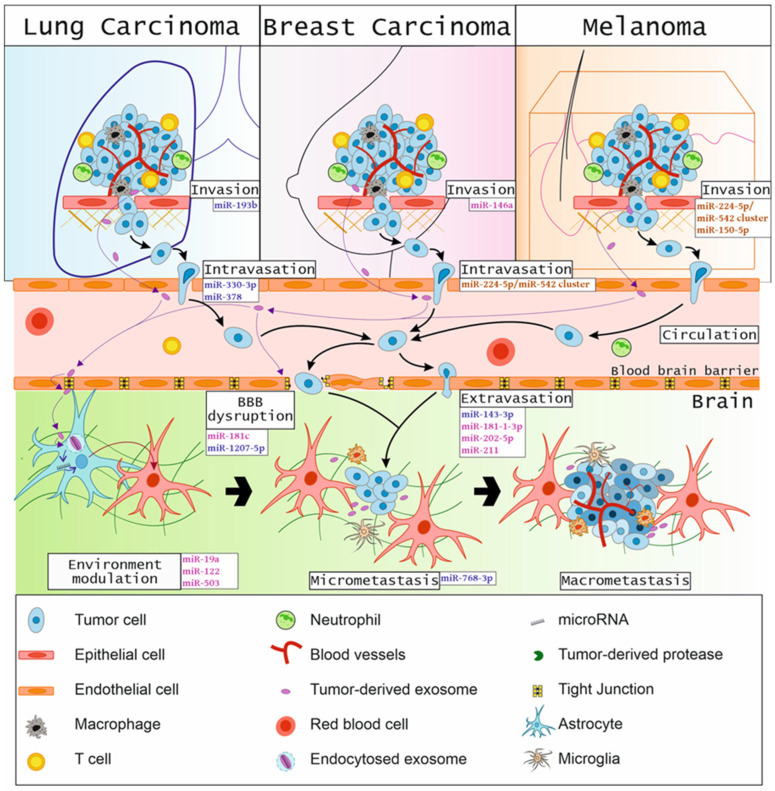
Brain metastases are the most frequent intracranial tumors in adults and the cause of death in almost one-fourth of cases. The incidence of brain metastases is steadily increasing. The main reason for this increase could be the introduction of new and more efficient therapeutic strategies that lead to longer survival but, at the same time, cause a higher risk of brain parenchyma infiltration. In addition, the advances in imaging methodology, which provide earlier identification of brain metastases, may also be a reason for the higher recorded number of patients with these tumors. Metastasis is a complex biological process that is still largely unexplored, influenced by many factors and involving many molecules. A deeper understanding of the process will allow the discovery of more effective diagnostic and therapeutic approaches that could improve the quality and length of patient survival. Recent studies have shown that microRNAs (miRNAs) are essential molecules that are involved in specific steps of the metastatic cascade. MiRNAs are endogenously expressed small non-coding RNAs that act as post-transcriptional regulators of gene expression and thus regulate most cellular processes. The dysregulation of these molecules has been implicated in many cancers, including brain metastases. Therefore, miRNAs represent promising diagnostic molecules and therapeutic targets in brain metastases. This review summarizes the current knowledge on the importance of miRNAs in brain metastasis, focusing on their involvement in the metastatic cascade and their potential clinical implications.
脑转移瘤是成人中最常见的颅内肿瘤,几乎四分之一的病例因脑转移瘤而死亡。脑转移瘤的发病率正在稳步上升。发病率上升的主要原因可能是引入了新的、更有效的治疗策略,这些策略使患者生存期延长,但同时导致脑实质浸润的风险更高。此外,成像方法的进步能够更早地识别脑转移瘤,这也可能是这些肿瘤记录病例数增加的一个原因。转移是一个复杂的生物学过程,在很大程度上仍未被探索,受多种因素影响且涉及多种分子。对这一过程的更深入理解将有助于发现更有效的诊断和治疗方法,从而提高患者生存质量和延长生存期。最近的研究表明,微小RNA(miRNA)是参与转移级联反应特定步骤的关键分子。miRNA是内源性表达的小非编码RNA,作为基因表达的转录后调节因子,从而调控大多数细胞过程。这些分子的失调与包括脑转移瘤在内的许多癌症有关。因此,miRNA在脑转移瘤中是很有前景的诊断分子和治疗靶点。本综述总结了目前关于miRNA在脑转移中重要性的知识,重点关注其在转移级联反应中的作用及其潜在的临床意义。