Wiśniewski Oskar Wojciech, Dydowicz Franciszek, Salamaga Szymon, Skulik Przemysław, Migaj Jacek, Kałużna-Oleksy Marta
Faculty of Medicine, Poznan University of Medical Sciences, 10 Fredry Street, 61-701 Poznan, Poland.
1st Department of Cardiology, Poznan University of Medical Sciences, 1/2 Dluga Street, 61-848 Poznan, Poland.
J Pers Med. 2022 Jun 27;12(7):1049. doi: 10.3390/jpm12071049.
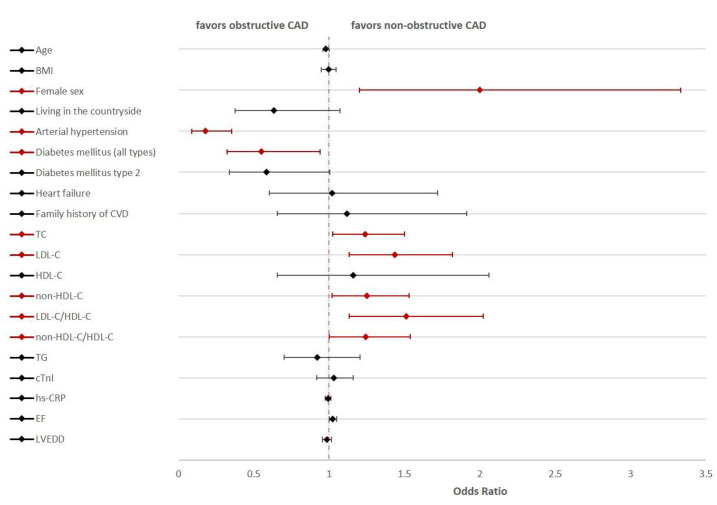
No hemodynamically significant atherosclerotic plaques are observed in up to 30% of patients reporting angina and undergoing coronary angiography. To investigate risk factors associated with non-obstructive coronary artery disease (NOCAD), we analyzed the medical records of, consecutively, 136 NOCAD subjects and 128 patients with significant stenosis in at least one coronary artery (the OCAD group). The blood concentrations of the TC (4.40 [3.78−5.63] mmol/L vs. 4.12 [3.42−5.01] mmol/L; p = 0.026), LDL-C (2.32 [1.80−3.50] mmol/L vs. 2.10 [1.50−2.70] mmol/L; p = 0.003), non-HDL-C (2.89 [2.29−4.19] mmol/L vs. 2.66 [2.06−3.39] mmol/L; p = 0.045), as well as the LDL-C/HDL-C ratio (1.75 [1.22−2.60] vs. 1.50 [1.10−1.95]; p = 0.018) were significantly increased in the NOCAD patients compared to the OCAD group due to the lower prevalence and intensity of the statin therapy in the NOCAD individuals (p < 0.001). Moreover, the abovementioned lipid parameters appeared to be valuable predictors of NOCAD, with the LDL-C (OR = 1.44; 95%CI = 1.14−1.82) and LDL-C/HDL-C (OR = 1.51; 95%CI = 1.13−2.02) showing the highest odds ratios. Furthermore, multivariable logistic regression models determined female sex as the independent risk factor for NOCAD (OR = 2.37; 95%CI = 1.33−4.20). Simultaneously, arterial hypertension substantially lowered the probability of NOCAD (OR = 0.21; 95%CI = 0.10−0.43). To conclude, female sex, the absence of arterial hypertension, as well as increased TC, LDL-C, non-HDL, and LDL-C/HDL-C ratio are risk factors for NOCAD in patients reporting angina, potentially as a result of poor hypercholesterolemia management.
在报告有胸痛症状并接受冠状动脉造影的患者中,高达30%的患者未观察到具有血流动力学意义的动脉粥样硬化斑块。为了研究与非阻塞性冠状动脉疾病(NOCAD)相关的危险因素,我们连续分析了136例NOCAD患者和128例至少有一支冠状动脉存在明显狭窄的患者(阻塞性冠状动脉疾病组,OCAD组)的病历。由于NOCAD患者他汀类药物治疗的患病率和强度较低(p<0.001),与OCAD组相比,NOCAD患者的总胆固醇(TC)血浓度(4.40[3.78−5.63]mmol/L对4.12[3.42−5.01]mmol/L;p = 0.026)、低密度脂蛋白胆固醇(LDL-C)(2.32[1.80−3.50]mmol/L对2.10[1.50−2.70]mmol/L;p = 0.003)、非高密度脂蛋白胆固醇(non-HDL-C)(2.89[2.29−4.19]mmol/L对2.66[2.06−3.39]mmol/L;p = 0.045)以及LDL-C/HDL-C比值(1.75[1.22−2.60]对1.50[1.10−1.95];p = 0.018)显著升高。此外,上述血脂参数似乎是NOCAD的有价值预测指标,其中LDL-C(OR = 1.44;95%CI = 1.14−1.82)和LDL-C/HDL-C(OR = 1.51;95%CI = 1.13−2.02)的比值比最高。此外,多变量逻辑回归模型确定女性性别是NOCAD的独立危险因素(OR = 2.37;95%CI = 1.33−4.20)。同时,动脉高血压显著降低了患NOCAD的概率(OR = 0.21;95%CI = 0.10−0.43)。总之,女性性别、无动脉高血压以及TC、LDL-C、非HDL和LDL-C/HDL-C比值升高是报告有胸痛症状患者患NOCAD的危险因素,这可能是由于高胆固醇血症管理不善所致。