Kaźmierska Joanna, Kaźmierski Michał R, Bajon Tomasz, Winiecki Tomasz, Bandurska-Luque Anna, Ryczkowski Adam, Piotrowski Tomasz, Bąk Bartosz, Żmijewska-Tomczak Małgorzata
Department of Electroradiology, University of Medical Sciences, 10 Fredry St., 61-701 Poznan, Poland.
Department of Radiotherapy II, Greater Poland Cancer Center, 15 Garbary St., 61-866 Poznan, Poland.
J Pers Med. 2022 Jun 30;12(7):1092. doi: 10.3390/jpm12071092.
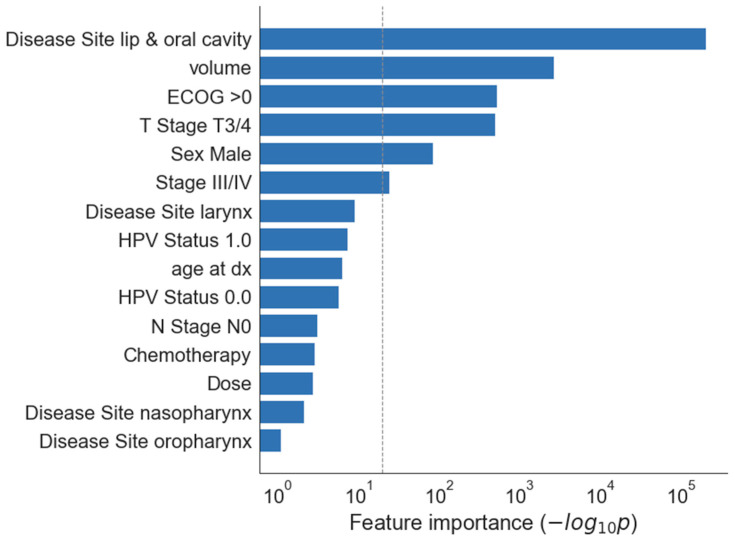
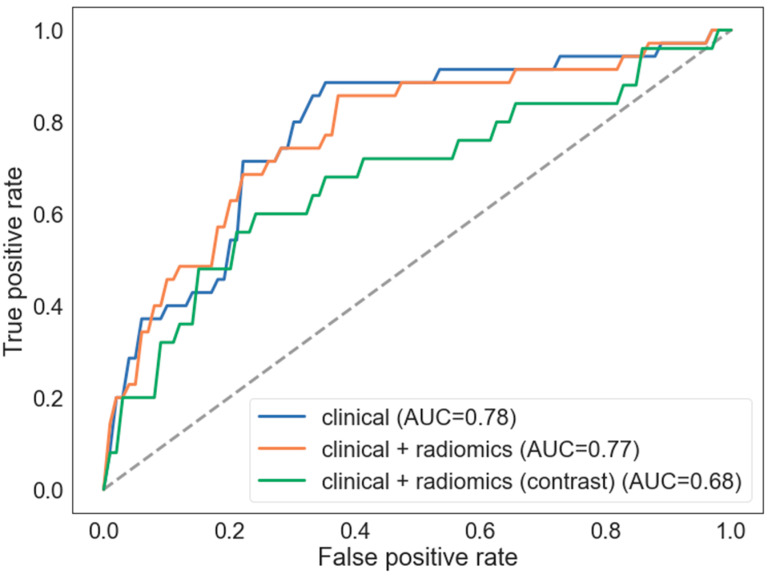
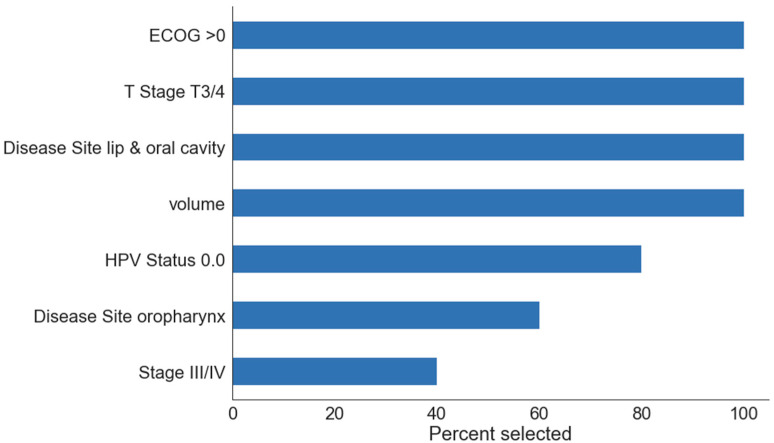
Radical treatment of patients diagnosed with inoperable and locally advanced head and neck cancers (LAHNC) is still a challenge for clinicians. Prediction of incomplete response (IR) of primary tumour would be of value to the treatment optimization for patients with LAHNC. Aim of this study was to develop and evaluate models based on clinical and radiomics features for prediction of IR in patients diagnosed with LAHNC and treated with definitive chemoradiation or radiotherapy. Clinical and imaging data of 290 patients were included into this retrospective study. Clinical model was built based on tumour and patient related features. Radiomics features were extracted based on imaging data, consisting of contrast- and non-contrast-enhanced pre-treatment CT images, obtained in process of diagnosis and radiotherapy planning. Performance of clinical and combined models were evaluated with area under the ROC curve (AUROC). Classification performance was evaluated using 5-fold cross validation. Model based on selected clinical features including ECOG performance, tumour stage T3/4, primary site: oral cavity and tumour volume were significantly predictive for IR, with AUROC of 0.78. Combining clinical and radiomics features did not improve model's performance, achieving AUROC 0.77 and 0.68 for non-contrast enhanced and contrast-enhanced images respectively. The model based on clinical features showed good performance in IR prediction. Combined model performance suggests that real-world imaging data might not yet be ready for use in predictive models.
对于被诊断为无法手术的局部晚期头颈癌(LAHNC)患者的根治性治疗,仍然是临床医生面临的一项挑战。预测原发性肿瘤的不完全缓解(IR)对于LAHNC患者的治疗优化具有重要价值。本研究的目的是开发并评估基于临床和影像组学特征的模型,以预测被诊断为LAHNC并接受确定性放化疗或放疗的患者的IR情况。本回顾性研究纳入了290例患者的临床和影像数据。基于肿瘤及患者相关特征构建临床模型。基于影像数据提取影像组学特征,这些影像数据包括在诊断和放疗计划过程中获取的对比增强和非对比增强的治疗前CT图像。采用ROC曲线下面积(AUROC)评估临床模型和联合模型的性能。使用五折交叉验证评估分类性能。基于选定临床特征(包括东部肿瘤协作组(ECOG)体能状态、肿瘤分期T3/4、原发部位:口腔和肿瘤体积)的模型对IR具有显著预测性,AUROC为0.78。将临床特征和影像组学特征相结合并未改善模型性能,非对比增强图像和对比增强图像的AUROC分别为0.77和0.68。基于临床特征的模型在IR预测方面表现良好。联合模型的性能表明,现实世界的影像数据可能尚未准备好用于预测模型。