Liu Wanjun, Liu Xiaolei, Liu Tao, Xie Yang, He Xingwei, Zuo Houjuan, Zeng Hesong
Department of Cardiology, Tongji Hospital, Tongji Medical College, Huazhong University of Science and Technology, Wuhan 430030, China.
Hubei Key Laboratory of Genetics and Molecular Mechanisms of Cardiological Disorders, Wuhan 430030, China.
J Clin Med. 2022 Jul 18;11(14):4170. doi: 10.3390/jcm11144170.
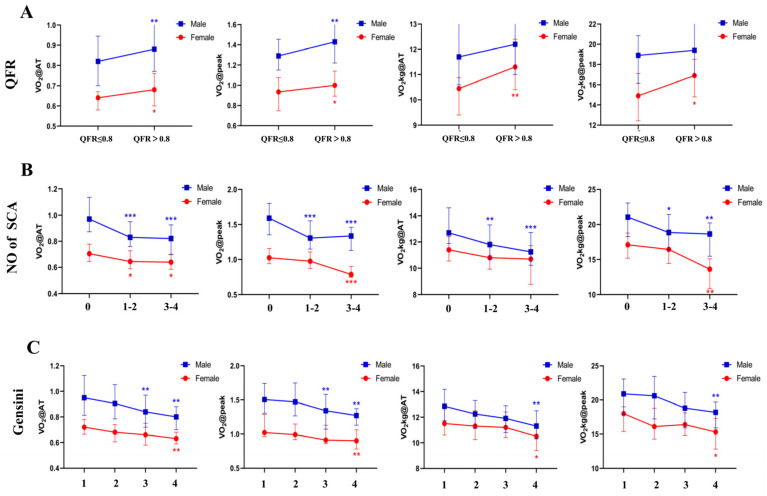
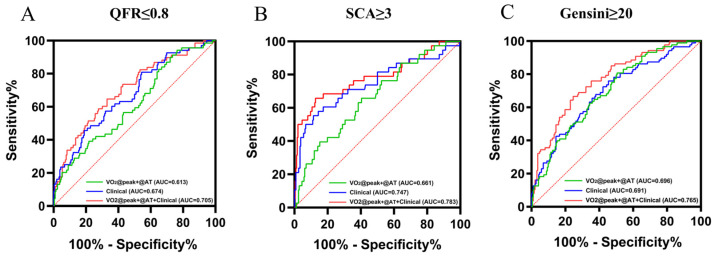
There have been a limited number of quantitative studies on the relationship between coronary artery disease (CAD) and cardiorespiratory fitness (CRF), as measured by cardiopulmonary exercise testing (CPET). Thus, we aimed to investigate the association between CRF and the severity of coronary artery disease from the most comprehensive perspective possible, and to affirm the predictive value of CPET in the severity assessment of CAD. Our study included 280 patients with coronary angiography, who had undergone CPET in Tongji Hospital. The patients' CRF was measured through their peak oxygen uptake (VO@peak), their oxygen uptake at the anaerobic threshold (VO@AT) and through other parameters of CPET on a bicycle ergometer. The severity of the coronary artery disease was assessed in the following three layers: functionally significant lesions (quantitative flow ratio [QFR] ≤ 0.8), the number of stenotic coronary arteries (SCA, stenosis ≥ 50%) and the Gensini score. The correlation analyses were carried out between the CRF and the severity of the coronary artery disease. A ROC curve was plotted, and the AUC was calculated to distinguish the severe CAD and the non-severe CAD patients, as measured by the QFR, the number of SCA, and the Gensini score. The VO@AT and VO@peak were inversely associated with the QFR. The VO@AT, VO@peak and VO/kg@peak were associated with the number of SCA. Meanwhile, the VO@AT, VO/kg@AT, VO@peak and VO/kg@peak were associated with the Gensini score. An ROC analysis proved that a combination of traditional clinical risk factors and the VO@peak/VO is valuable in predicting CAD severity. Our study demonstrated a strong and inverse association between CRF and the severity of CAD. A combination of traditional clinical risk factors and CRF is valuable in predicting CAD severity.
关于通过心肺运动试验(CPET)测量的冠状动脉疾病(CAD)与心肺适能(CRF)之间的关系,定量研究数量有限。因此,我们旨在从尽可能全面的角度研究CRF与冠状动脉疾病严重程度之间的关联,并确认CPET在CAD严重程度评估中的预测价值。我们的研究纳入了280例在同济医院接受过CPET的冠状动脉造影患者。通过患者的峰值摄氧量(VO₂peak)、无氧阈摄氧量(VO₂AT)以及在自行车测力计上进行的CPET的其他参数来测量CRF。冠状动脉疾病的严重程度从以下三个层面进行评估:功能上有意义的病变(定量血流比[QFR]≤0.8)、狭窄冠状动脉的数量(SCA,狭窄≥50%)和Gensini评分。对CRF与冠状动脉疾病严重程度进行了相关性分析。绘制了ROC曲线,并计算了AUC,以区分根据QFR、SCA数量和Gensini评分测量的重度CAD和非重度CAD患者。VO₂AT和VO₂peak与QFR呈负相关。VO₂AT、VO₂peak和VO₂/kg@peak与SCA数量相关。同时,VO₂AT、VO₂/kg@AT、VO₂peak和VO₂/kg@peak与Gensini评分相关。ROC分析证明,传统临床危险因素与VO₂peak/VO₂的组合在预测CAD严重程度方面具有价值。我们的研究表明CRF与CAD严重程度之间存在强烈的负相关。传统临床危险因素与CRF的组合在预测CAD严重程度方面具有价值。