Yakimov Anton S, Denisov Ivan A, Bukatin Anton S, Lukyanenko Kirill A, Belousov Kirill I, Kukhtevich Igor V, Esimbekova Elena N, Evstrapov Anatoly A, Belobrov Peter I
Laboratory of Physical and Chemical Technologies for the Development of Hard-to-Recover Hydrocarbon Reserves, Siberian Federal University, 660041 Krasnoyarsk, Russia.
Laboratory of Bioluminescent Biotechnologies, Siberian Federal University, 660041 Krasnoyarsk, Russia.
Micromachines (Basel). 2022 Jul 20;13(7):1146. doi: 10.3390/mi13071146.
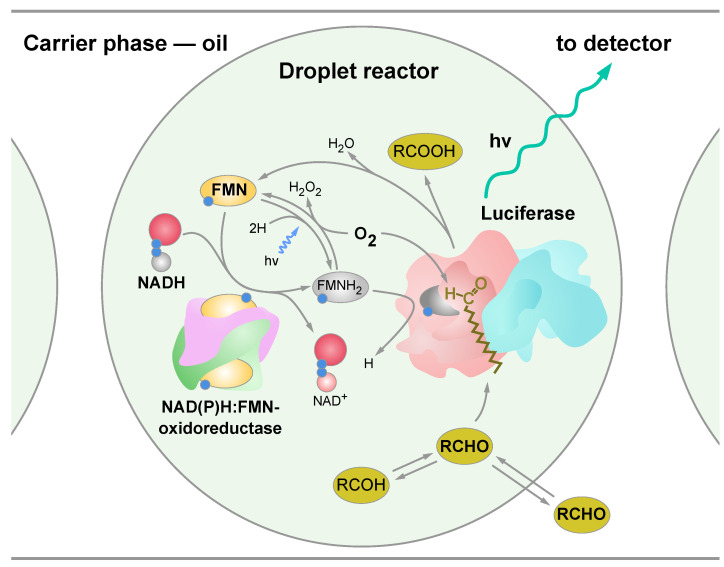
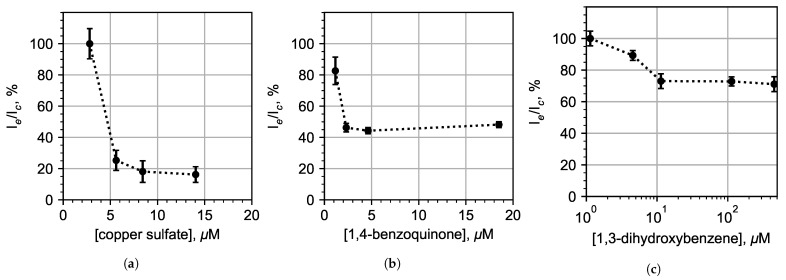
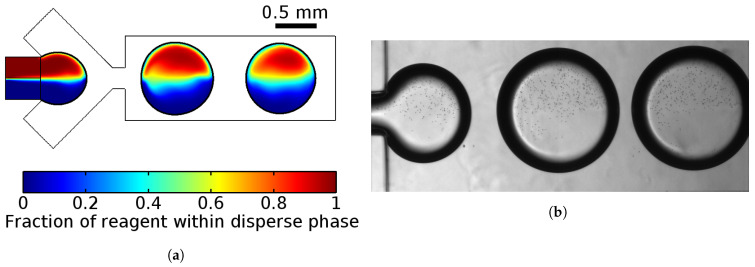
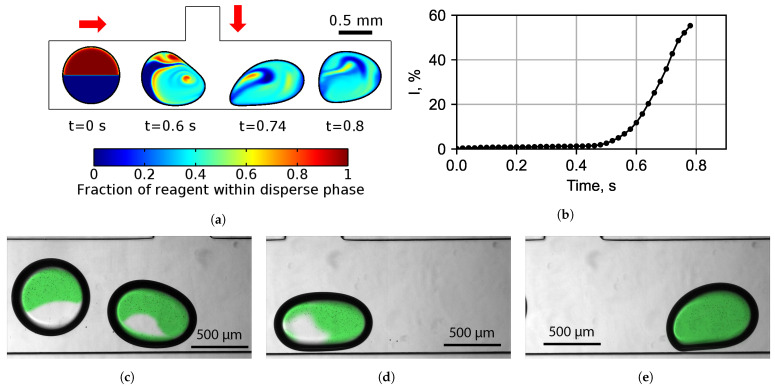
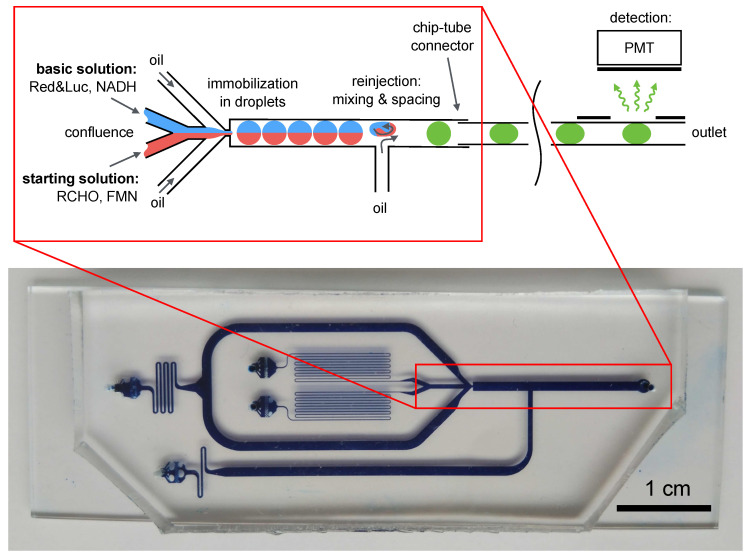
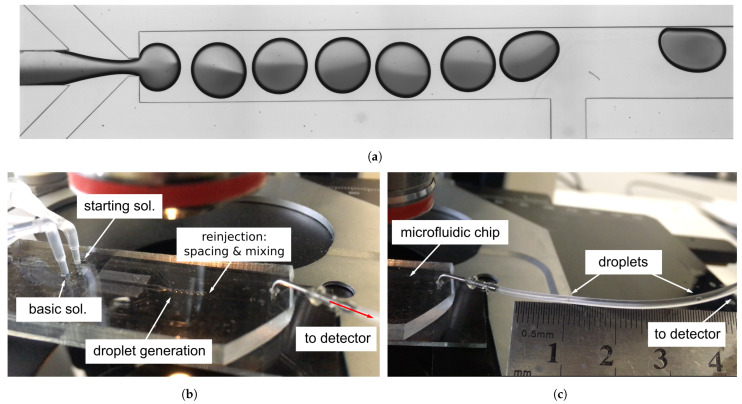
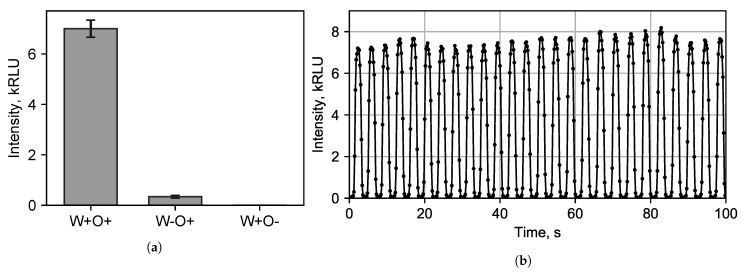
The rapid detection of pollutants in water can be performed with enzymatic probes, the catalytic light-emitting activity of which decreases in the presence of many types of pollutants. Herein, we present a microfluidic system for continuous chemoenzymatic biosensing that generates emulsion droplets containing two enzymes of the bacterial bioluminescent system (luciferase and NAD(P)H:FMN-oxidoreductase) with substrates required for the reaction. The developed chip generates "water-in-oil" emulsion droplets with a volume of 0.1 μL and a frequency of up to 12 drops per minute as well as provides the efficient mixing of reagents in droplets and their distancing. The bioluminescent signal from each individual droplet was measured by a photomultiplier tube with a signal-to-noise ratio of up to 3000/1. The intensity of the luminescence depended on the concentration of the copper sulfate with the limit of its detection of 5 μM. It was shown that bioluminescent enzymatic reactions could be carried out in droplet reactors in dispersed streams. The parameters and limitations required for the bioluminescent reaction to proceed were also studied. Hereby, chemoenzymatic sensing capabilities powered by a droplet microfluidics manipulation technique may serve as the basis for early-warning online water pollution systems.
利用酶探针可以快速检测水中的污染物,在多种污染物存在的情况下,其催化发光活性会降低。在此,我们展示了一种用于连续化学酶生物传感的微流控系统,该系统可生成含有细菌生物发光系统的两种酶(荧光素酶和NAD(P)H:FMN氧化还原酶)以及反应所需底物的乳液滴。所开发的芯片可生成体积为0.1 μL、频率高达每分钟12滴的“油包水”乳液滴,并能在液滴中实现试剂的高效混合及其间距控制。通过光电倍增管测量每个单独液滴的生物发光信号,信噪比高达3000/1。发光强度取决于硫酸铜的浓度,其检测限为5 μM。结果表明,生物发光酶反应可以在分散流中的液滴反应器中进行。还研究了生物发光反应进行所需的参数和限制条件。因此,由液滴微流控操纵技术驱动的化学酶传感能力可作为早期预警在线水污染系统的基础。