Zlotnikov Igor D, Belogurova Natalya G, Krylov Sergey S, Semenova Marina N, Semenov Victor V, Kudryashova Elena V
Department of Chemistry, M.V. Lomonosov Moscow State University, Leninskie Gory, 1/11B, 119991 Moscow, Russia.
N. D. Zelinsky Institute of Organic Chemistry RAS, 47 Leninsky Prospect, 119991 Moscow, Russia.
Pharmaceuticals (Basel). 2022 Jul 14;15(7):861. doi: 10.3390/ph15070861.
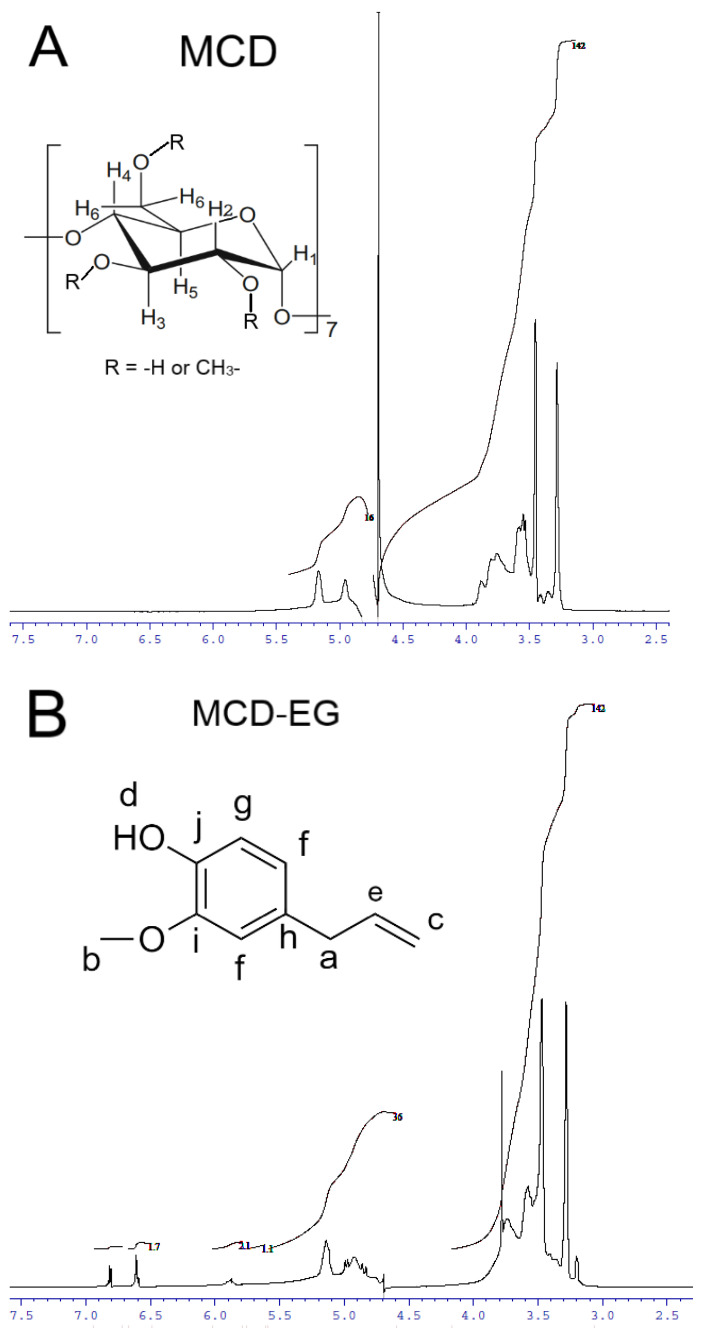
Allylpolyalkoxybenzenes (APABs) and terpenoids from plant essential oils exhibit a range of remarkable biological effects, including analgesic, antibacterial, anti-inflammatory, antioxidant, and others. Synergistic activity with antibiotics of different classes has been reported, with inhibition of P-glycoprotein and impairment of bacterial cell membrane claimed as probable mechanisms. Clearly, a more detailed understanding of APABs' biological activity could help in the development of improved therapeutic options for a range of diseases. However, APABs' poor solubility in water solutions has been a limiting factor for such research. Here, we found that complex formation with β-cyclodextrins (CD) is an efficient way to transform the APABs into a water-soluble form. Using a combination of spectroscopic (FTIR, NMR, UV) methods, we have estimated the binding constants, loading capacity, and the functional groups of both APABs and monoterpenes involved in complex formation with CD: ethylene, aromatic, methoxy and hydroxy groups. In the presence of a molar excess of CD (up to 5 fold) it was possible to achieve the complete dissolution of APABs and terpenoids in an aqueous medium (at 90-98% encapsulation) higher by 10-1000 times. Further, we have demonstrated that CD-APABs, if used in combination with levofloxacin (Lev), can be antagonistic, indifferent, additive, or synergistic, mostly depending on the concentration ratio: at high Lev concentration with the addition of APAB is typically neutral or even antagonistic; while at a Lev concentration below MIC, the addition of CD-APAB is either additive or synergistic (according to FICI criteria). An over three-fold increase in Lev antibacterial activity was observed in combination with eugenol (EG), as per the growth inhibition diameter measurement in agar. Interestingly, a synergistic effect could be observed with both Gram-positive and Gram-negative bacteria. So, obviously, the APAB-CD and terpenoid-CD mechanism of action is not limited to their interaction with the bacterial membrane, which has been shown earlier for CDs. Further research may open new prospects for the development of adjuvants to improve the therapeutic regimens with existing, as well as with new anti-infective drugs.
植物精油中的烯丙基聚烷氧基苯(APABs)和萜类化合物具有一系列显著的生物学效应,包括镇痛、抗菌、抗炎、抗氧化等。已有报道称它们与不同类别的抗生素具有协同活性,其可能的机制是抑制P-糖蛋白和破坏细菌细胞膜。显然,更详细地了解APABs的生物学活性有助于开发针对一系列疾病的更好治疗方案。然而,APABs在水溶液中的低溶解度一直是此类研究的限制因素。在此,我们发现与β-环糊精(CD)形成复合物是将APABs转化为水溶性形式的有效方法。通过结合光谱(FTIR、NMR、UV)方法,我们估算了与CD形成复合物的APABs和单萜类化合物的结合常数、负载能力以及参与复合物形成的官能团:乙烯基、芳基、甲氧基和羟基。在CD摩尔过量(高达5倍)的情况下,有可能使APABs和萜类化合物在水性介质中完全溶解(包封率为90 - 98%),溶解度提高10 - 1000倍。此外,我们已经证明,如果将CD - APABs与左氧氟沙星(Lev)联合使用,可能具有拮抗、无影响、相加或协同作用,这主要取决于浓度比:在高Lev浓度下添加APAB通常是中性甚至拮抗的;而在Lev浓度低于最低抑菌浓度时,添加CD - APAB则是相加或协同的(根据FICI标准)。根据琼脂中生长抑制直径测量,与丁香酚(EG)联合使用时,Lev的抗菌活性提高了三倍多。有趣的是,对革兰氏阳性菌和革兰氏阴性菌都能观察到协同效应。所以,显然,APAB - CD和萜类化合物 - CD的作用机制并不局限于它们与细菌膜的相互作用,而这一点之前已在环糊精中得到证实。进一步的研究可能为开发佐剂以改善现有以及新型抗感染药物的治疗方案开辟新的前景。